Tocqueville Fellow Blog by Ellison White: The Importance of a Liberal Arts Education
Ellison White is a member of Furman University’s Class of 2028 from Durham, North Carolina, double-majoring in International Business and Politics and International Affairs, and a Tocqueville Fellow.
Neither Finnish President Alexander Stubb nor General Joshua Rudd arrived at Furman knowing where their education would lead. Earlier this semester, both returned to campus for America and the World, the Tocqueville Center for the Study of Democracy and Society’s biggest event to date. Their experiences suggest that uncertainty is not a weakness of a liberal arts education, but part of its value.
Their experiences illustrate two different ways a liberal arts education can shape a career; by introducing students to interests they might never have discovered otherwise and developing skills that remain valuable beyond a student’s original plans. President Stubb arrived at Furman in 1989 on a golf scholarship with the intention of joining the Finnish National Golf Team and majoring in business. However, after taking a class in the Political Science Department, he dropped the sport and switched his primary focus of study to politics. General Rudd did not plan on spending his career in the military, but the discipline and routine he established in the Furman ROTC program paved the way to his eventual position as head of the National Security Agency.

Tocqueville Fellow Ellison White ’28 attends the student and faculty Q&A with Finnish President Alexander Stubb ’93 and General Joshua Rudd ’93.
How a Liberal Arts Education Encourages Academic Exploration
Although Stubb and Rudd took different paths after graduation, their time at Furman demonstrates one of the central benefits of receiving a liberal arts education: the opportunity to explore areas of study that differ from one’s original plan. Some students come into Furman with a set idea of what they want to major in and pursue after graduation, and there is nothing wrong with that. However, Furman’s General Education Requirements (GERs) stipulate that all students must take courses from a spectrum of departments.
While these requirements are often seen as frustrating by many students focused on completing their major requirements, they also help students to explore areas of study that high school may not have exposed them to. For President Stubb, International Political Economy (IPE), taught by Dr. Brent Nelsen, was one of these classes. Through IPE, Stubb discovered his passion for Political Science that ultimately shaped his career. At an institution that did not require students to take classes outside their major, Stubb may not have discovered that interest.
Stubb’s experience shows how a single class can introduce students to interests they may not otherwise pursue. I experienced something similar during my freshman year, when I took Early Modern Passages (HST-112) with Dr. Timothy Fehler to satisfy my Historical Analysis GER. During the class, I became fascinated by the various trade networks established during the 15th and 16th centuries. After the semester ended, Dr. Fehler reached out to me about a minor in Medieval and Early Modern Studies (MEMs), and I did not hesitate to declare. The class I originally took to fulfill a GER requirement led to me adding an interdisciplinary minor to my academic plan.

Finnish President Alexander Stubb ’93 waves to the audience, with General Joshua Rudd ’93 and Tocqueville Center Director Brent Nelsen in the background.
Connecting the Humanities and Sciences at Furman University
During his visit, Stubb also spoke of the broader value of a liberal arts education, explaining, “The beauty of a liberal arts education is that it tries to combine humanities and science.” His observation highlights a broader benefit of the liberal arts: studying across disciplines broadens the way students understand the world around them.
Currently, I am taking Introduction to Political Analysis as well as Business Analytics, two courses from different departments for different majors. Despite being in different departments, I have noticed similarities between the two classes’ vocabulary and methodologies, helping me to write essays and prepare for tests. For example, both courses include learning how to use data organization software, such as Microsoft Excel and IBM’s Statistical Package for the Social Sciences. While they are not used for the same type of interpretation, learning how to use both softwares at the same time has made it easier to navigate similar terminology and layout. More importantly, understanding the relationship between these two classes has helped me to see how concepts apply across areas of study. This is the advantage of a liberal arts education.
Does a Liberal Arts Education Prepare Students for Careers?
The liberal arts curriculum is criticized for prioritizing broad academic exploration rather than practical career preparation. This concern is understandable. Students want to graduate knowing their time in college has equipped them with skills they can use in the workforce. Many students want to be prepared for the future but are unsure if they have what it takes to succeed in the real world.
When asked what advice he would give to today’s Furman students, who are undoubtedly feeling this pressure, General Rudd responded, “You’re ready.” To succeed in life, students do not have to have everything figured out by graduation. The skills developed through Furman’s liberal arts curriculum allow students to adapt to uncertainty and utilize critical thinking skills to make informed decisions. A liberal arts education gives students room to explore their interests while equipping them with skills to navigate what comes next.
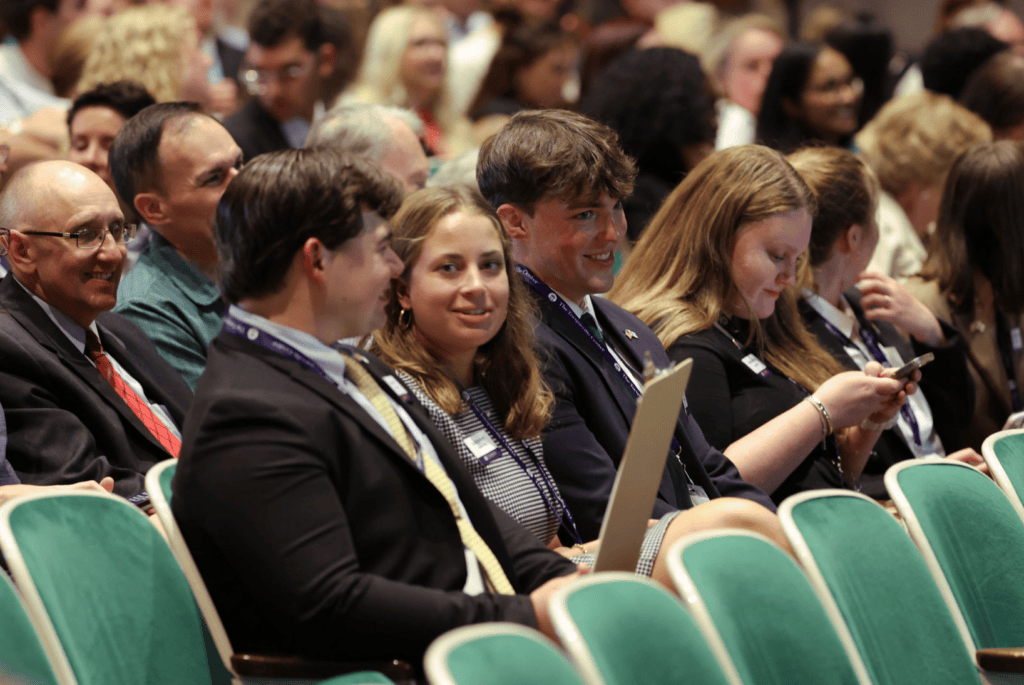
Tocqueville Fellow Ellison White ’28 joins fellow students for the “America and the World” event featuring Finnish President Alexander Stubb ’93 and General Joshua Rudd ’93.
The Lasting Value of a Liberal Arts Education
The Furman experiences of President Stubb and General Rudd demonstrate that the benefits of a liberal arts education are not isolated to one career path. Stubb discovered a passion for Political Science through a class he otherwise might not have taken, while Rudd’s advice reminds students that they do not need to have everything figured out. Stubb and Rudd’s stories from their time at Furman, along with my own experiences, have shown me the value of being open to subjects outside my interests. One of the most valuable parts of a liberal arts education comes from exploring new things and discovering connections between subjects that initially seem unrelated. Not everyone begins their time at Furman knowing exactly what they want to pursue after college. However, Furman’s commitment to the liberal arts allows students to explore unfamiliar interests and discover passions that shape their future endeavors.