News from campus and beyond
Yale Historian explores miracles in Townes Lecture Series in Faith and Reason
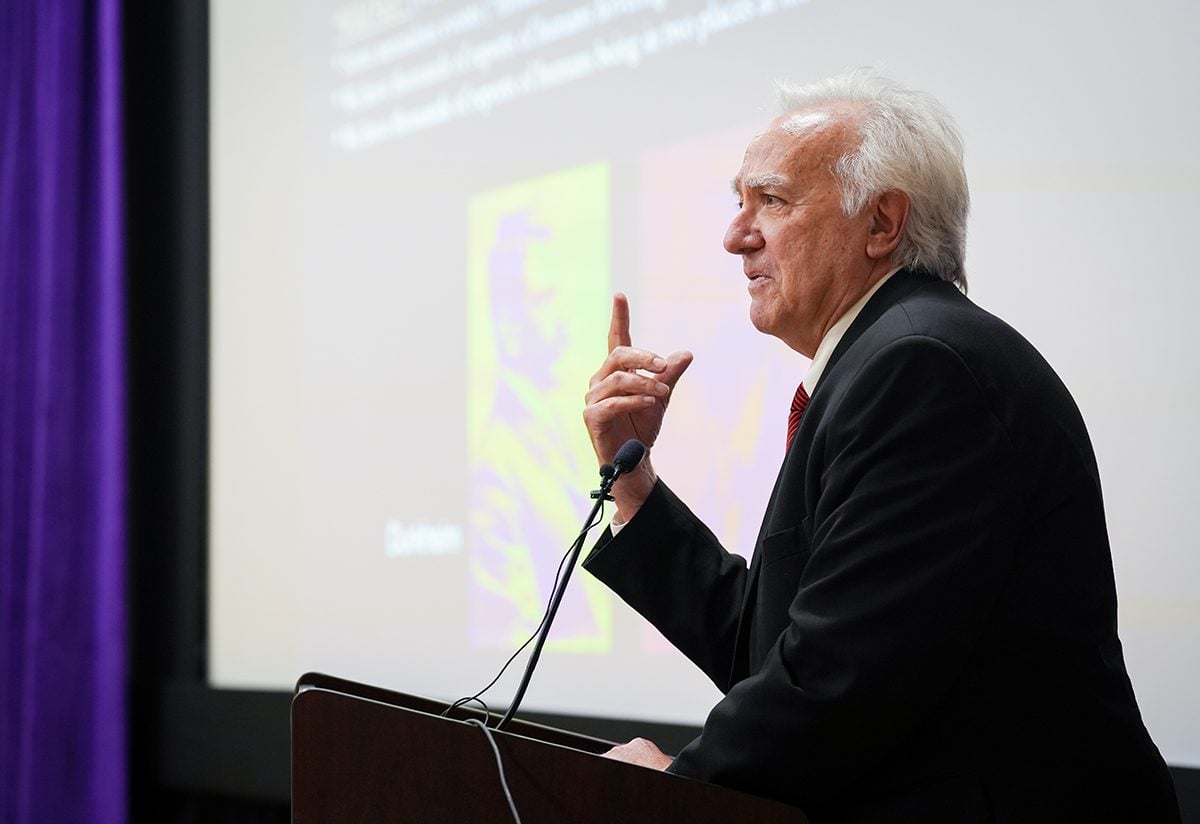
Carlos M. N. Eire, the T. Lawrason Riggs Professor of History and Religious Studies at Yale University, delivered the 2024 Charles H. Townes Lecture Series in Faith and Reason on Oct. 28. Photo by Nathan Gray, Furman University.
For 1,500 years, starting around 100 CE., saints levitated above crowds and appeared in two places at once. Then came the Protestant Reformation and supernatural events became the work of the devil.
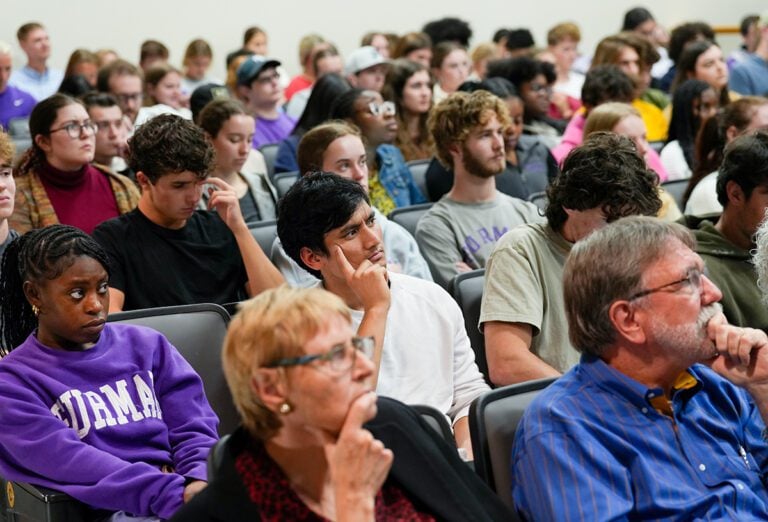
Students, faculty and members of the public listen as Carlos M. N. Eire, the T. Lawrason Riggs Professor of History and Religious Studies at Yale University, delivered the 2024 Charles H. Townes Lecture Series in Faith and Reason. Photo by Nathan Gray, Furman University.
Carlos M.N. Eire, the T. Lawrason Riggs Professor of History and Religious Studies at Yale University, described to a packed house of students, faculty and staff in Furman University’s Burgiss Theater on Monday, Oct. 28, why recalling that history matters today.
“There’s much more to the world than we can imagine,” Eire said. Even recent scientists have come to understand that some things occur that are outside what we assumed were the laws of physics. It’s important to be skeptical of things seemingly unnatural and of people who quickly discount those things, he said. “Reality’s complicated, and it’s the basis of religion. Religion is all about positing that there’s some other dimension that interlocks with this one.”
Eire’s talk, “They Flew: A History of the Impossible,” the 2024 Charles H. Townes Lecture Series in Faith and Reason, was based on his latest book of the same name, which recently won an Award for Excellence in the Study of Religion in Historical Studies. He presented several well-documented cases of people levitating or bilocating (being in two places at once), which seem to defy reason, yet are supported by eyewitness accounts.
Levitators, accounts say, went into a cataleptic seizure. Their bodies, even their clothes, froze as they rose off the ground, said Eire. In ways not understood, the temporal merged with the spiritual.
St. Joseph of Cupertino flew over the head of the Spanish viceroy in Southern Italy, causing his wife to faint. St. Teresa of Avila repeatedly levitated and wrote about it, saying “a great force comes beneath you and lifts you up.” When she levitated, her fellow nuns moved her body about like a giant balloon. St. Joseph of Cupertino, the patron saint of flyers, was “the greatest levitator of all time,” Eire said. Joseph once placed his hand on a man and they both levitated. Another saint levitated with a sheep.
Bilocators appeared in places they had never been, communicating with people who spoke foreign languages. The most prominent was Maria de Agreda in the first half of the 1600s. She never left her convent in Spain but according to reports she ministered to the Jumanos people in present day Texas and New Mexico more than 500 times. When friars moved into the area, the Jumanos asked to be baptized, saying Maria had taught them about Christianity.
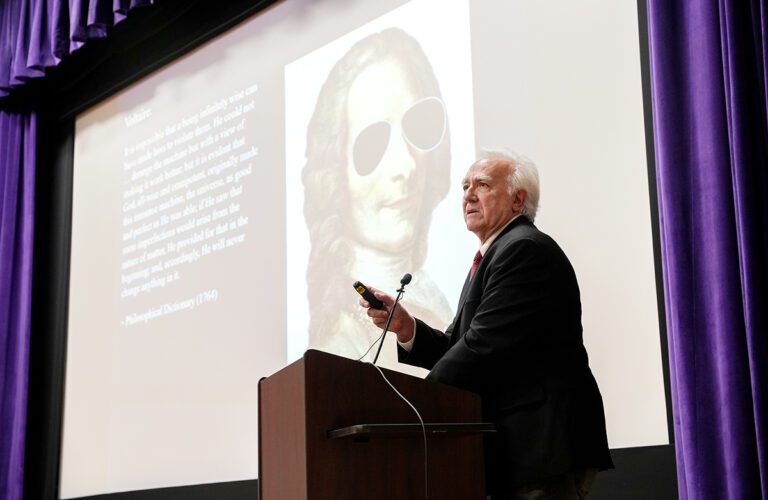
Carlos M. N. Eire, the T. Lawrason Riggs Professor of History and Religious Studies at Yale University, delivers the 2024 Charles H. Townes Lecture Series in Faith and Reason. Photo by Nathan Gray, Furman University.
With the Protestant Reformation came skepticism and scorn. Martin Luther said miracles were “signs for the ignorant, unbelieving crowd.” John Calvin said, “Satan has his miracles, though they are deceitful tricks rather than true powers” and are “such a sort as to mislead the simple minded and untutored.”
Miracles, Calvin thought, were a special dispensation for the biblical era and ended in about 100 CE. Eventually some Protestants would again accept the miraculous in the working out of “God’s plan for the world,” said Helen Lee Turner, professor of religion and chair of the Townes Lecture Committee.
While Protestants in that era considered “the impossible” to be acts of the devil or witches, Catholics continued to see them as acts of God. According to Eire, Max Weber, a founder of the discipline of sociology, said Protestant Reformers took away the magic and created a “disenchanted world.”
The dichotomy presented a war between social facts, something widely accepted that governs the way people think, and wild facts, which accepts that some events defy explanation and seem contrary to the laws of nature, Eire said.
“I say be truly skeptical,” Eire told the crowd. “Be skeptical that (miracles) are absolutely possible, but also (be skeptical) that they are impossible because we have testimonies.”
In 2003, Eire gave his own testimony of an almost unreal story. He was a boy in pre-Castro Cuba in 1961 when his parents put him on a plane with his older brother and sent them away to Florida as part of Operation Peter Pan, a program that rescued more than 14,000 children. His memoir about that journey, Waiting for Snow in Havana, won the 2003 National Book Award.
Before his lecture, at a gathering of Religion majors, Eire shared how his life story influenced his own theological questions.
“Although our majors find many applicable skills in their Religion courses, for many students, studying Religion is a second major, not pursued primarily as a career pathway, but more as a personal academic journey,” Turner said. Eire’s conversation with students, “about how his unusual life story influenced both his academic and personal questions was a conversation quite meaningful to that audience.”
The Townes Lecture Series in Faith and Reason was hosted this year by the Department of Religion and the faculty of the recently established Medieval and Early Modern Studies minor.
Charles Townes ’35 won the Nobel Prize in physics in 1964 for his invention of the maser, the predecessor of the laser. He earned a bachelor of science and a bachelor of arts in modern languages from Furman.
“The Furman Lectureship was begun with funds Townes received when he won the Templeton Prize in 2005, but it was 1966 article, ‘The Convergence of Science and Religion’ that established him as a voice seeking commonality between the two disciplines. Toward the end of his life, Townes reflected on the importance of being open-minded when pursuing such deep questions as the meaning of our universe and life itself. Historian and scholar of Religion, Carlos Eire reminded us of these same questions in his lecture,” Turner said.