News from campus and beyond
By creating an event on Native American health, a student finds renewed inspiration
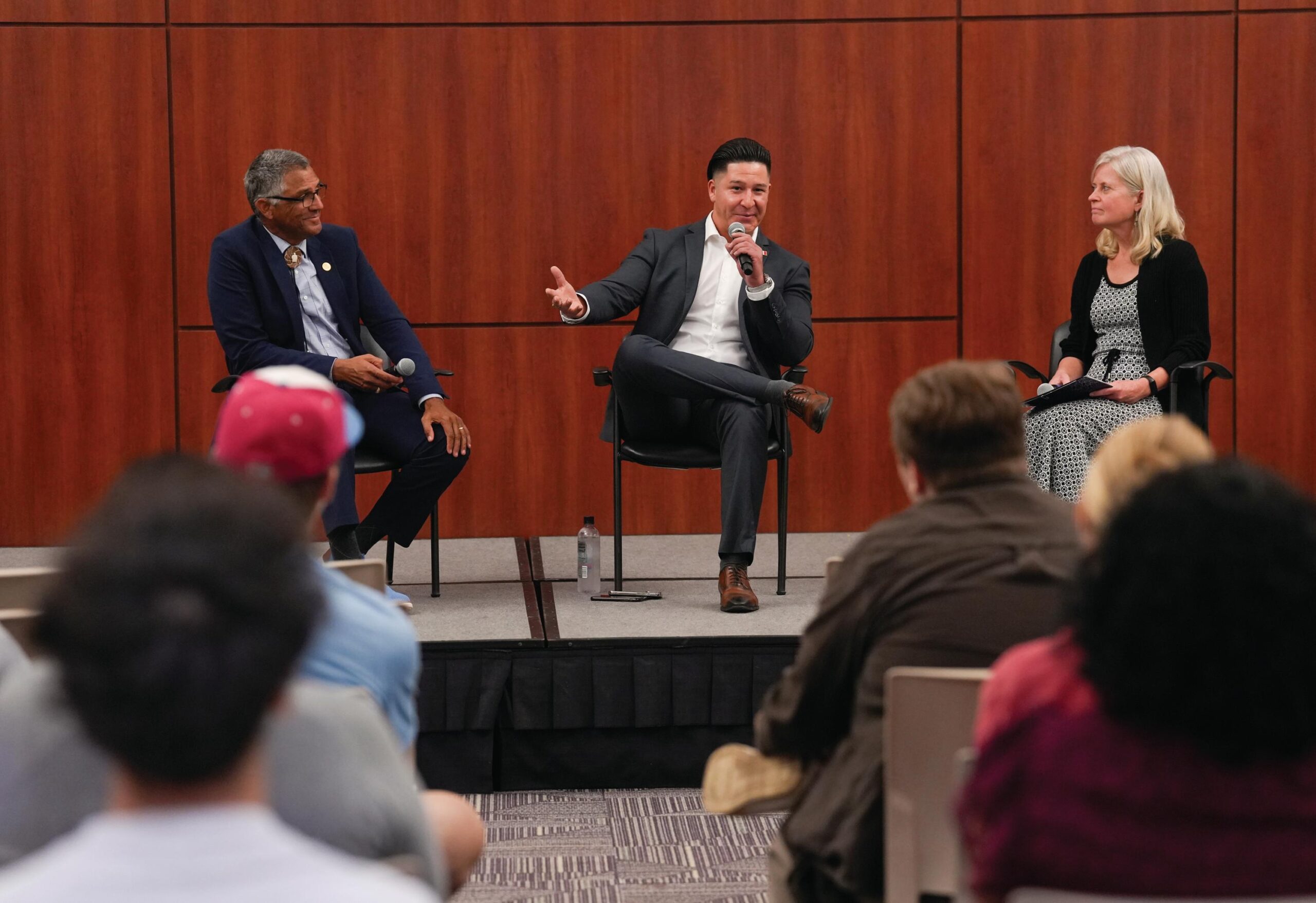
Kristy Maher, right, professor of sociology, moderated “Bridging Cultures: Indigenous Insights in Modern Medicine,” a CLP with Marcos Moreno, middle, from Yale University School of Medicine, and Ronny Bell, left, from the University of North Carolina at Chapel Hill, in the Watkins Room of the Trone Student Center on Thursday evening, Nov. 7, 2024. Photo by Nathan Gray, Furman University.
What started last summer as a hunch for Jason Levitt ’26, a public health major from Spartanburg, SC, turned into a quest and an accomplishment beyond his initial dreams.
Levitt, an enrolled member of the Pascua Yaqui Tribe in Arizona and vice president of Furman University’s Native American and Indigenous Students Association, created “Bridging Cultures: Indigenous Insights in Modern Medicine,” a Cultural Life Program, in honor of Native American Heritage Month, that took place Nov. 7 in the Trone Student Center.
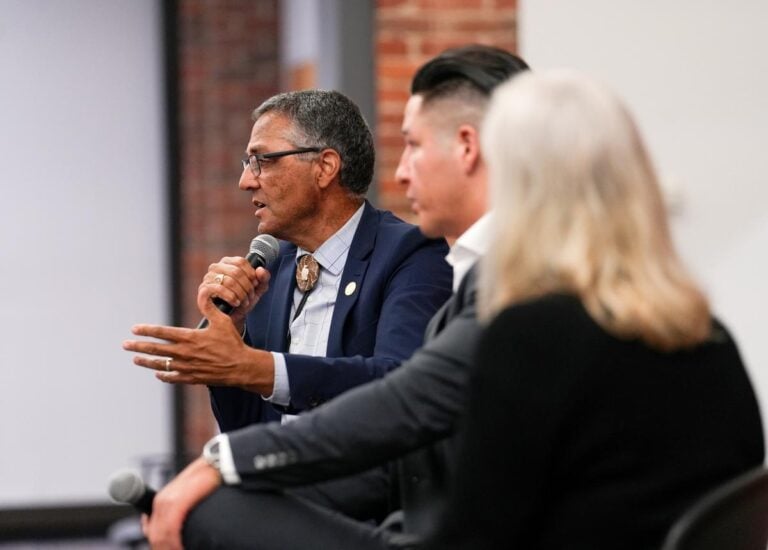
Ronny Bell, from the University of North Carolina at Chapel Hill, speaks during the CLP “Bridging Cultures: Indigenous Insights in Modern Medicine.” Photo by Nathan Gray, Furman University.
“I felt like I really got to experience The Furman Advantage” by conceptualizing, creating, and organizing the event, Levitt said. He worked with leaders from Furman’s institutes and faculty from several departments who guided him through the process and provided financial, logistical and motivational support.
The speakers he invited were also eager to visit Furman and discuss health issues facing Native Americans.
Levitt first searched for someone in his own tribe and found Marcos Moreno, the chief psychiatry resident at the Yale School of Medicine and an advisory board member for Wassaja Montezuma Center for Native American Health at the University of Arizona. Levitt emailed him out of the blue; an hour later, Moreno emailed back and said he’d love to come.
Levitt searched again and contacted Ronny Bell, an enrolled member of the Lumbee Tribe, the Fred Eshelman Distinguished Professor and chair of pharmaceutical outcomes and policy in the Eshelman School of Pharmacy at the University of North Carolina at Chapel Hill and chair of the North Carolina American Indian Health Board.
“Dr. Bell was also extremely willing to come and speak at Furman. He was like, ‘Yeah, let me know when. I’d be very interested in participating,’” Levitt said.
Back at Furman, Levitt met with the Institute for the Advancement of Community Health, who agreed to help fund and support the event. So did the departments of health sciences, religion and sociology.
The Riley Institute sponsored a dinner the night before the talk. Moreno, Bell and the members of NAIA were invited, as were IACH’s student Community Health Champions, Riley’s Advantage Scholars and some faculty and staff.
“The speakers talked with all the students about their career paths and gave wonderful advice,” Levitt said. “I truly appreciated the fact that all these different groups were so willing to support our vision and make the evening one to remember.”
Following the dinner, Levitt and Morgan Locklear ’25, president of the NAIA, introduced Moreno and Bell to a large crowd in the Trone Student Center. Then, Helen-Lee Turner, professor of religion and faculty advisor of the NAIA, provided a brief overview regarding Native American views on health.
Kristy Maher, professor of sociology, moderated a discussion that covered topics including high rates of suicide and chronic diseases, lack of representation in healthcare, historical and contemporary trauma and cultural preservation. The speakers provided great explanations as to why there are poorer health outcomes for Native Americans and ways that Western medicine could accommodate Native American customs and values, Levitt said.
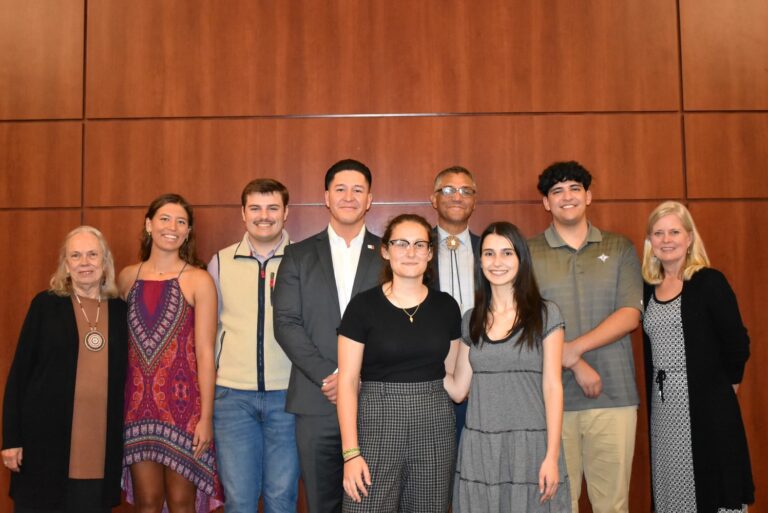
Helen Lee Turner, professor of religion; Megan White ’27; Hudson Jamison ’27; Marcos Moreno from Yale University School of Medicine; Kara Justus ’25, Ronny Bell from the University of North Carolina at Chapel Hill; Morgan Locklear ’25; Jason Levitt ’26 and Kristy Maher, professor of sociology. Photo provided.
For Levitt and the NAIA, sharing their culture and highlighting the disparities many Native communities face was paramount, but connecting with other Native Americans was also special. “Living in South Carolina, it feels like Native Americans and Indigenous Peoples live in history books,” while the culture is more alive on tribal lands in the West. Levitt now feels like he has a new role model in Moreno, who grew up on tribal lands in Arizona.
In the next few months, Levitt will begin preparing for the MCAT, the medical school entrance exam, and continue serving his communities on and off campus.
“After seeing what Native leaders like Dr. Moreno and Dr. Bell have been able to accomplish, I have gained a newfound sense of motivation that I can accomplish great things, too,” Levitt said. “There are communities who want help and there are people who want to help them. I just want to be part of that movement and find where I can make meaningful contributions.”
A recording of the CLP discussion is available here. You can follow the Furman University NAIA on Instagram.