News from campus and beyond
Quinn receives Governor’s Award for Excellence in Science
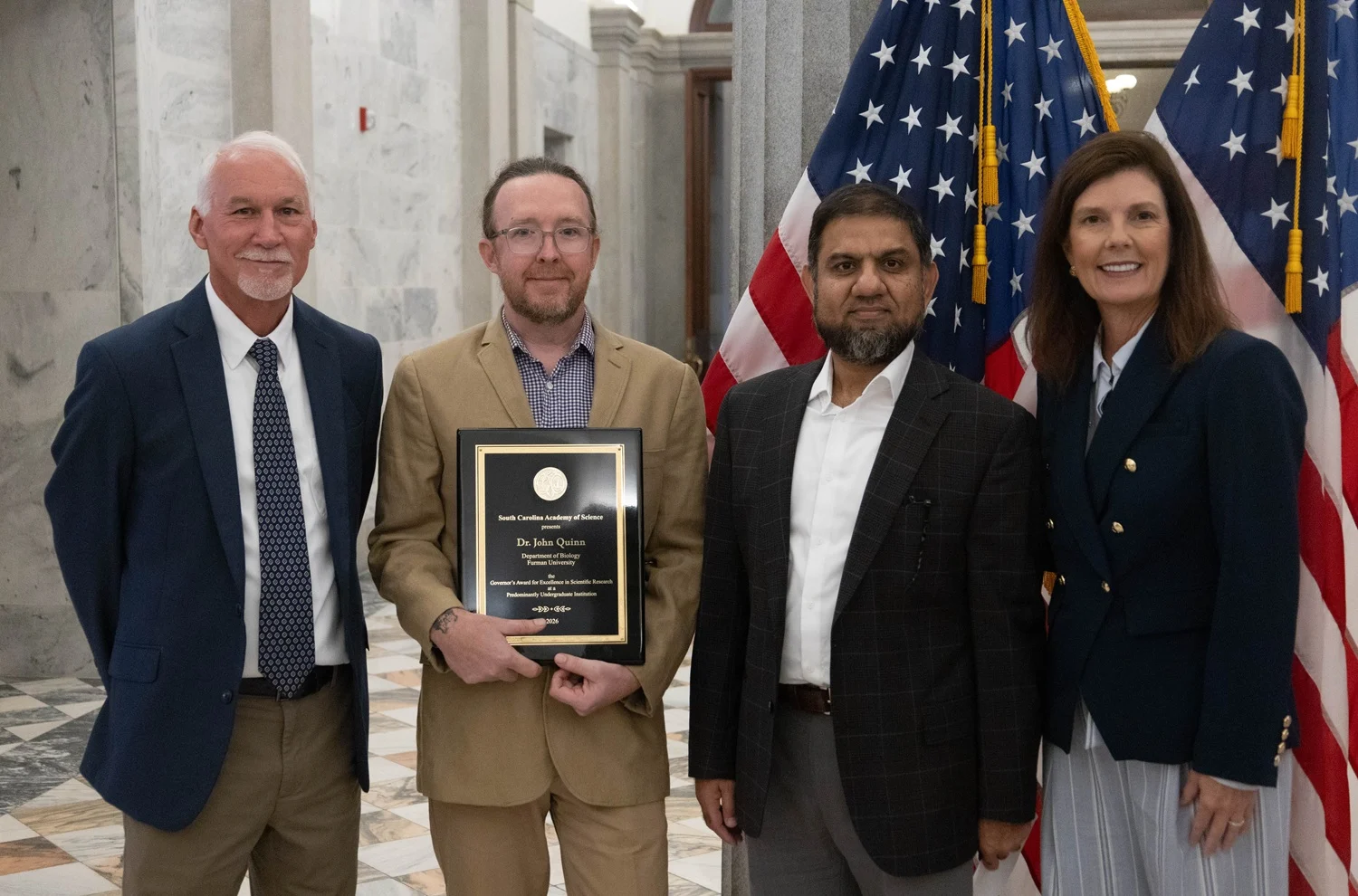
John Quinn accepts the SC Governor’s Award for Excellence in Science Research at a PUI at the Statehouse. From left: SCAS President Bill Jackson; Biology Professor Quinn; Senior Director of Technology, Kemet (a YAGEO company), Javaid Qazi; Lt. Gov. Pamela Evette.
On Aug. 5, 2026, in the hallowed halls of the South Carolina Statehouse rotunda, Furman University’s John Quinn accepted the Governor’s Award for Excellence in Scientific Research at a Predominantly Undergraduate Institution (PUI) from Lt. Gov. Pamela Evette. Quinn, the Henry Keith and Ellen Hard Townes Professor of Biology and director Environmental Studies, is the eighth Furman faculty member to receive an Excellence in Science Award since 1985.
The honor, now administered jointly by the Governor’s Office and the South Carolina Academy of Science, is presented annually to one faculty member statewide across all STEM fields and recognizes exceptional scholarship and undergraduate engagement.
“One of the best parts of working at Furman has been the research collaborations with students,” said Quinn, a faculty member since 2012. “This award reflects those collaborations over the years and the creativity that emerges from interdisciplinary scholarship.”
All told, Quinn has mentored 82 Furman undergraduates, high school students and a South Carolina high school teacher in research projects. Fifty-two of those are completing undergraduate theses in Biology or Earth, Environmental, and Sustainability Sciences at Furman.
At the core of Quinn’s research and mentorship is a fundamental tenet – “there need not be a binary choice between conservation and development” – a timely philosophy for a region like the Greenville area that is experiencing explosive growth. It’s an idea that says thoughtful development can and should coexist with protecting our natural resources.
To that end, Quinn and his undergraduate colleagues have directly assisted in orchestrating Biodiversity Management Plans across 12 Michelin North America properties using novel bioacoustics data and GIS (geographic information systems) bolstered by AI and data analytics.
Quinn and his undergraduate research team have partnered with nonprofit Upstate Forever to conduct a large-scale mapping project for identifying critical tracts across a 10-county region in need of conservation investment.
Filtering out noise, building better data
Increasingly, Quinn is leveraging the use of AI and machine learning in bioacoustics, collecting and refining bird calls and sounds from other animals. The technologies boost the capacity to identify and track species in a fixed location and time as well as monitor temporal changes related to environmental stressors, seasonality, migratory patterns and more.
From Kansas farmlands to the Canadian Prairies to the forests of South Carolina, Quinn and company have deployed automated recording units to capture and fine-tune avian sound signatures. This kind of work – identifying new ways of solving environmental problems – is gaining traction from the US Forest Service, the National Science Foundation and local funding sources to support cross-disciplinary STEM investigations.
During the Statehouse ceremony, Dean of Faculty Jeremy Cass ’00 said, “John and his student collaborators – more than 75 undergraduates – have demonstrated that successful conservation strategies in working landscapes must account for the social, ethical and historical drivers of land management, effectively merging the biophysical sciences with the human experience.”
For Quinn, seeing what’s happening around us matters, but hearing is just as essential.
“By listening to the environment, we can learn new things about the natural world,” Quinn said. “And while we have always collected data by listening, the recent development and use of AI and machine learning tools has allowed us to answer new questions about how wildlife uses the landscapes we share.”