For alumni and friends
of the university
of the university
Paladin Pride
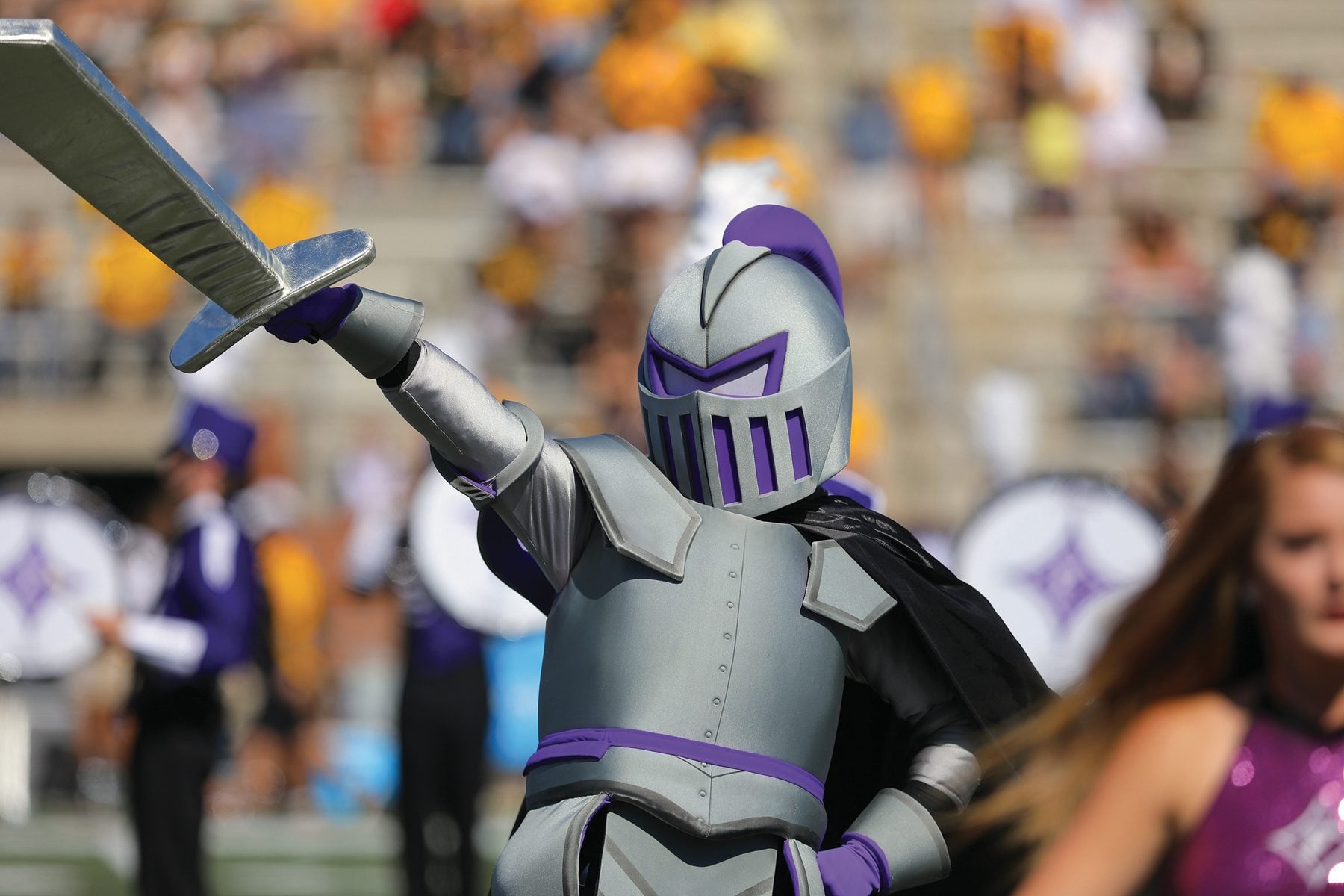
The Paladin Mascot during a football game in 2016.
FURMAN UNIVERSITY’S PALADIN MASCOT, dignified color scheme and “Diamond F” logo have been signs of pride and uniqueness among the school’s alumni, administration, students, athletes, coaches and fan base for generations. But the tales of how the iconic, distinguished nickname came to be is filled with a unique past, a fuzzy gnome, an oddly placed wizard and a sharp-witted newspaper sports editor. Still, the university’s athletics traditions and identities are felt today from the Furman Bell Tower to Paladin Stadium and Timmons Arena through a unique mascot that didn’t come to represent the entire athletic department until the 1960s.
“Buzzing” Beginnings: 1889-Early 1900s
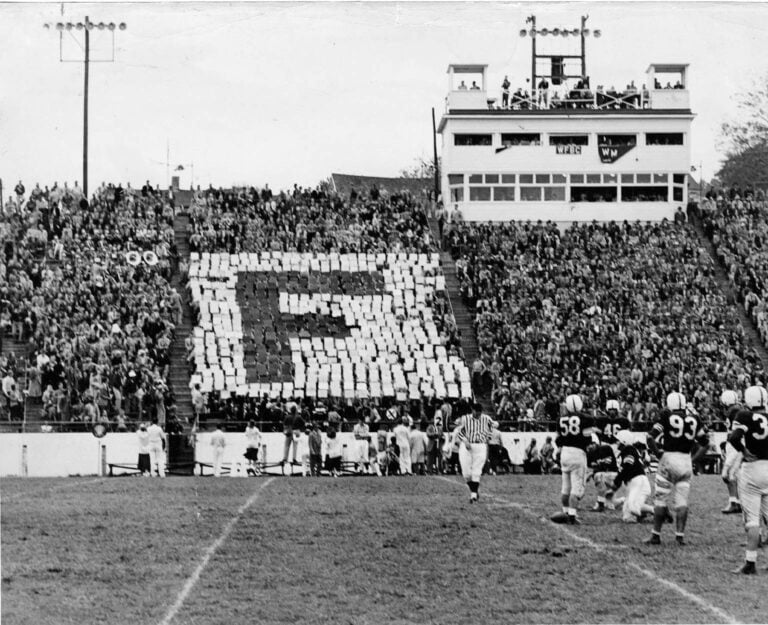
Furman hasn’t always been known as the Paladins. In fact, the school’s first athletic programs were recognized by different names for 70 years. The Furman Football Squad first began play in 1889. Two years later, a group of alumni held a meeting outside of Greenville and decided that the school’s colors should be royal purple and white. At the turn of the century, the baseball program was known as the Hornets, the first nickname given to a Furman athletic squad by at least 10 years. Neither the name nor the mascot found its way to other Furman sports, but the Hornets played a university role in the early 1900s. “There was a lot of imagery of hornets buzzing around together in solidarity, working together as a unit [during that era],” distinguished university public historian Courtney Tollison ’99 says. “The university promoted that imagery in the early 20th century for purposes of solidarity.”
Becoming a Paladin: 1920s-1960s
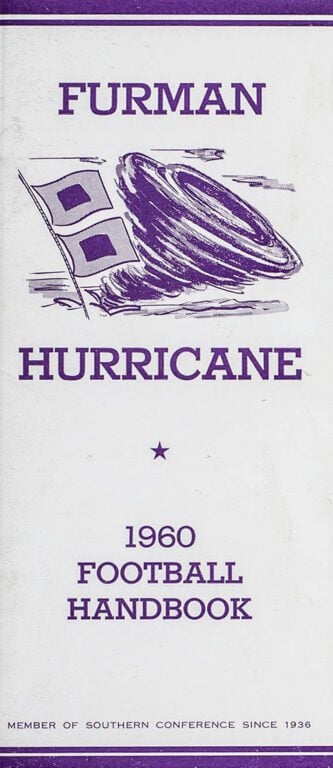
Meanwhile, Furman’s football program didn’t have a true nickname until 1920, when sports editor and columnist Carter “Scoop” Latimer of The Greenville News called the team the Purple Hurricane in his writing. It took until 1927 before the first mention of Furman’s now iconic brand made its first appearance in print. Latimer pinned “the Purple Paladins of the court” in his articles on the basketball team, giving the athletic department its third different mascot. “They had names and nicknames, but they didn’t necessarily have a graphic identity or a fuzzy-suited person jumping around on the sidelines at that point,” Furman University archivist Jeffrey Makala says. “That comes much later. But the name stuck.” After the downtown Greenville campus merged with the current campus in 1961, the student newspaper, known as “The Hornet” after the baseball team, called for unification and published a poll in one of its early issues. The student body was asked to pick among the Hornets, Hurricanes and Paladins. The basketball team was the pride of campus at that time, riding the success of the previous decade under head coach Lyles Alley and star player Frank Selvy. That led to the student body picking “Paladins,” and it became the school’s official nickname on Sept. 15, 1961. A Paladin is associated with Charlemagne’s court for its chivalry and heroism. With Furman being founded as a Baptist school, ties to a Christian knight helped the school come up with what the Paladin looks like today. “It’s an unusual mascot, but I think that’s why Furman people love it,” Tollison says. “It’s not something that is extremely common and it carries a sort of a sophistication to it.” That same year, a person began dressing like a medieval knight while riding a white horse at football games, a tradition that is carried out at each home football game. It was so synonymous with Furman that in 1963, the horse was kidnapped by a group of Citadel cadets, commemorating one of the most storied chapters in the Paladins-Bulldogs rivalry.
Bringing the logo to life: 1970s
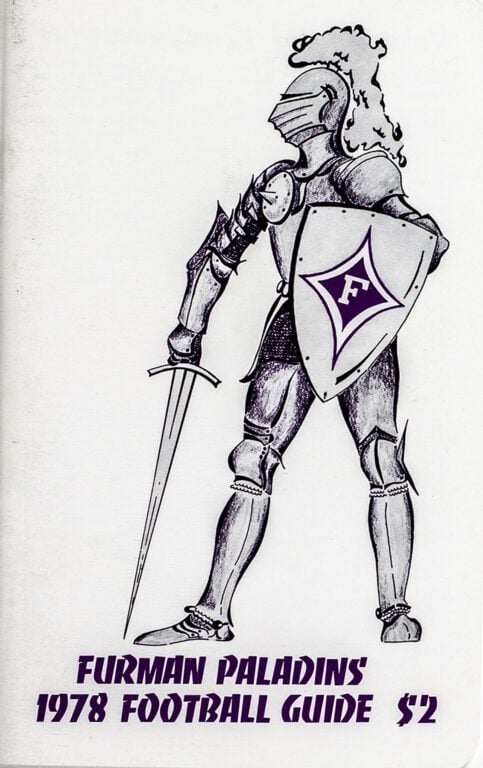
During the first decade or so of the Paladins’ nickname, the logo was a simple “F” on a shield. That shifted in 1973 when head football coach Art Baker wanted a new image to wash away multiple losing seasons. Alley, who had then become Furman’s athletic director, paid an art student and track athlete $25 to design a new logo. Dennis Zeiger ’74 came up with what is now referred to as the “Diamond F,” which has been the lasting symbol of Furman and its athletic programs for more than 50 years. The mid-1970s also brought on the “FU cheer” at the start of the third quarter at football games, accidentally started by President Gordon Blackwell and made a tradition by his successor John Johns.
Roaming the sidelines: 1980s-present
It wasn’t until the 1980s and 1990s that a more big-headed, caricature-like Paladin mascot began walking the sidelines at sporting events. And he wasn’t alone. Furman tried out a slew of characters to see what might stick as a tradition. There was Norman the Gnome, donning a robe and pointy hat with the Diamond F logo on it, who roamed the sidelines with the Paladin mascot for a short time. There was also a wizard making appearances and jumping around during the 1980s, but that wouldn’t last long. Over time, the Paladin mascot evolved into the puffy costumed Victor. “Sir Paladin” also upgraded to a full suit of armor, and for many years, the horse Fury was ridden by Atlanta resident Dave Hanson. “I think people love the white horse on the field and the knight on horseback galloping every time we score a touchdown,” Tollison says. In 2016, the athletic department unveiled a new “complimentary” Paladin mascot logo, linking the purple past with a distinctive brand that separates Furman University from its peers. “I’ve never heard any discussion of changing [the Paladin mascot], Tollison says. “I think it’s embraced.”