For alumni and friends
of the university
of the university
Name Drop
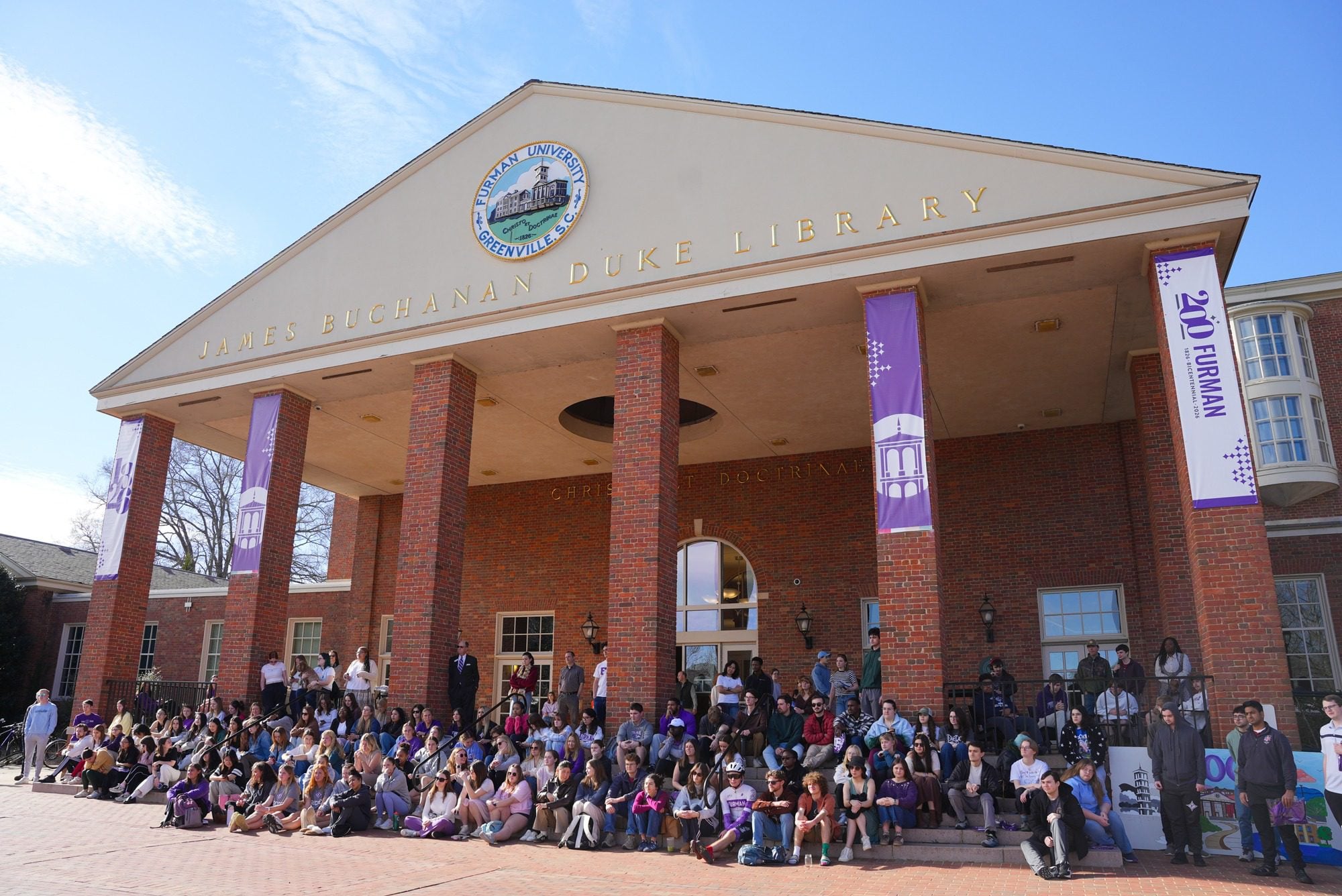
Students, faculty and staff gather outside the James B. Duke Library on Feb. 12, 2026, to celebrate the opening of a time capsule buried by the university in 1993. Photo by Nathan Gray, Furman University.
Stories exist on every corner of Furman University’s campus. They are rooted in the Rose Garden that adds fragrance to campus, in the Japanese temple that offers respite on the edge of the lake and in the library where students study. Since the university moved to its current home in 1958, the Furman campus has evolved into a living space that moves in harmony among the classrooms, common areas, residence halls, and the people who use them. Lest we forget those who make these spaces possible. These buildings have a name that offers deeper insight into the individuals who have shaped, and continue to shape, Furman.
Trone Student Center and Trone Center for Mental Fitness
These spaces are central to student life on campus and can be attributed to David J. Trone ’77, a graduate of Furman and a member of the Board of Trustees. Trone is the owner and founder of Total Wine & More, which operates 290 stores in 30 states plus the District of Columbia, and served as a U.S. Representative for Maryland’s 6th District from 2019 to 2025. One of his areas of focus is mental health and well-being, which inspired the donation from he and his wife, June, to enhance mental health services at Furman. The Student Center got a revamp in 2005 and today it houses meeting space, a theater, cozy space to study and gather, a pub-style restaurant and resources like career services, engaged learning and student life services, not to mention a beautiful view of Furman Lake
James B. Duke Library
James Buchanan Duke believed in education, so much so that upon his death in 1925, the American Tobacco Co. founder left half of his estate to The Duke Endowment. The funds, which totaled $67 million (the equivalent of $1.2 billion today) were designated to be given to four universities – Duke University, Davidson College, Johnson C. Smith University and Furman University. Duke’s legacy also includes the creation of Duke Energy, which he and his brother, Ben, founded in the early 1900s as Catawba Power Co. and Southern Power Co. The common thread throughout his life was philanthropy. Duke took a particular interest in higher education, rooted in the belief that “educating principled people in medicine, law and other fields will benefit society.”
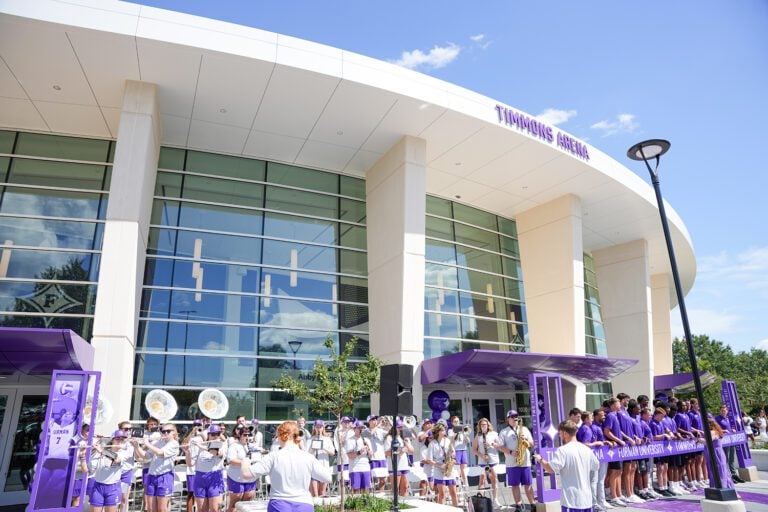
A ribbon cutting ceremony was held for the renovated Timmons Arena on Monday, August 27, 2025.
Timmons Arena
The 10,000-square-foot arena came to life in December 1997 and underwent extensive renovation in 2024. Prior to the arena, the Paladins basketball team played home games at the old Memorial Auditorium in Greenville. The arena construction got a boost in 1998 with a $4 million donation from William R. Timmons Jr. ’49, Jean Timmons Pelham ’42 and Charlie and Kitty Wells ’48 Timmons. Charlie’s father, William R. Timmons, was a Class of 1914 graduate. Furman alum Ravenel B. Curry III ’63 kicked off the $40 million renovation in 2023 with a $10 million gift, one of the largest in Furman University history. Keeping with their tradition of giving, the Timmons and Pelham families also donated toward the renovation, honoring their family’s original commitment to the arena in 1997. The men’s and women’s basketball teams played their first season in the renovated arena in 2025-2026, featuring new seating, private suites and a more interactive experience.
Herman Lay Physical Activities Center (PAC)
Did you know? Furman’s hub for student fitness is named for a man who popularized snack foods in the United States. Ironic? Not when you consider Herman Lay, who was born in Charlotte, North Carolina, attended Furman on a baseball and basketball scholarship. After college and the Great Depression, Lay took his knack for business into a career as a traveling salesman and delivery driver for a potato chip company. He eventually formed his own chip company, the H.W. Lay & Co., in 1932. By 1961, the company merged with the Frito Co., forming the Frito-Lay Corp. – the largest snack food company in the United States. Eventually, Frito-Lay merged with Pepsi-Cola to create PepsiCo, Inc. So, between late-night study snacks and the PAC, Lay could arguably be considered one of the most important pieces to the Furman University legacy.
Hartness Admissions Center
The Hartness Admissions Center is just one space that has been touched by the generosity and spirit of Thomas and Edna Hartness. It’s a fitting tribute to a couple and family that held community, adventure and outreach close to their hearts. Thomas Hartness was owner of the Pepsi-Cola bottling plant in Greenville starting in 1940. He later founded Hartness International, a manufacturer of packaging equipment, which today sells products in over 100 countries, though the Hartness family sold the company in 2009. Edna Hartness was an avid naturalist and devoted herself to preserving natural spaces, working with children and promoting access to music. She sponsored a music scholarship at Furman and sponsored both the Hartness and the Gladden Quartets.
Hill Plaza/The Hill Institute
Robert and Margaret Hill have remained connected to Furman even after both graduated in 1983. The Hills have served as chairs of the Board of Trustees and chairs of the Richard Furman Society, working to ensure future students have chances for enrichment at Furman. The Hill Institute for Innovation and Entrepreneurship launched in 2018 and today houses undergraduate and graduate programs that nourish and engage creative, entrepreneurial ideas with tangible learning.
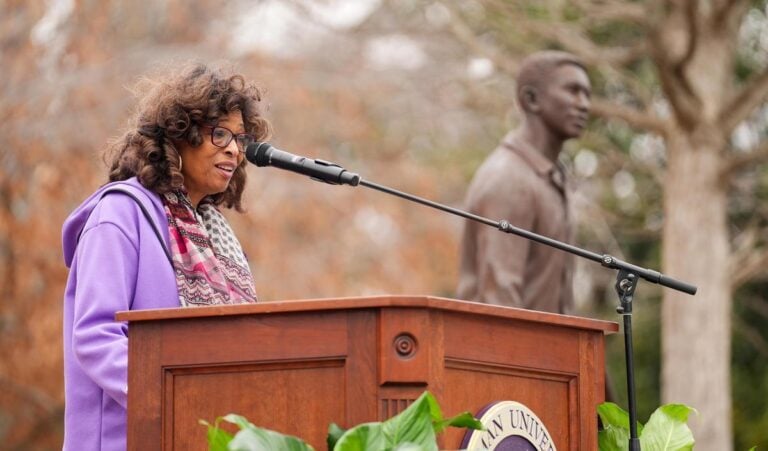
Lillian Brock Flemming ’71 M’75 H’14 speaks at the Joseph Vaughn Plaza in 2025.
Joseph Vaughn Plaza
Dedicated in 2021, this space just outside Duke Library honors Joseph A. Vaughn, Furman’s first Black undergraduate student. Vaughn enrolled at Furman on Jan. 29, 1965, paving the way for an integrated university. Vaughn grew up in Greenville and attended Sterling High School, also where Rev. Jesse Jackson was a student. Vaughn graduated cum laude in 1968 with degrees in English and French. While a student, he was involved in the Greenville NAACP Youth Chapters, the Southern Student Organizing Committee, Color Guard and the Baptist Student Union. The plaza, which features a life-size statue of Vaughn, was dedicated as part of the university’s “Seeking Abraham” initiative, which guided the way Furman would honor, remember and reflect on its history with slavery and racial injustice.
Daniel Chapel
Constructed in 1992, this building is named after Charles E. Daniel. Daniel, who founded Daniel Construction Co. in 1934, played a significant role in laying the groundwork for South Carolina’s international business landscape. The chapel was completed thanks to a $24.5 million donation in memory of Charles Daniel.
Farmer Hall
Named for Tom Farmer, a 1950 graduate of Furman. Farmer was raised by a single mother who modeled resilience and giving back. Over the years, Farmer funded scholarships for Furman students and helped finance projects like the construction of the residence hall that bears his name.
Clark Murphy Housing Complex
The housing complex got its new name as part of the university’s “Seeking Abraham” initiative. Clark Murphy was an African American groundskeeper and janitor who documents show tended to the once all-women’s residence hall for four decades in the late 1800s and early 1900s. Records and documents from the time indicate Murphy was a beloved and integral part of the student experience. As a plaque outside the complex now indicates, the renaming was also a chance to honor “the unsung men and women who labored throughout the long history of this institution, and in doing so have contributed meaningfully to the life of this community.”
Halls named after Furman presidents
Manly Hall: Charles Manly, Furman’s president from 1881 to 1897.
Geer Hall: Bennette Eugene Geer, a Furman graduate who became the school’s president in 1933.
Blackwell Hall: Gordon Williams Blackwell ’32, who became Furman’s eighth president in 1965. The original residence hall was demolished in 2023 as part of a comprehensive residence hall renovation project. A new residence hall now bears the name.
Poteat Hall: Edwin McNeill Poteat, Furman’s president from 1903 to 1918.
McGlothlin Hall: William Joseph McGlothlin, Furman’s president from 1919 to 1933.
Johns Hall: Named after Furman’s ninth president, John E. Johns. The building was dedicated in 1998. During his tenure (1976-1994), Furman separated from the South Carolina Baptist Convention in 1992.