For alumni and friends
of the university
of the university
Fifty Years of Gratitude
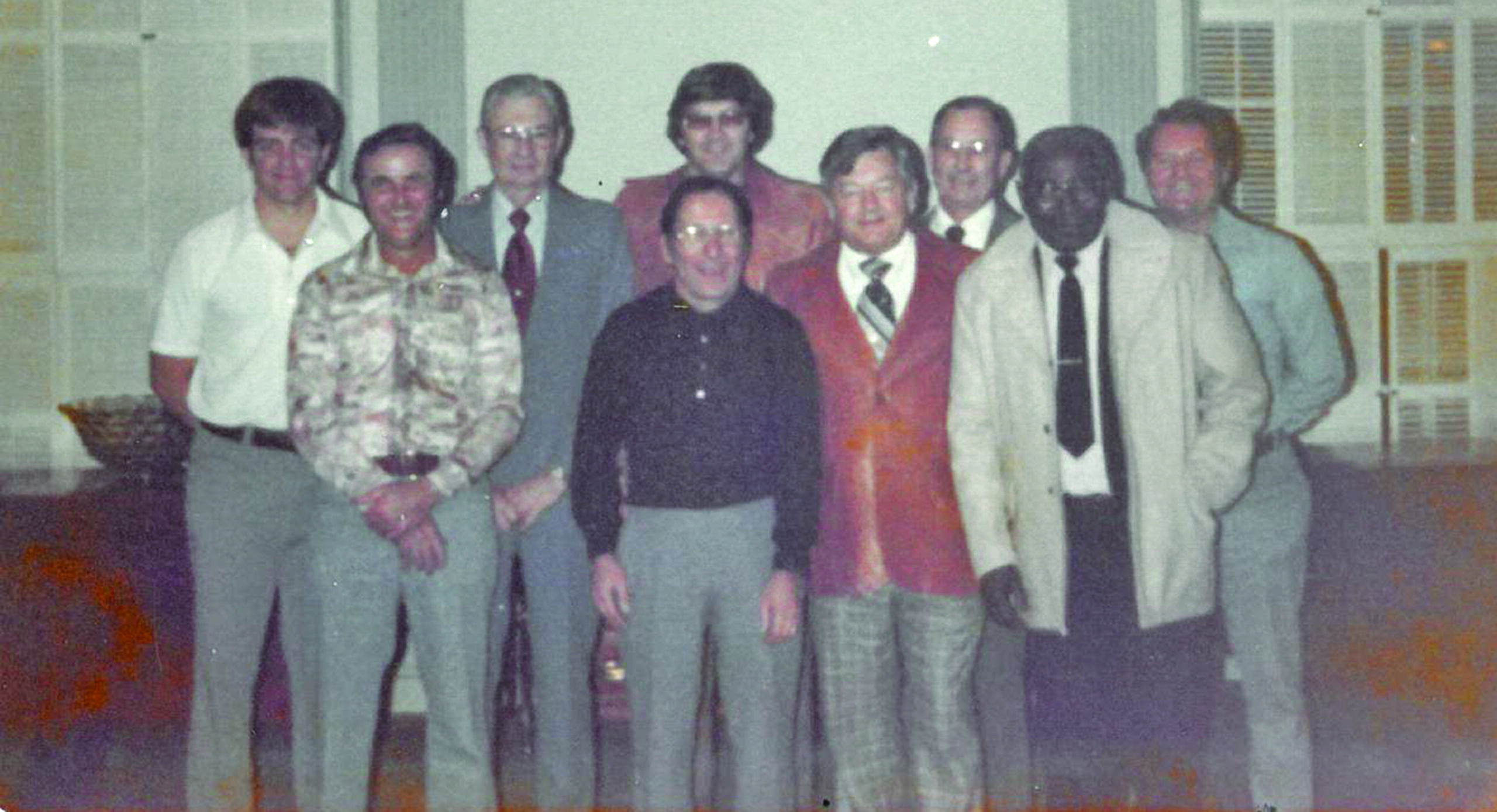
Front row – Ed Childers, Richard Brakefield, President John E. Johns, Furman Hill; Back row – Coach Eddie Williamson, Richard Hamby, Coach Jimmy Satterfield, Frank Bonner, Carol Owens in 1975. Courtesy photo
It was 50 years ago this coming fall that Furman laid the foundation for what started as a way to enjoy a round of golf a couple times a week and turned into a tradition that would span generations. The Purple & White Golf League, a competition that allows Furman faculty and staff to demonstrate their skills on the golf course, has invited hundreds of university employees to the Furman Golf Course during the past five decades. And even after most experienced the agony of defeat, they will be the first to tell you that nothing compares to these twice-weekly forays to the links during the spring and summer months.
Greats of the gridiron who were on the sidelines for Furman’s national championship victory in 1988 knew all about pressure. Little did they know they might feel a similar pressure to perform in front of co-workers on each hole of the Purple & White.
Ken Pettus, who was an assistant coach on Dick Sheridan’s staff in the 1980s played in the league for more than 20 years. He says he’s been just as stressed trying to protect a two-point lead late in a football game as he was standing over an important putt in the league.
“I always dreaded those three-footers on No. 9 when the other players were watching to see if you would make it,” says Pettus, who returned to Furman in 2000 as an associate athletic director. “You knew you would hear about it if you didn’t.”
No matter the skill level and no matter the position held, this Purple & White Golf League has endured. League members would readily admit the quality of play could be better, but that’s why nobody who participates takes the game – or themselves – too seriously. A drive blasted onto Highway 25 from the first tee is guaranteed to draw derision from one’s playing partners.
A missed putt from two feet and one inch – the worst possible miss since anything inside two feet is good – will get little sympathy.
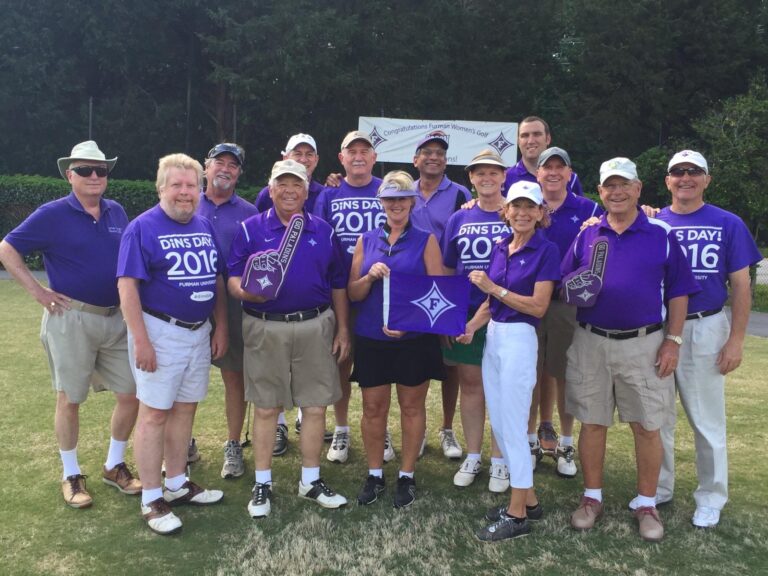
Bing Vick, Steve Long, Bob Chance, John Burns, Randy Dill, Kirk Karwan, Mickie Spencer. Kailash Khandke, Debbie Stegall, Julie Goldberg, Alex Loeb, Vince Moore, James Odom, Owen McFadden in a picture from 2016. Courtesy photo
A “Take Up Tennis” trophy is awarded each year to the person who could have played better and is known to have a healthy sense of humor. The captains of the two teams also present a Most Valuable Player for the Other Team award, given to the player deemed to have done the most to hurt his or her team’s cause during the season.
Finally, the losing captain is required to present the winning captain the championship trophy at the league’s year-end party. During the off-season, in a tribute to the National Hockey League’s traveling Stanley Cup, the trophy makes its way throughout campus to reside in the offices of the winning team members.
The golfing fun began in the fall of 1975 as a modest form of recreation for a few members of the university’s facilities crew, who had earned a well-deserved break after overseeing much of the construction of a new campus. After work on Tuesdays and Thursdays, the loosely organized group known as the “Carpenters and Plumbers” would play nine holes at the Furman Golf Course.
It became so popular that “outsiders” like President John Johns, Provost Frank Bonner and football coaches Bob King and Dick Sheridan soon joined the group. Most of Furman’s presidents have played in the league, including Gordon Blackwell and current President Elizabeth Davis.
The league grew exponentially after it was officially opened to all Furman employees. It was renamed the Purple & White Golf League and became a more organized effort. A scoring system was devised where all players, no matter their skill level, could be equally competitive. A double bogey limit was mercifully invoked, and putters were taped so any putt measured inside two feet was good. Each day, tee times were assigned so players were sure to be paired with different people.
Steve Long, a project manager in Facilities Services and the lone remaining member of the original “Carpenters and Plumbers,” was put in charge of the scoring system. Fifty years later, he is still working and playing in the league.
“I’ve enjoyed being involved in the league as it’s evolved over the last 50 years,” Long says. “It’s not so much about playing well or winning as it is about spending time outdoors with co-workers and bonding as friends and colleagues.”
In a nod to the PGA Tour, the league even appointed a commissioner to oversee its success. John Burns, a former assistant athletics director at the university, held that position for 38 years, which extended into his retirement. Chemistry professor Brian Goess took over for Burns in 2024. Both were chosen for the task because they could be counted on to play most every round and understood what the league was ultimately about.
“I joined Purple & White right after I came to Furman in 1984,” Burns said, “and it was a great way to meet people I might not have otherwise come in contact with. Of course, playing nine holes of golf twice a week after work was a good thing, too.”
While the Purple & White has had some participants who played on their college golf teams and others who could get around in par on a good day, the league has never been about who played the best. It’s about spending a couple of hours with your co-workers and learning to appreciate a game you can play for a lifetime.
It’s for those reasons that the league’s members expect it to remain a popular pastime at the university for another 50 years.
“This is my 20th year at Furman and my 20th year with Purple & White,” Goess said. “At this point, I can’t imagine one without the other. The league gives its members the opportunity to develop true friendships and experience that shared misery we call golf.”