For alumni and friends
of the university
of the university
Clicking in the Classroom

Matthew Cohen, middle, associate professor of sustainability science, leads a Principles of Sustainability Science class. Photos by Nathan Gray.
There’s no secret ingredient to student success at Furman. It’s a recipe mixing engaged learning, reflection and mentoring, prepared by committed and passionate faculty and staff on the side.
Many classes at Furman go beyond listening to lectures. They find unique ways to bring their subjects to life. Here are a few of the classes that can spice up a schedule and student experiences.
Calculus for Management, Life and Social Sciences – MTH 145
Whether it’s analyzing business margins, studying population growth rates or calculating realistic movements for the animations in a video game, calculus is a necessary tool in a number of fields.
It’s not just for math majors. “I always try to pull examples from a variety of majors that students are pursuing, so they can see how the course connects with their career goals,” says Lori Alvin, the Henry Keith and Ellen Hard Townes Associate Professor of Mathematics.
MTH 145 provides the framework to understand many of the functions that serve as building blocks for models throughout the sciences and gives students the confidence to use these analytical tools when tackling problems. Working in small groups helps build community throughout the class, and the focus on how calculus is applied shows students how the branch of mathematics can inform their own futures.
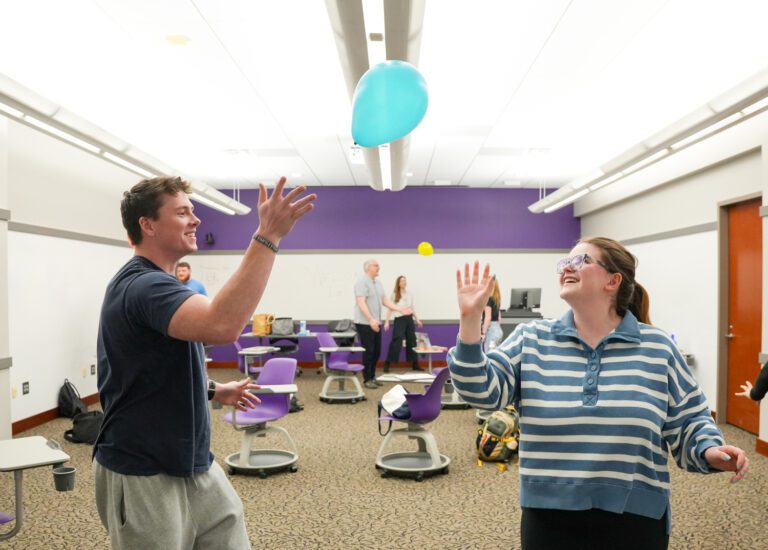
Joe Graham ’25, left, and Maggie Malcolm ’27 participate in ice-breaker exercises in an Intergroup Dialogue class led by Andy Coe and Claire Whitlinger.
Introduction to Intergroup Dialogue – IGD 101
Dialogue, by its nature, is integral in every field around the world. From the local politician running for the first time to the CEO of a Fortune 500 company, clear speech and the willingness to communicate are paramount to success.
IGD 101 offers a more social environment than the average lecture, bringing together people from diverse backgrounds to explore their differences and similarities. Through semi-structured discussions, people leave this class with a better understanding of the lives of those around them.
The theory and practice of intergroup dialogue equips them with the ability to listen fully to others and understand the complex factors that inform people’s perspectives. The subjects of this class vary but always seek to explore the identities that unite and divide people.
“I think it positions students to leave Furman with an appreciation for nuance, with an ability to listen deeply and well and to express deeply held beliefs and positions in a non-combative way,” says Andy Coe, associate director of the internship office and an IGD instructor.

Students in the Dance Techniques II class practice a routine in the dance studio of The Playhouse on Monday.
Foundations of Dance – DAN 120
More than a rest from the rigorous academic responsibilities of other classes, DAN 120 is a journey of self-discovery through movement. No experience with dance is needed, and part of the appeal is the unknown, says Adjunct Professor of Dance Helen Joy.
“We explore concepts through movement, playfully expand our physical possibilities and we do it all with joy and empathy,” Joy says. “It allows for balance and guides students to make time for their mental and physical wellness.”
This class teaches the basic techniques of dance while building a familiarity with the styles often seen in contemporary dance practices. Alongside this foundational knowledge of dance and movement, the course encourages students to know themselves better, celebrate others and engage authentically in all they do.
Introduction to Innovation and Entrepreneurship – BUS 270
Creative problem solving is at the core of innovation. What new business doesn’t have its fair share of hurdles to overcome? BUS 270 provides the skills to identify real-world problems and design solutions, whether that’s a product, a service or an entire business model.
“They also gain communication skills that are critical not only for entrepreneurs, but for anyone working with customers, managers or investors,” says Steven Stewart, the Robert E. Hughes Associate Professor of Business and Accounting.
Outside of the classroom, this course connects students with entrepreneurship opportunities through the Hill Institute for Innovation and Entrepreneurship.
Business demands critical thinking, creativity, empathy and the ability to reason, making it a part of the liberal arts tradition at Furman University.
“For some, it’s a first step into business. For others, it becomes a framework they carry into any career — whether they pursue entrepreneurship or not,” Stewart says.
Furman Band – MUS 061
Joining the Furman bands is stepping into an already established community and support system.
“They instantly have a group in which they belong, made of people with whom they have something in common,” says Sue Samuels, director of bands and music education coordinator.
Musicians in this program come from all backgrounds and majors. The various band ensembles have lighter rehearsal schedules than high school bands, so students can fit them into their busy schedules. The hard work
and focus the musicians put into their rehearsals pays off when they’re enjoying each other’s successes or basking in an audience’s applause. Through these shared experiences, they hone not just their musical skills, but social and leadership abilities as well.

Audrey Cochran ’27, right, and Grace Buckley ’28 work on costumes for the play “ Tartuffe” as part of a Costume Design class.
Costume Crafts – THA 116
They say dress for the job you want. For actors, that changes with every role, and costume crews are responsible for designing, building and styling the outfits that help sell the magic of any stage production.
This course introduces the vocabulary and tools of theatrical costuming before offering the chance to get to work.
“They are actually crafting wearable works of art,” says Margaret Caterisano, professor of costume design and costume shop supervisor.
The skills go beyond basic sewing to fabric identification and modification. Whether it’s building suits of armor, stitching hats and headwear or painting elaborate costume pieces, they’ll have the knowledge needed to tailor a costume to fit not just the body, but a character’s personality.
Principles of Sustainability Science – SUS 120
The sustainability challenges the world faces can be daunting, and eco-anxiety is real. With projections of Earth’s population rising to 9 billion by 2037, this class engages with the challenge of supporting that population without destroying Earth’s resources or social integrity.
“We strive to engage students in not only understanding the problems we face, but to feel empowered to seek solutions,” says Matt Cohen, associate professor in the Department of Earth, Environmental and Sustainability Sciences. “Sustainability can actually be quite aspirational.”
Through lab projects and even trips to the Furman Farm, SUS 120 confronts the serious problems our world faces by exploring how they connect to students’ interests. In that way, they can interfuse sustainability concepts to everything else they study at Furman.
Color and Digital Photography – ART 206
Everyone has a camera in their pockets now, but ART 206 encourages thinking about the images and not just recording wherever the camera is pointing. With a 35mm DSLR camera in hand and a basic understanding of Photoshop, the world transforms into art around every corner.
“Art assignments are about creative problem-solving, a skill that can and should be applied to any career,” says Terri Bright, professor of art.
ART 206 is an invitation to get out and expand your artistic horizons by capturing compelling images. It offers freedom of expression alongside the opportunity to unplug from the daily grind and explore the world through your lens.
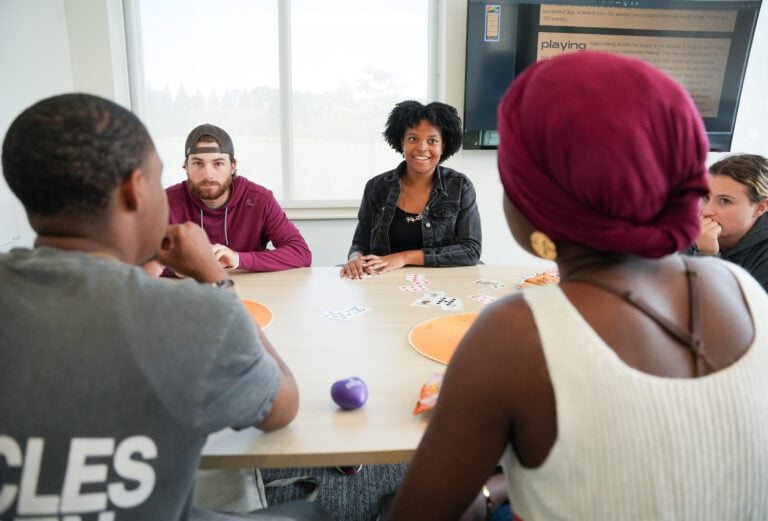
Students in an African Studies class learn how to play Spades at the Center for Interpersonal Connections.
Introduction to Africana Studies – AFS 100
AFS 100 surveys the historical and contemporary social, economic and political experiences of Africans and the African Diaspora. In-class debates, community-building games and even creating soundtracks to pair with course topics build the foundation to developing sharper critical thinking skills that explore Black life throughout the diaspora.
“In this course, we value and discuss the lived experiences and historical context of Africana Studies scholars and intellectuals, as well as our own backgrounds and perspectives,” says Kaniqua Robinson, assistant professor of anthropology.
Beyond the history, this class develops emotional intelligence and interpersonal skills needed to navigate diverse environments at Furman and beyond.
Mindfulness for Stress Reduction and Wellness – HSC 102
College is a time of transitions. It’s a bridge between the comfort of high school and the “real world” that awaits when students leave campus.
“Change is inevitable, and often stressful,” says Scott Murr, associate professor of health sciences. “With an increased awareness of the importance of mental health on campus, mindfulness education can help students reduce the negative effects of stress.”
HSC 102 promotes stress management by teaching how to incorporate mindfulness into students’ lives, improving resilience and well-being. This experiential course also covers stress physiology and the research behind various mindfulness-based techniques, including meditation, body scans and mindful movement.
Mental health is a top priority; this course helps students develop a consistent stress management plan and “build their focus, concentration and awareness to be able to manage the pressures of life, on campus and beyond the gates of Furman,” Murr says.