News from campus and beyond
Going to the source: Students study how much methane comes from streams

Max Ferrier ’25 takes water samples from local streams to measure methane levels as part of a research project. Photo by Nathan Gray, Furman University.
Methane—a powerful greenhouse gas that warms the planet by acting like a molecular blanket—seeps into the atmosphere from freshwater rivers and streams. This summer, a Furman research team wants to know how methane ended up in the streams around the university in the first place.
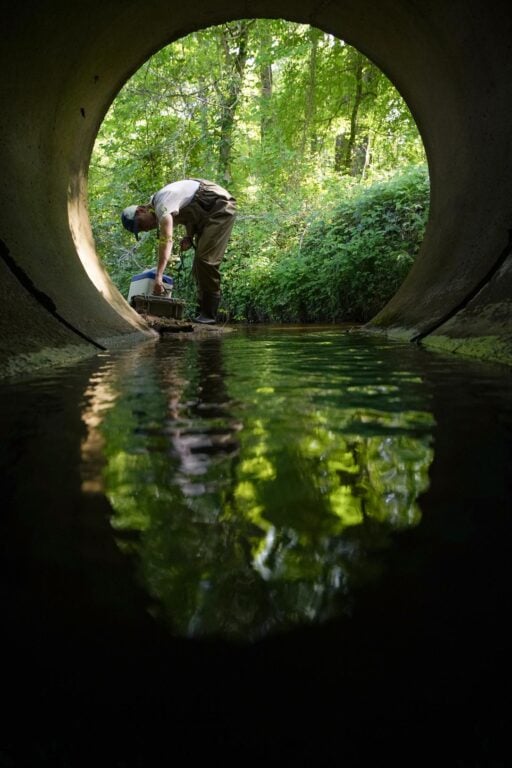
Max Ferrier ’25 takes water samples from local streams to measure methane levels. Photo by Nathan Gray, Furman University.
Max Ferrier ’25 and Christian Anderson ’26, both in the Department of Earth, Environmental, and Sustainability Sciences, are working with Brannon Andersen, Ph.D, the Rose J. Forgione Professor in that department, to determine if groundwater could be the source.
The team is analyzing samples taken from wells installed in Little Creek, which flows through the forest behind Daniel Chapel. They want to know if the groundwater contains higher concentrations of methane than the Reedy River that it flows into.
“If the groundwater has higher methane than the streams and it’s discharging into the stream, then groundwater can be a source of methane to the streams here,” said Andersen.
For more than 25 years, Andersen has studied how human transformation of landscape affects carbon and nitrogen cycling in rivers, streams, wetland and soils. He turned his attention to methane in recent years as external scientific reports increasingly pointed to rivers as contributors to its release into the atmosphere.
Andersen began to monitor methane in previous undergraduate research projects that discovered high concentrations in rivers in the South Carolina Piedmont region. Methane enters the atmosphere when it becomes overpressured in a river, similar to the way that bubbles leave a can of soda that has been popped open, he said.
“We’ve known for a long time that landfills, cattle, rice paddies and oil and gas wells are producers of methane, but rivers have been vastly understudied as a natural source of methane,” he said.
Methane is the second-most abundant greenhouse gas after carbon dioxide, accounting for about 16 percent of global emissions, but is 28 times as potent as carbon dioxide at trapping heat, according to the U.S. Environmental Protection Agency. Concentrations of methane in the atmosphere have more than doubled in the last two centuries, according to the agency.
In the South Carolina Piedmont region, Andersen is working to compare methane concentrations in rivers at different altitudes and in both rural and urban areas to better understand origin of and controls over methane in a temperate river system.
“Since the methane is natural, this is not a situation where mitigation strategies can lower methane oversaturation,” he said. “The larger goal is to better understand the magnitude of methane emissions from rivers (which currently has large uncertainty), along with the origin of that methane.”
In 2017, he and his team built an instrument for quantitative methane analysis using a 1983 Hewlett Packard machine discarded by the chemistry department. Ferrier and Anderson are using the instrument to analyze samples this summer and will present their findings at a professional conference next spring, said Andersen.
“This research is important because methane emissions are increasing worldwide, and it is a potent greenhouse gas,” said Ferrier. “Streams and rivers are large sources of these emissions, with not much knowledge out there about the specific sources of methane within streams.”
Ferrier said that his undergraduate research thesis will be focused on the methane work, and that he could see himself working on similar types of sustainability issues throughout his career.
Anderson said that the summer research project has helped him to learn “how to think critically about the results that I am getting and apply new knowledge to previous knowledge. I am interested in pursuing a career in environmental science, so doing research with the department allows me to better understand what a career in this field would entail.”


