News from campus and beyond
Clay Wallace ’26 receives Furman’s first Yenching Scholar fellowship
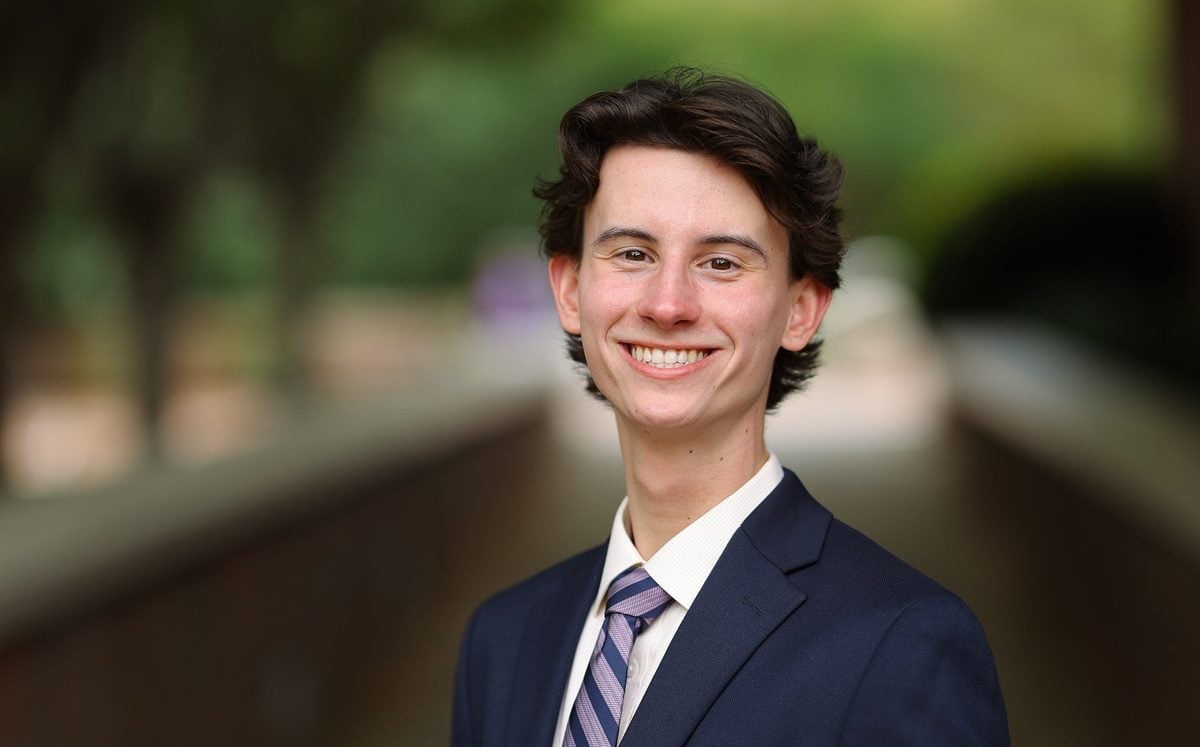
Clay Wallace ’26. Photo: Jeremy Fleming
Clay Wallace ’26 had an idea when acceptance notices would be circulating about a two-year graduate fellowship program at Yenching Academy. One early morning, still bleary-eyed, he reached for his bedside phone. And there it was – an email from the academy housed at Peking University in Beijing, China.
“I took a second, took a breath, opened it and saw I was accepted. I called my parents and told them, called my girlfriend and told her. It’s been exciting. It’s been surreal,” he said.
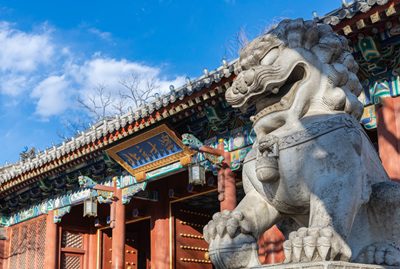
Beijing’s Peking University is the home of Yenching Academy. Photo: iStock.com
Wallace, a politics and international affairs and Chinese studies double major and Furman’s first recipient of the fully funded scholarship, said the news was jarring to him because among the four fellowships he applied for, this one was the most competitive and most ambitious. Fewer than 3% of applicants are accepted.
In September 2026, he’ll join 120 international students at Yenching Academy, a program that welcomed its first cohort in 2015.
Wallace will pursue the politics and international relations track, one of the academy’s six areas of study. He’ll focus on China’s political institutions, governance and policy, and comparative political systems all while enjoying one of the country’s cultural and political hubs.
The chance to hone his language skills in an immersive environment was one of the reasons he applied for the fellowship. Wallace, of Bowling Green, Kentucky, has studied Mandarin Chinese throughout his time at Furman including a semester study away in Taipei. He has conversational proficiency in the language, but fluency is his aim.
Beyond language, he wants to build on the interdisciplinary training he has received at Furman and develop his understanding of academic perspectives on China as a political entity, as a political system, and as an actor in the larger political landscape, Wallace said.
Wallace was also drawn to the program’s inherently international scope and the diverse viewpoints he could glean from his peers – not just from the U.S. and China, but also from the rest of Asia, Europe, Africa and Latin America.
Rallying reinforcements
To help clinch the deal, Wallace enlisted the guidance of Scott Henderson, the William R. Kenan Jr. Professor of Education and director of National and International Scholarships, who assisted in shaping his personal statement and essay.
Henderson lent his expertise on the Yenching Academy application as well as three other prestigious fellowships. “I think he reviewed every single one,” Wallace said. “He was helpful in providing me feedback and ways I might add content or adjust the framing to better fit the goals of the programs and what reviewers are looking for,” he added.
Wallace also leaned on valuable counsel from his advisor Kate Kaup, a China scholar and the James B. Duke Professor of Asian Studies and Politics and International Affairs, who has worked closely with him since his first days at Furman.
Looking back at his Furman career, Wallace said courses like “Politics of China” and “Authoritarianism” with Kaup were critical for his knowledge base and foundational to his thesis research and graduate studies pursuits. Other professors in the Department of Asian Studies – Dongming Zhang, Lane Harris and Eiho Baba, also informed his experience, adding important context to his political science studies, he said.
So, Wallace was more than prepared for the Yenching fellowship interview. But it wasn’t what he expected. “It was nerve-wracking,” he recalled. Conducted via Zoom, the session included a panel of professors who had little interest in small talk.
The panel immediately launched into specific questions about his undergraduate thesis, his research proposal, and other qualifications. “It was pretty rigorous,” Wallace said. “They challenged me to think hard and think critically about research design and opportunities to expand on methodological elements of my proposal or different approaches I could take.”
Wallace apparently aced the audition. He said it’s difficult to know how the committee weighed the various selection criteria, but he’s sure his undergraduate thesis about China and the international political economy played a big part in his acceptance. “I used some advanced quantitative methods that might be a little rare for undergraduate political science students to employ,” said Wallace, a data analytics minor.
Wallace’s ability to clearly articulate his career interests and how the training at Yenching Academy would align with those goals served him well, he said. Ultimately, he wants to explore the legal field working across private practice and research.
“I’m fascinated by how international business and economics affects politics. I’m interested in engaging with mid-sized Chinese companies that want a manufacturing presence in the United States,” he said. “Chinese language skills, along with cultural competency and deep understanding of the country itself will be very necessary and essential to that career.”
Advice for fellowship-seeking undergrads
Meanwhile, Wallace has advice for undergraduates. He urges students interested in graduate fellowships to start the process early. That way, they can understand the critical dates for applications and when to shift things into high gear.
“And if it’s something you really care about, ask yourself, ‘What can I do during my time at Furman that will help set me up for success?’” And, he said, “Definitely talk to Dr. Henderson. He’s a fantastic resource and a great person to have on your team.”