News from campus and beyond
Chemistry students take an untraditional path to medical school at Furman

Sky Warf ’24, George Shields and Shannon Harold ’22 M’23 in a 2023 photo. The pair worked with Shields to publish research on the prebiotic atmosphere.
Shannon Harold ’22, M ’23 prepped for medical school in a chemistry lab at Furman.
“I learned a lot of thinking on my feet and how to think through things when I don’t know the answer right away,” said Harold, who’s in her third year at the University of South Carolina School of Medicine Greenville.
She found her footing quickly when she shifted from Furman student to first-year medical student. “As it gets harder, and of course it does, I felt like I was able to do it,” Harold said.
Nationally, it’s more common for students to go through the biology department on their way to medical school. But Furman chemistry professor George Shields said medicine requires heavy lifting in math and chemistry as well, so a chemistry degree can set students apart in the competitive application process.
He’s proud that Furman’s chemistry students have a 95 percent acceptance rate to medical schools, which look for outstanding grades, undergraduate research, high scores on the MCAT and experiences such as shadowing or internships.
“They don’t accept people who haven’t demonstrated that they really know what they’re getting into,” Shields said.
For example, without an internship, someone who’s good at math and science might never know they’re not up for the sight of blood. Through a partnership with Prisma Health, Furman students have access to a range of first-hand experiences.
“Furman does a really good job of making sure that students have all four of those things that you need to do really well,” Shields said.
And one more thing: Furman offers students teachers like Shields.
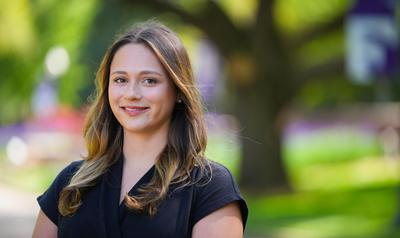
Olivia Longsworth ’25. Photo: Nathan Gray.
Olivia Longsworth ’25 worked in his lab every summer through college. The lab was a safe, collaborative space for her first research experience. And because most student researchers were undergraduates, there was no worry about PhD candidates or post-doctoral students doing the heavy lifting and leaving limited work for younger students.
“It was a really enjoyable way to connect to students that were older than me,” Longsworth said.
Shields encourages his students to work together and thinks there are fewer barriers to them asking each other questions than asking him. “I don’t consider myself to be real warm and fuzzy,” Shields said.
His students beg to differ.
“He is, in the best way, very hands-off,” Longsworth said. “He is there to guide you and to point you in the right direction. … But he is just excited to watch you shine. He wants to see you grow as an individual and a scientist.”
Shields regularly has four or five projects underway in his lab. Students conducting different research use the same techniques but don’t always know about each other’s projects. “Breaking down those barriers with some sort of social interaction is really important,” he said. Cue the annual Iron Chemist competition, featuring high-stakes contests of bowling and ping pong.
Chemistry majors are required to complete one cycle of research before graduation. “Most people enjoy it so much, they just stay on,” Harold said.
Longsworth came to Furman planning to major in chemistry, a class she’d loved in high school. But she didn’t have a clear picture of her future: research? medicine? private research and development?
“I was really lucky to have a lot of opportunities to flesh that out at Furman,” she said.
Shadowing experiences were a key to her decision to pursue medical school. That and watching her friend, Harold, blaze the trail.
“I was able to see what her life looked like as a [medical] student,” said Longsworth, who is now in her first year at USC School of Medicine Greenville.
“The content is hard and the volume is even harder,” she said. “Nothing can really prepare you, but I feel very confident.”
Her confidence rests in the fact that whatever the next challenge, she’s ready to meet it. “Furman has instilled in me the critical thinking skills and the reasoning skills,” she said.
Because of COVID restrictions, Harold couldn’t have in-person hospital experiences until her senior year. That led her to hold off on a medical school decision. “I didn’t want to commit to it before I had shadowed,” she said.
Shadowing made the decision; Harold knew for sure that med school would be her next step. But she was midway through a project with Shields and knew the process of applying would take the better part of a year. She decided to pursue a master’s degree while completing her research and working on applications.
Her time with Shields was deeply influential. The professor gives students the chance to choose and shape projects as well as author papers. “Things that are really unusual for an undergraduate level of research,” Harold said.
He also gave older students the opportunity to mentor younger students. “I could pass on what I learned to Olivia,” Harold said.
Longsworth said her favorite memories from Furman all come from summers in the Shields Group lab. “Looking back, that was a highlight of my experience,” she said. “Everyone’s there cheering you on. It is really one big family.”
Shields said both women were “superstars” in his lab.
“I’m really proud of all of them,” he said. “One of the secrets of being a great teacher is to really like your students.”
And he does.
“I’m just more quiet about it,” Shields said.
Harold worked in the lab with him until the week before she started medical school.
“I’m really happy with where everything ended up and Dr. Shields was a huge part of that,” Harold said.