News from campus and beyond
Search for Extraterrestrial Intelligence Institute publishes findings
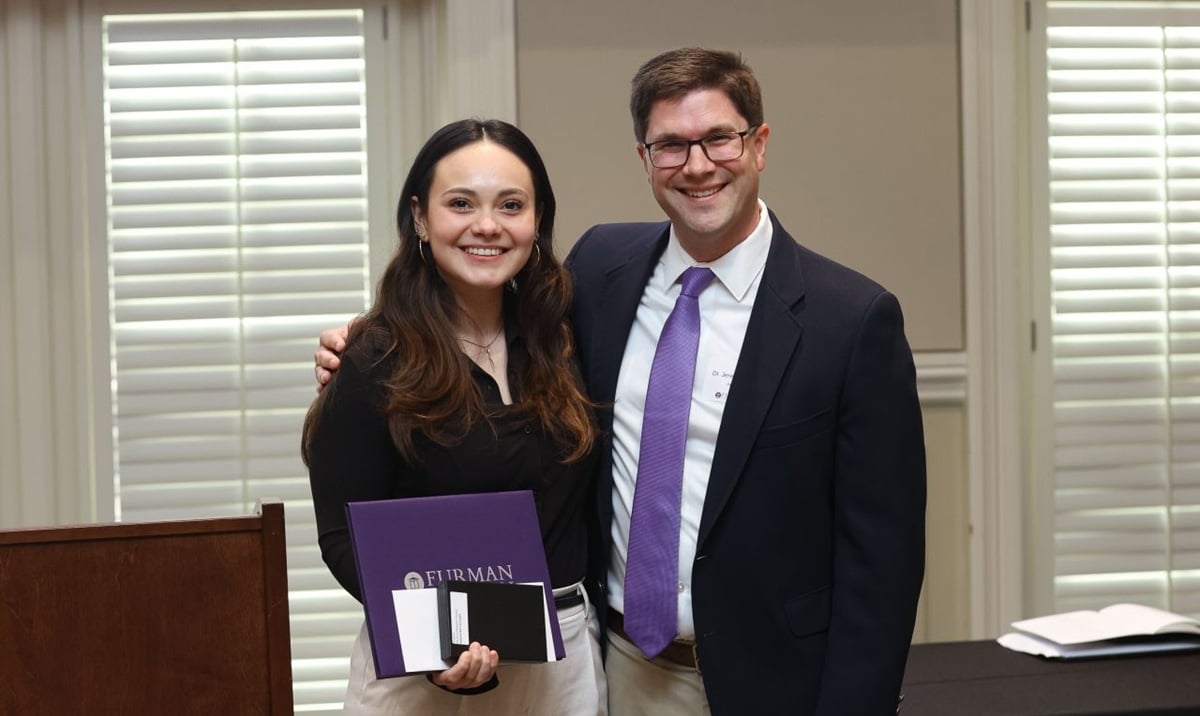
Valeria Garcia Lopez (left) accepts an award from Jeremy Gulley ’03, professor and chair of the Department of Physics.
Enthusiasts and professionals who scan the airwaves for signs of extraterrestrial existence likely had a disappointing day this week. The SETI (Search for Extraterrestrial Intelligence) Institute said Wednesday that extensive radio scans by its telescope in Northern California found no signs of otherworldly technology from comet 3I/ATLAS, which ventured into our solar system last year. In short, the comet is just that – an interstellar ice ball hurtling through space.
Furman University physics and applied mathematics alum Valeria Garcia Lopez ’26 was part of SETI Institute affiliate team at UC Berkeley that studied millions of narrow-band radio signals emanating from the comet. Their findings were published in The Astronomical Journal, and several news organizations picked up the story including AP, PBS, Phys.org and USA Today.
In a statement, co-author Garcia Lopez said, “The results from 3I/ATLAS show how realistic it is to detect a signal with the technology we have today. That is why it is important to keep searching for technosignatures, even from objects we might not expect to have signals.”
Garcia Lopez served an internship with UC Berkeley’s Breakthrough Listen program in the summer of 2025. This year, the graduating Furman senior presented her research at the Physics and Astronomy Congress (SPSCon) 2025 and the 247th American Astronomical Society Meeting. She received the Physics Research Award from Furman University’s Physics Department in spring this year.