News from campus and beyond
Furman Scientists Discuss Hurricane Helene’s Impact on Ecology
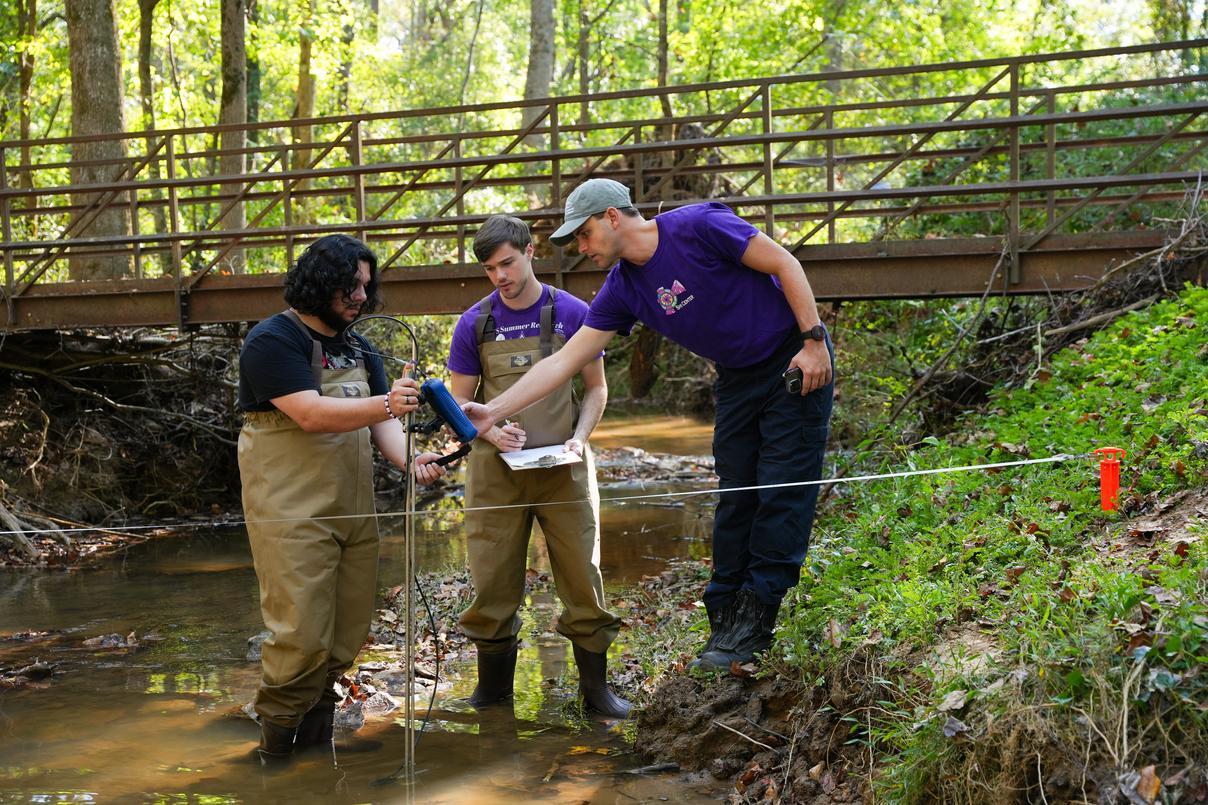
Gustavo Coelho, assistant professor of water resources, right, talks with hydrology class students Dayton Delaune ’26, left, and Houston Brooks ’25 at Little Creek on Furman’s campus to measure the effects of Hurricane Helene on Wednesday, Oct. 9, 2024.
Months after Hurricane Helene roared through the region, evidence of its ferocity can still be seen in Upstate South Carolina in the downed trees, snapped utility poles and tarp-covered roofs.
But what did the superstorm mean for the ecosystem?
Furman researchers say the catastrophic weather event provides an opportunity to learn more.
“Helene impacted the ecosystem without a doubt,” said John Quinn, the Townes Professor of Biology and Director of Environmental Studies. “But there are some unknowns about what the impact on local biodiversity would be.”
Forest management
For instance, he said, a number of landowners in the area lost up to 10 percent of their trees. But is that necessarily a negative?
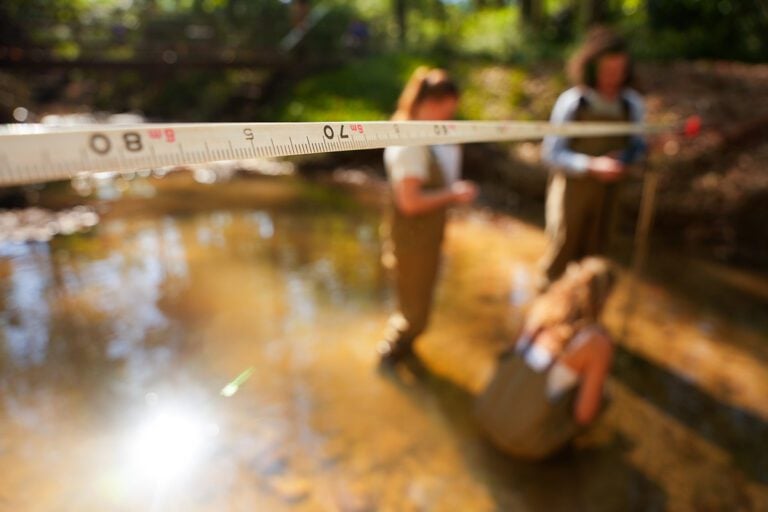
Hydrology class students measure water levels at Little Creek to document the effect of Hurricane Helene on Wednesday, Oct. 9, 2024. Photo by Nathan Gray, Furman University
“One could argue that it’s a good thing if it’s an overgrown, poorly-managed forest,” he said. “I was talking to a timber manager … about how when he takes out a 10-acre block of timber, birds respond positively. They need it to find the right nesting habitats.”
Downed trees also mean that more sunlight gets through to the forest floor, allowing new plants to grow, he said.
“(When that happens,) you’ll see something new within 6 months. In 5 years, you can’t recognize it,” he said. “What I don’t know … is if Helene had a negative impact on forest health across the state, did it negatively impact the bird populations I study in any meaningful way?”
Because he wasn’t collecting data before the hurricane, Quinn says it’s hard to gauge the impact.
“If we are going to understand the effects of these sorts of events on ecosystems,” he said, “we can’t just do responsive science after the fact.”
But his project to monitor bird communities in forest ecosystems in South Carolina can’t proceed without outside funding, which continues to be uncertain amidst federal budget cuts, he said.
“I would say broadly that if the frequency of those sorts of events increases, we’d need proactive forest and tree management to make sure ecosystems are resilient,” he said. “That takes time and investment.”
The impact of flooding on local plant species is also worthy of study, said Ashley Morris, professor of biology and curator of the Ives Herbarium.
The bunched arrowhead
One federally endangered species called the bunched arrowhead, for example, is only known to grow in Greenville County and Henderson County, North Carolina, she said.
The plant is thought to be easily dispersed by water to re-establish itself in a new location, she said, so scientists speculate that flooding has the potential to expand their territory.
“The problem of such movement might be that when flooding recedes, the landing spot … may not be appropriate for growth, and you could envision a situation where a colony is either largely disrupted or even lost to a flood event,” she said.
After the storm, Morris said Furman’s colony of bunched arrowhead was just where she expected it to be.
“I don’t know how long the site was inundated, but it was still wet in the surrounding area, and that was three weeks after Helene,” she said, adding that a contact in North Carolina found colonies there to be intact as well.
Morris said biologists want to understand how flooding affected the number of plants, their genetic makeup and flowering ability.
“It is quite possible that the species has persisted in these environments long enough to have adapted to intermittent, but significant, flooding such as that experienced with Helene,” she said. “We just won’t know until we follow up on the next few growing seasons.”
Rivers and trees
Gustavo Coelho, assistant professor of water resources in the Department of Earth, Environmental and Sustainability Sciences, researches flooding risks and is mapping Helene’s flooding to better forecast the timing and location of future deluges.
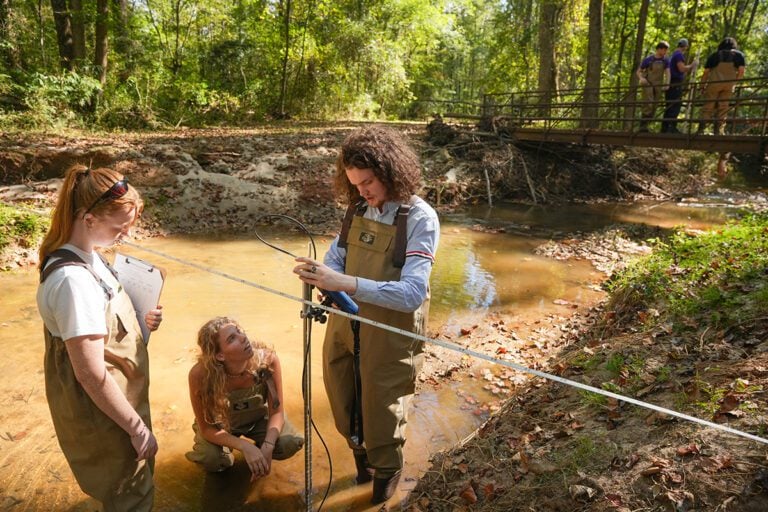
Hydrology class students, from left, Katie Balog ’26, Claire Perry ’26 and William King ’26, measure levels of Little Creek to document the effects of Hurricane Helene on Wednesday, Oct. 9, 2024. Photo by Nathan Gray, Furman University
“We saw the flooding where you’d expect to see it, but also … much wider,” he said. “Unity Park, for example, saw much more flooding than expected.”
One result, he said, was that the bridge at the park suffered structural damage because of the high waters.
Ecologically, he said, the floodwaters carried sediment from the banks of the Reedy River downstream, where it could impact water quality.
But one of Helene’s most significant impacts was on trees, he said, causing many to fall and leaving others compromised and in need of removal.
“We received a lot of rain – 8 inches of rain. And we had a lot of rain in the days before Helene … which resulted in the saturation of the soil, and made the trees much more vulnerable to falling during strong winds,” he said.
Meanwhile, Coelho said, the buffer zones along the river showed resilience and grasses should be back by summer.