News from campus and beyond
Furman’s Cothran Center hosts NetVUE conference, celebrates new publication

The walking labyrinth on Furman University’s campus is part of a “Campus Reflective Walk” promoted by the Cothran Center to encourage people to see the campus with fresh eyes.
Furman University’s Cothran Center is hosting a regional gathering of the Network for Vocation in Undergraduate Education (NetVUE) this weekend. Part of the conference will be the launch of a new book about vocational exploration featuring a chapter by Associate Professor Meghan Slining.
For the Cothran Center, the term “vocation” is broadly defined as a person’s purpose, calling or the sense of meaning they find in their lives.
“Those are things that apply to everyone, no matter their life context,” said John Harris, faculty director of the Cothran Center. “People of all ages and stations can benefit from intentional reflections on what is important and meaningful, and the Cothran Center programs offer opportunities for students, faculty, staff and alumni to do just that.”
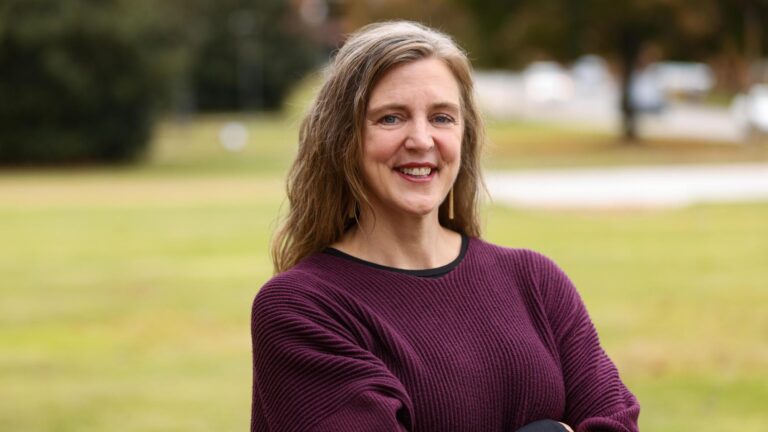
Meghan Slining, an associate professor of health sciences
The gathering at the Younts Conference Center features panel discussions, a plenary session, workshops and campus walking tours. Furman is among several hundred institutions that are part of NetVUE and has been a leader in vocational reflection, with the Cothran Center in operation since late-2000. Helping students reflect on their lives and potential career paths is a key component of The Furman Advantage, whether that’s through internships, research opportunities or study-away experiences.
At the center of the NetVUE gathering is a celebration of the network’s new volume, “Called Beyond Our Selves: Vocation and the Common Good.” As a professor of health sciences, Slining contributed an essay to the book that explores how to model compassionate pedagogy in the classroom.
“I chose a career in the liberal arts specifically because it would allow me to engage in vocational conversations with students, supporting them as they consider what provides meaning and purpose in their own lives,” Slining said.
Her chapter explores the sense of responsibility many people feel to their work when they find meaning in caring for the common good. That kind of intense personal investment, she writes, can lead to some of the highest rates of burnout among professions. As an epidemiologist who researched and wrote this chapter during the COVID-19 pandemic, Slining said she experienced the toll that feeling a responsibility to one’s profession can take. Cultivating deeper compassion is what helped her navigate it.
“I argue that educators have an important role in equipping, encouraging and preparing our students for sustainable vocational responsiveness,” she said. “Our communal responsibility as educators is to minimize burnout and engage in compassionate caring for students, colleagues and ourselves so that we may continue to nurture the common good.”