News from campus and beyond
Cothran Center’s Cherokee trip offers students insight into Indigenous culture

Among the stops on the Cothran Center’s trip to Cherokee, North Carolina, was the Qualla Arts and Crafts Mutual, the nation’s oldest Native American cooperative. Photo provided.
Native American history is still being written, and Furman University students traveled to Cherokee, North Carolina, to learn directly from people of the sovereign Cherokee Nation.
The trip, hosted by Furman’s Cothran Center, ran from Jan. 17-20. Students had the chance to visit museums and cultural centers and have in-depth discussions with Indigenous people. While learning about the historical unjust treatment of Indigenous people, students were also encouraged to reflect on how these lessons and experiences might inform their vocational choices, said Rolyn Rollins, the Cothran Center’s program coordinator for student initiatives.
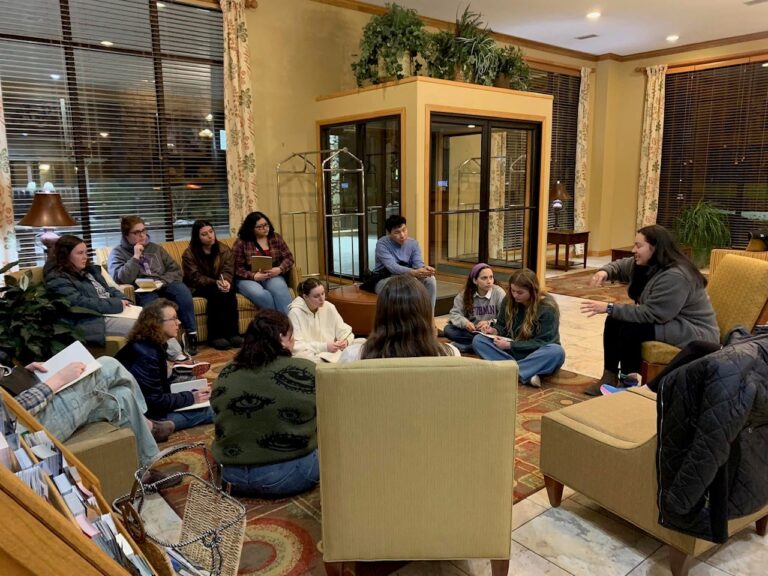
Students on the Cothran Center’s trip to Cherokee, North Carolina, had a fireside chat with Shelby Parker ’14, Furman’s first known Cherokee student. Photo provided.
“In a liberal arts education, we expose students to a variety of subjects so they learn new ways of thinking and problem-solving,” said Danielle Vinson, professor of politics and international affairs. Vinson and religion professor Helen Lee Turner joined Rollins and Whitney Brown, the program coordinator for alumni and community initiatives as leaders on the trip.
“Exposing them to Indigenous culture and history is another way to expand our perspectives,” Vinson said. “It has the potential to teach us things our own culture has lost sight of.”
Cherokee Tribal Courts Judge Barbara “Sunshine” Parker gave the group an example of how the Cherokee Nation shapes its justice system to meet community needs, like providing restorative justice programs for juveniles and people struggling with substance abuse.

The Cothran Center’s trip to Cherokee, North Carolina, featured a short hike at Oconaluftee Visitor Center before a discussion with Judge Barbara “Sunshine” Parker. Photo provided.
For sustainability science major Nabila Wilson ’27, this trip was a chance to expand on what she learned about Native American cultures in Turner’s “Religion in America” class.
“Because the Cherokee people are sovereign, they have a lot of power to shape their justice system,” Wilson said. “I’m really interested in policy, so this made me want to know more about the Cherokee justice system and how other tribes are using this freedom.”
During a fireside chat with Furman’s first known Cherokee student Shelby Parker ’14, Wilson said she was moved by Parker’s description of the ridicule and shame she felt at times over her heritage. But Wilson was also inspired hearing about Furman’s expansion of Native American programming and the land acknowledgement made in 2019 recognizing the campus’ placement on traditional land of the Cherokee People.
“We definitely have made some progress, which makes me even more excited for the potential change we can make in the future,” Wilson said.