All Blog Posts
Community Engaged Medicine Program Fosters Curiosity in Student
For as long as she can remember, Eva fostered a deep curiosity for the sciences. As a three-year-old, she would flip through her children’s anatomy book, captivated by the systems of the human body. She would eagerly share fun facts like “Did you know the cerebellum is the center of balance?” By fourteen, she was shadowing surgeons, thanks to her grandmother, who made connections during her knee replacement surgery. Even then, it was clear that Eva was destined for a future in healthcare. It was in her pursuit of this field that she enrolled in Furman University’s Master of Science in Community Engaged Medicine (MS-CEM) as a crucial step toward achieving her dream of practicing medicine.
The Master of Science in Community Engaged Medicine is a 12-month graduate program that puts students in the field to learn about health inequities firsthand. Students explore the combination of community health sciences and biomedical sciences. This experience-based learning, coupled with classroom education, provides a solid foundation for students to either enter health careers or pursue professional health education. Although the MS-CEM program is not primarily a pre-med program, it offers a recruitment program with the University of South Carolina School of Medicine Greenville, plus professional advising and Kaplan exam preparations, all included in tuition.
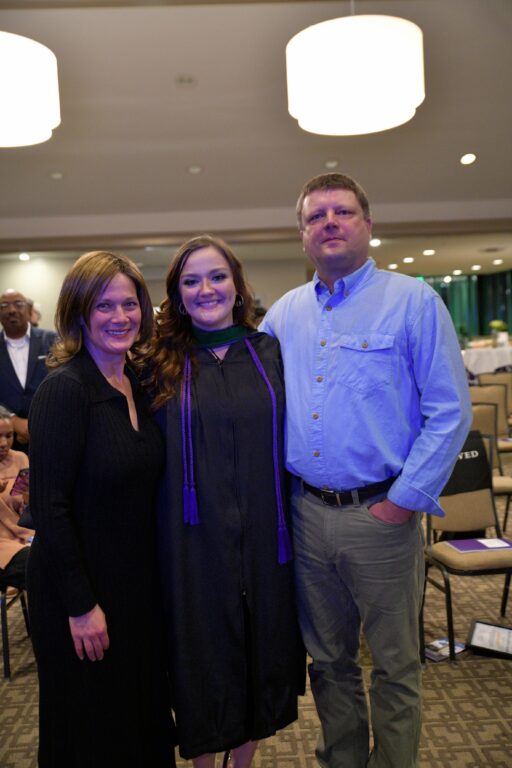 Eva started the MS-CEM program in January 2024 and graduated in December 2024. Starting in the spring semester provided several benefits for Eva. She explained, “Completing a master’s degree in one calendar year was a really rewarding feeling!” She was also able to take her MCAT exam during summer break in May, which aligned well with her course schedule since recently learned content that was needed for the exam was fresh on her mind. Additionally, her exam prep helped familiarize her with concepts that would be covered in future classes, helping her to feel more prepared for upcoming classwork.
The MS-CEM program’s emphasis on community sets it apart from other programs. Furman’s personalized academic experience, focus on serving people beyond studying anatomy, and small class sizes made it the perfect fit. “Our cohort was so close-knit,” Eva explained, which was a welcome change from her impersonal undergraduate academic experience. During their MS-CEM class seminars, the cohort would often joke that they were having a “book club” session rather than a lecture because the discussions were so engaging. Even after graduating, Eva remains involved with Furman’s MS-CEM community by providing tutoring services for students in the program.
Eva was drawn to MS-CEM’s unique structure and emphasis upon community engagement, not just in name but in practice. As part of the curriculum, students are placed in different organizations that are working to address health inequities across the community to gain experience and apply their classroom learning. Eva worked at 864 Pride and the Queer Wellness Center, where she wrote grants, assisted and expanded her knowledge of health needs and disparities. “A lot of science master’s programs focus solely on the body and structures, but this program really emphasized the human aspect and community engagement, which felt more aligned with my goals in medicine,” Eva explained.
Since completing her master’s degree, she took some time to relocate to Greenville, find a job and build up her support system. She was accepted as a regular decision applicant to medical school and is currently in her second month at the University of South Carolina School of Medicine Greenville. She credits this accomplishment in part to the values instilled by MS-CEM. “I’m so incredibly grateful to my professors at Furman, both for their support and for preparing me so well for medical school,” she said.
The program taught her how to approach medical care differently, reframing her understanding of professional health and providing her with textbook knowledge in addition to the realities of medical school, like developing critical time management skills. “A lot of the coursework overlaps with what you’ll encounter in medical school, as well as areas covered on the MCAT,” she explained. MS-CEM provides not just the education but the skills that students need to go beyond just absorbing knowledge. For Eva, the MS-CEM program at Furman was more than an academic pursuit—it was a life-changing experience that shaped her path to medical school and beyond. With a deeper understanding of both the biological and human aspects of health, she feels more prepared than ever to enter the medical field and make a difference in her community.
If you’re looking for a multidisciplinary approach to health careers, Furman’s Master of Science in Community Engaged Medicine is your gateway to success. Like Eva, you might find that it’s the perfect fit for your future as a health professional. Learn more at https://www.furman.edu/graduate-studies/community-engaged-medicine/.