
BY CLAIRE WHITLINGER, Ph.D. & JILLIAN HALL
Sociology
_

_
Several years ago, I (Claire) attended a reception at the Cherrydale Alumni House, a farmhouse turned stately plantation residence of former university president James C. Furman, now perched on Furman University’s highest hill. It had been nearly twenty years since the structure was moved five miles north on Poinsett Highway to this picturesque resting spot,[1] now the site of frequent university-sponsored gatherings. Recalling this reception, my memory is limited. I cannot recall the reason for the event or the names of those who attended, but one fragment remains clear: As onlookers admired the striking view of campus from the building’s porch, a longtime faculty member told one version of Furman’s campus origin story. It was at this spot, he recounted, that university leaders, surveying farmland nestled beneath Paris Mountain, decided to procure this land for Furman’s future campus and its next chapter: building a “greater Furman.”[2]
Although primary records do not yet confirm this account,[3] the story’s retelling remains significant as part of the university’s collective memory. Whether conveyed through oral traditions or inscribed in bronze plaques, an institution’s collective memory represents a particular narrative of its past – a narrative that is ripe for revisiting. With this in mind, we (Claire and Jillian ‘25) sought to understand whether and how the university had commemorated its campus relocation.
Nearly all official histories of the campus relocation suggest that, in 1947, Furman was at a crossroads. Since the 1930s when Furman subsumed the nearby Greenville Women’s College, the university maintained two campuses, straining institutional resources.[4] By the end of World War II, the arrangement had become untenable. Enrollments surged as returning soldiers pursued higher education in greater numbers, causing overcrowding on the men’s campus. Additionally, as Alfred Reid notes in his 1976 history of the university, “poor facilities, and restrictive codes…made student life difficult for worldly-wise veterans” as did the recently established Bob Jones University whose new campus made Furman look antiquated.[5] In the ever-competitive field of higher education, it appeared that Furman was falling behind.
Faced with an overcrowded campus and antiquated facilities, it would seem that the decision to move the campus was inevitable. Whether the university could have achieved its goals for expansion at its downtown location, however, was a matter of debate. However, archival records reveal that the Olmstead Brothers, landscape architects hired by the Board of Trustees to evaluate possible sites for a new campus, questioned the need to relocate.

The outside firm’s appraisal concluded that “[a] revision of existing roads and paths, the development of new parking facilities and some additional recreational units, together with new buildings, would, I believe, meet your requirements for many years, and at a considerably less cost than if an entirely new site were to be developed.” Furthermore, after conceding they had not been hired to assess possibilities for retaining the downtown campus, the landscape architects argued that “the possibilities should not be lightly dismissed.” [6]
The Board of Trustees remained unconvinced. After considering multiple locations in Greenville County, Board members voted to pursue the Poinsett Highway option in a special meeting at the Poinsett Hotel on August 22nd, 1950, a decision President John Plyer described as “the most momentous and forward-looking decision since the founding of the school.”[7]
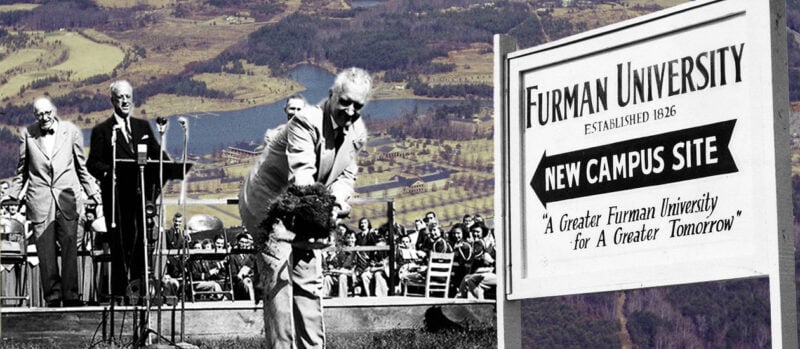
On a mild autumn day three years after the consequential vote, university leaders hosted a symbolic groundbreaking where some depicted the new campus as “destiny”. Following a serenade from the Furman Singers, 86-year-old Alester G. Furman, Sr. reportedly boasted an “expression of joy” as he dug out the first shovel of dirt, later describing the ceremonial excavation as the greatest moment of his life.[8] Indeed, those gathered that day had lofty intentions, viewing the institution’s expansion in light of its relationship to the Southern Baptist denomination and Christian stewardship more broadly. As one observer of the groundbreaking noted:
A Christian denomination, mindful of its stewardship of the Gospel, is aware of its significant role in the making of history in the days ahead. The building of a new Furman for the new day represents a responsible and forward-looking people preparing to play their role. Thus they, and the community which so cordially supports them, will not only meet their “appointment with destiny,” and see how history is made. They will help make it. Aye, they are determined to be ready to make history His story.”[9]
“Today, glimmers of Furman’s past are inscribed in monuments and historic markers around the old and new campus sites. At least thirteen historic markers reference the campus move with the most recent having been erected in 2018. Efforts to revise the memory of the campus move have been an ongoing project.”
_
After years of meticulous planning[10] and substantial fundraising efforts,[11] the new campus officially opened in 1958.[12] Yet, amidst the excitement and anticipation, one student reporter noted, “These pioneering first students…knew they were abandoning old traditions – the tug of war across the Reedy River between freshman and sophomores, snake dances down Main Street following football victories, proposals of marriage at the top of the Bell Tower.”[13] The traditions that connected past, present, and future Furman students had to be made anew.[14]
Today, glimmers of Furman’s past are inscribed in monuments and historic markers around the old and new campus sites. At least thirteen historic markers reference the campus move with the most recent having been erected in 2018.[15] Efforts to revise the memory of the campus move have been an ongoing project.
Attempts to commemorate the downtown campus were immediate and intentional, growing alongside the construction of the university’s new suburban campus. The “Old College,” constructed in 1851 as a temporary classroom on the men’s campus, was moved to the Poinsett Highway campus in 1958, representing an architectural relic of Furman University’s hundred-year history in downtown Greenville. Similarly, in 1961, the “Shack”,[16] a snack bar and gathering place built in 1937 for students at the Greenville Women’s College, was similarly relocated near the lake and continues to be a point of pride for GWC alumni.[17] Most notably, in 1965, a replica of the downtown campus’ iconic bell tower was reconstructed, as its bronze plaque informs, “to bring back memories of the beginnings of Furman University in Greenville.”[18]
Efforts to memorialize the previous campuses were also underway shortly after the construction began, and in 1975, two South Carolina State markers were erected downtown. Each plaque provides a straightforward account including the date of each institution’s founding, their previous locations (in the case of the men’s college), and their move to a new campus “six miles north of town.” It would take nearly forty years—and a notable anniversary—for the local memorial landscape to expand its narrative beyond these basic geographic notations.
Fifty years after the groundbreaking, in 2008, Furman commemorated that historic event with a “Golden Anniversary” campaign, featured in the Furman Magazine’s 2003 summer issue and the center of a fundraising campaign, resulting in a new fiftieth-anniversary memorial plaza, now adjacent to the Susan Shi memorial garden. With two F-shaped benches and a stone water fountain from the old campus on one side, the brick floor that denotes the plaza spans across the walkway to two stone columns bearing the Furman University and GWC seals. Surrounded by Ginko trees (the same species that lined “Old Main”), the plaza displays thoughtful commemoration of Furman’s past in downtown Greenville.

As the Furman administration worked to bring iconic symbols of the past to the new campus in the plaza, they were similarly motivated to represent their history in downtown Greenville. As with most major anniversaries, the fiftieth anniversary of the new campus provided a moment of reflection. The new campus had met the expectations of its visionaries, allowing for indefinite expansion and providing generations of students with an idyllic setting in which to pursue their studies.[19] But the transition had come with costs as well.
Once deeply enmeshed, “town” and “gown” had grown distant.[20] To rekindle Furman’s reputation as “Greenville’s university,” the university collaborated with the city of Greenville in constructing a second fiftieth-anniversary memorial in the newly restored Falls Park.[21] Situated at the base of the hill where Furman University once stood (now occupied by the South Carolina Governor’s School for the Arts and Humanities), the stone wall features the historic seals of Furman University and the Greenville Women’s College alongside a historic marker that provides a more thorough retelling of Furman’s hundred-year history in the heart of Greenville. The narrative with a brief mention of the campus relocation and the fate of the university’s former dwelling: “In 1958, the university moved to a new campus in the shadows of Paris Mountain, five miles north of town, its former tree-shaded grounds and buildings were razed, and Bell Tower shopping center, now County Square, took their place.”
“Few Furman students are familiar with their campus’ origin story or the vibrant history that preceded it.”
_
Despite this robust memorial landscape, few Furman students are familiar with their campus’ origin story or the vibrant history that preceded it. This disjuncture is perhaps not surprising. Few passersby stop to review historic markers, let alone busy students, and as of yet, the history of Furman is not a required part of the curriculum. But we suspect this disconnection may be connected to a deeper truth. Collective memory (like individual memory) is selective, reflecting what the present deems worthy of remembrance.
Moreover, this analysis reveals that the collective memory of the campus move overstates its inevitability and overlooks the impact of the university’s departure from downtown. In this context, we can understand the Placing Furman Project as the continuation and expansion of an ever-evolving story about Furman’s past, and that past’s relevance to the present.
_
ENDNOTES
_
[1] Furman University Archives and Special Collections, The Furman Paladin, “Dedications Highlight Homecoming”, October 22, 1999, Vol. 88, No. 7, p. 2.
[2] Furman University Archives and Special Collections, The Furman Magazine,” President’s Column”, September-October, 1953, Vol. II, No.6, p.2.
[3] We were unable to confirm this recollection with primary sources. However, on the “golden anniversary” of the new campus groundbreaking in 2003, Joe M. King wrote: “As it turned out, farm property in the shadow of Paris Mountain north of the city became the site most favored by the committee charged with choosing the new location. It has been said that the decision was finalized when the committee stood on the hill on the south end of campus, where the Cherrydale Alumni House stands today, and marveled at the magnificent view.” (Our emphasis; University, Furman (2003). “Furman Magazine. Volume 46, Issue 2- Full Issue,” Furman Magazine: Vol. 46: Iss. 2, Article 1).
[4] In 1826, Richard Furman founded Furman University in Edgefield, South Carolina, with the support of South Carolina and Georgia Baptists. For practical and financial reasons, Furman moved to Santee, then Winnsboro, before settling in Greenville, where the institution found bountiful opportunities for success and expansion in the 1940s. In 1854, Vardry McBee transferred ownership of 30 acres of his land along the Reedy River to the South Carolina Baptist Convention, upon which the Greenville Baptist Female College was founded (precursor to Greenville Women’s College). Operating together under the South Carolina Baptist Convention and being so close geographically, the GWC and Furman grew to have a close relationship over the next decades. In the early 1900s, the GWC was struggling to meet the requirements for accreditation. Despite valiant efforts of the administration, it became clear to the Southern Baptists that to salvage the GWC, it should be subsumed under Furman University. In January of 1938, the Greenville Women’s College ceased to exist after their debts were paid in full and the transfer of property to Furman was complete. Furman became a co-educational institution and went on to educate students on two downtown campuses until the move to Poinsett Highway in 1958. (Tollison, Courtney. Proceedings and Papers of the Greenville Country Historical Society 2006-2014, 2015, “New Home for Furman University”, Volume XIII, pp. 84-99.)
[5] Reid, Alfred. “Furman University Toward a New Identity 1925-1975,” Duke University Press, 1976, P. 129 and pp. 133-134.
[6] Furman University Special Collections and Archives. Trustees Meeting Minutes. Letter from the Olmstead Brothers to the Trustees. July, 27, 1950. From Trustees Meeting Minutes August 22, 1950, Exhibit A: Statement of President John L. Plyler Concerning the Consideration of a New Site for Furman University, pp. 3-7.
[7] Furman University Archives and Special Collections, Dr. John L. Plyler Presidential Papers 1927-1964, Letter to Fellow Alumni and Other Friends of Furman, Box 19, Folder 5.
[8] Furman University Archives and Special Collections, Furmaniana Reference Files,”A Date, Dirt and Destiny.” by E.F. Haight, 12 October 1953, Box Campus-New, Folder History.
[9] Furman University Archives and Special Collections, Furmaniana Reference Files,” A Date, Dirt and Destiny.” by E.F. Haight, 12 October 1953, Box Campus-New, Folder History.
[10] Much of the inspiration for the design of the new campus was taken from John L. Plyler and Beatrice Plyler’s trip to Europe in 1949. John Plyler Jr. recalls his mother suggesting to his father that Furman ought to have fountains like the ones in Versailles, and gardens like those in England (Furman University Archives and Special Collections, Oral Histories, “John Plyler Jr. Oral History”, 2004, Oral History 32. https://scholarexchange.furman.edu/oral-histories/32.) Beatrice Plyler had an often overlooked but significant impact on the details and design of buildings on campus. (Furman University Special Collections and Archives. The Furman Magazine. “Golden Anniversary”. June 1, 2003. Volume 46, Issue 2, Article 1).
[11] To pay for the construction of the new campus, Furman launched the Greater Furman Fund. By 1954, with the support of the Baptist State Convention of South Carolina, the Rockefeller Foundation’s General Education Board, and other pledges, they had subscribed nearly half their total goal of $10,275,000. While Furman expected substantial gifts from Funds, Foundations, Trusts, corporations, and “certain sympathetic and philanthropic individuals of large means”, they appealed also to individuals and business firms of Greenville, alumni, and other friends of Furman to achieve a healthy balance of funding sources. Furman University Archives and Special Collections, Office of the Vice President For Development, “Furman Faces the Future,” Box Campaigns, Folder Materials for Volunteers.
[12] The University housed its first students, 108 freshman men, in the fall of 1955. Only Manly Hall was complete at this stage, and construction was finished on the first classroom building as students arrived for the fall semester. (Furman University Archives and Special Collections, The Furman University Magazine, “New Campus Opens”, August 1955.) The University maintained three campuses– Furman’s downtown campus, the Greenville Women’s College campus, and the new campus on Poinsett Highway for three years before, in 1958, all men and senior women moved to the new campus to begin the new era of Furman University. Finally, once the women’s dorms were complete in 1961, all students united on the new campus under one body, Furman University. (Furman University Archives and Special Collections, The Furman Paladin, “United Campus Begins New Era”, September 15, 1961, Vol. XLVII, No. 1.)
[13] (Bainbridge, Judith T. (2008) “A Greater Furman,” Furman Magazine: Vol. 52: Iss. 1, Article 4. Available at: https://scholarexchange.furman.edu/furman-magazine/vol52/iss1/4)
[14] While students said their bittersweet goodbyes to the campus that stood for nearly 100 years, educating students in the heart of Greenville, they looked to the future with an inspiring sense of opportunity. Marshall Frady, former columnist of The Hornet wrote, “Whatever is done now will forecast the future. The only sure thing is that there is going to be transformation, and it is now, while the principals of transformation are operating probably at their strongest and most dynamic pitch, that the transformation can be most easily and effectively directed. The theme struck now will be caught and carried for years to come.” (Furman University Archives and Special Collections. The Furman Hornet. “Now is Time for Forging FU’s Future”. September 17, 1960. Vol. 46. No.1, p. 2). Marshall Frady, a Furman graduate from the class of 1963, was a passionate writer of the student newspaper. He was not known for mincing words; even in his early days as a writer before and at Furman, he reported on controversial topics with a frankness that simultaneously stunned and inspired his readers. Once graduated from Furman, Frady had a successful journalistic career marked by winning an Emmy for his work as a television journalist on a documentary about mercenaries, Soldiers of the Twilight, in 1982. He published his first and most popular book 1968; Wallace, a biography of segregationist governor of Alabama, made waves in the 1968 presidential election where Wallace ran as an independent candidate. The book had gushing reviews and was later adapted into a television miniseries. Frady published four more books in his career, including biographies of evangelist Billy Graham, Jesse Jackson, and Martain Luther King Jr. Later in life, Frady returned to Furman University to join the faculty, but was unable to begin teaching before his death in 2004. (Wikipedia contributors. “Marshall Frady”, Wikipedia, The Free Encyclopedia, May, 13 2024. https://en.wikipedia.org/w/index.php?title=Marshall_Frady&oldid=1223592736). (Bruss, Kelly. “Master of the Skewer.” April 29, 2022. The Furman Magazine. https://www.furman.edu/furman-magazine/2022-spring/stories/master-of-the-skewer/)
[15] To be considered relevant to the collective memory of the campus move, these markers must explicitly mention the move to Poinsett Highway or the “old campus” (referring to that in downtown Greenville).
[16] Although “The Shack” was no longer a snack bar, in 1970, the University began using the building to house female students to alleviate overcrowding of dorms by students returning from abroad. “In 1987, increasingly distant from its history at the GWC, men started living in rough structure instead of women, and the structure began its slow descent into disrepair as the least energy efficient of Furman’s ’eco-cabins’ by the lake.” (Inabinet, Brandon. “The Shack”. PocketSights Tour Builder. https://pocketsights.com/tours/place/The-Shack-22305:2695)
It’s not clear when disrepair became too severe for students to reside in the old building, but, in 2024, it sits empty next to the lake, waiting to be rescued or demolished. It is the only remaining structure from the former Greenville Woman’s College. Its history was discovered only recently, in 2005, by an undergraduate student conducting research for a paper. Jennifer Ward (’07) dug into the history of the shack, and what she found compelled the university to erect a plaque commemorating the building’s construction, original use, its move to the new campus, it’s more recent use, and the fact that it is the last building standing from the Greenville Women’s College. (Furman University Archives and Special Collections. The Furman Magazine, “A plaque for the Shack”. June 1, 2006. Volume 48, Issue 4, Article 26).
[17] Also in 1961, two plaques from the downtown GWC campus residence halls were moved to the new campus. The first, a plaque dedicated to Alexander Sloan Townes, the president of GWC from 1878-1894, for securing the funds necessary to build the original dormitory building, was moved to the lake-facing side of Clark Murphy (the original women’s dormitory on the new campus) and affixed to the doorway leading to Townes Hall. The second, dedicated to David Marshall Ramsay, recognizes and appreciates his dedication to his roles as a trustee, chairman of the board, and President of the GWC. This plaque was also moved to the lake-facing side of Clark Murphy and affixed to the entryway to Ramsay Hall. Additional plaques explaining the origin of the Townes and Ramsay plaques were also erected.
[18] In honor of their father, the children of Alester Garden Furman spearheaded the construction of the bell tower replica.
[19] (Furman University Special Collections and Archives. Trustees Meeting Minutes. “Advantages and Disadvantages of Moving.” From Trustees Meeting Minutes August 22, 1950, Exhibit A: Statement of President John L. Plyler Concerning the Consideration of a New Site for Furman University, pp. 7-8.)
[20] ” Town and gown are two distinct communities of a university town; ‘town’ being the non-academic population and ‘gown’ metonymically being the university community” (Wikipedia contributors. “Town and Gown”, Wikipedia, The Free Encyclopedia, June, 13 2024. https://en.wikipedia.org/wiki/Town_and_gown)
[21] Interview with Jeff Redderson, Associate VP of Facilities and Campus Services and Project Manager, Steve Long, June 21, 2024.
Design of New Campus both Modern and Traditional

