

BY KANIQUA ROBINSON, Ph.D.
Anthropology
_

_
This essay explores the early history of Graceland Cemetery in Greenville, South Carolina. It specifically documents the era in which a racially restrictive covenant was included in the cemetery’s deed. This essay posits that the racially restrictive covenant was a standard part of the deed, despite ownership changes, until the Supreme Court ruled it unconstitutional.

Greenville Cemetery Association
_
In August 1913, J. Melvin Clark, J.H. Wiggins, W.E. Beckham, J. Hudson Williams, and W.C. Cleveland established the Greenville Cemetery Association. (J. Melvin Clark served as president and treasurer.) The association was created to “conduct a cemetery near the City of Greenville, in Greenville County” (Greenville County, SC Deed Book 1: 158).
The land for this new cemetery was deeded to the Greenville Cemetery Association by W.C. Cleveland and J. Hudson Williams (45 acres) as well as W.E. Batson (3 acres). Cleveland & Williams deeded acres that were about two and a half miles southwest of the City of Greenville and near Brandon Mills.
The property began on the east side of White Horse Road, crossed Pendleton Road, and touched the Southern Railroad (Greenville County, SC Deed Book 16: 349). W.E. Baston deeded property that was also two and a half miles southwest of the City of Greenville, near Fallis Station (Greenville County, SC Deed Book 20: 139).
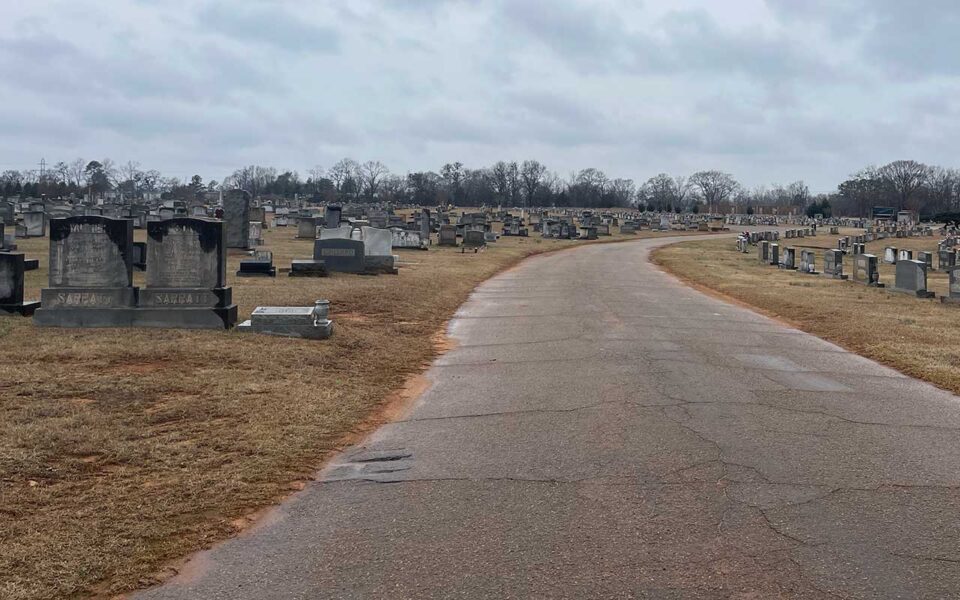
The cemetery also bordered Freetown,[1] one of the first Black communities in Greenville in which Black people could purchase land and own their homes.


The Greenville Cemetery Association did not immediately have a name for this cemetery, so they held a contest, which they announced in The Greenville News (The Greenville News, October 7, 1913). The article states: “Fifty dollars in gold will be given by the Greenville Cemetery Association to the person living in Greenville, or within a radius of 15 miles of the city who suggests the best name for the cemetery” (The Greenville News, October 7, 1913).
Lots were to be sold once the contest ended. Citizens entered the competition by filling out a coupon in the Greenville News newspaper and submitting it to Greenville Cemetery Association. On October 24, 1913, the judges of the competition chose “Graceland,” which was proposed by Mrs. J. R. Lawrence and Mr. A. C. Hunt, as the new name for “Greenville’s New Cemetery” (Greenville News, October 24, 1913).
The Greenville Cemetery Association began selling lots for Graceland Cemetery lots on Monday, October 27, 1913 (Greenville News, October 26, 1913).
Following the contest, Graceland Cemetery was consistently advertised in The Greenville News. The Association emphasized its uniqueness to Greenville: “First cemetery of its kind in the State where lots are cared for without cost to lot-holders” (The Greenville News, Sept. 13, 1914).
One of the primary attributes of Graceland was its provision for perpetual care, which refers to the cemetery’s permanent management of and care for burial plots and land. To manage this care, the Greenville Cemetery Association created an endowment fund to ensure continual maintenance of the property.


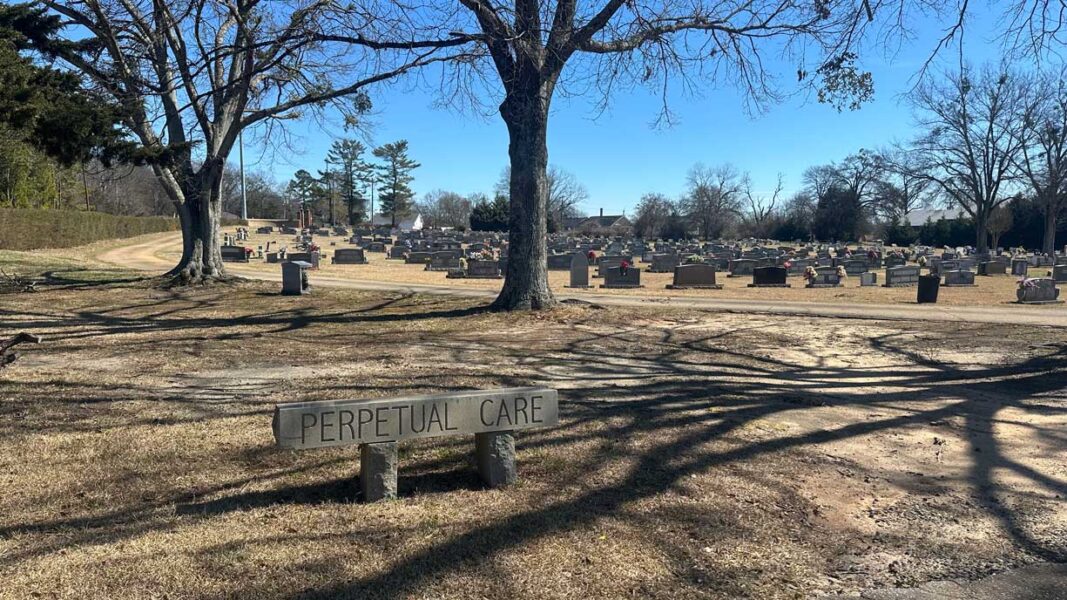
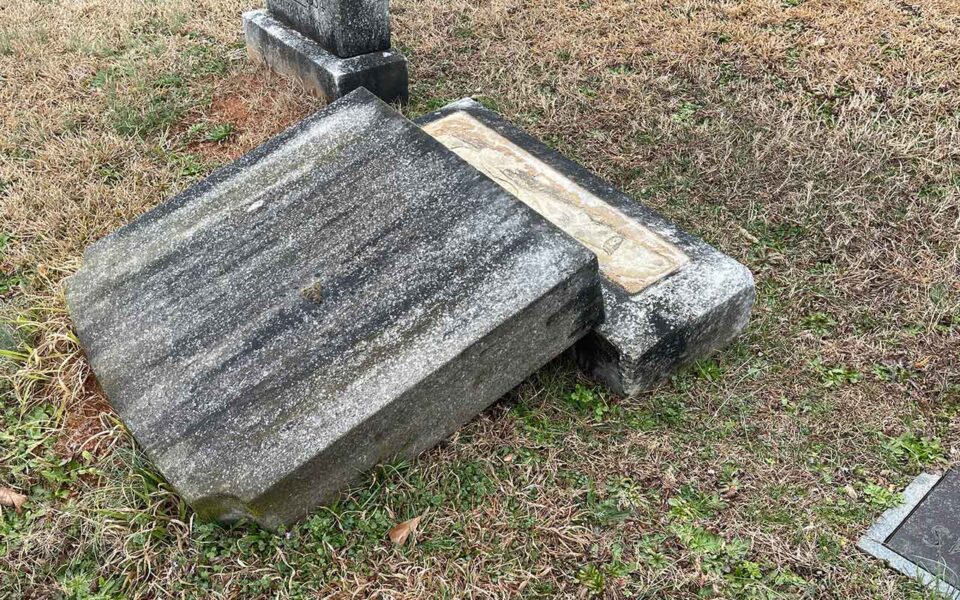
There were eighteen rules and regulations for Graceland Cemetery that were listed on deeds. For example, no double burials were allowed unless granted special permission; dogs were not permitted in the cemetery; no disinterment allowed without the Superintendent’s permission; and fast driving was not allowed or horses left unfastened.
However, the most notable rule reflected the racially segregationist practices of the time: “No person of African descent shall become the owner or be buried in any lot in this cemetery” (see Greenville County, SC Deed Book 29: 210).
This racially restrictive covenant (RRC) emphasized the “separate but equal” doctrine established by Plessy v. Ferguson in 1897 and stemmed from the belief that Black people were inferior and inhumane, even in death.
Further, this covenant meant that Freetown citizens could not intern their deceased at Graceland Cemetery.[2] This clause would remain in the cemetery deed even as the ownership changed.
In 1917, Alester G. Furman began to show up on deeds to Graceland Cemetery as president of Greenville Cemetery Association (see Greenville County, SC Deed Book 29: 324; The Greenville News, September 3, 1919). However, J. Melvin Clark also appeared on many deeds as president (i.e. Greenville County, SC Deed Book 29: 325).
This transition would become concretized after a re-organization of the Association in 1918. On March 26, 1918, stockholders of the Greenville Cemetery Association met and 16 of the city’s leading businessmen were elected as directors. Alester G. Furman, Sr. served as president and treasurer (The Greenville News, September 3, 1919). Some of the directors were on the old board, but there were new names (The Greenville News, March 27, 1918).
The directors included: Alester G. Furman, Alester G. Furman, Jr., Henry T. Mills, W. C. Beacham, H.J. Haynsworth, B.E. Geer, Allen J. Graham, and J.I. Westervelt. These specific businessmen were also directors of The Morris Plan Bank,[3] with Alester G. Furman, Sr. as president, W.C. Beacham as vice-president, and Alester G. Furman, Jr., as cashier of the bank.
Graceland Cemetery, Inc.
_
The Greenville Cemetery Association managed Graceland Cemetery until it was dissolved in 1939. Stockholders of the Greenville Cemetery Association met on June 27, 1939 to discuss the liquidation of the corporation, closing its affairs, and selling the property.
In the legal notice in The Greenville News, the Association stated that the dissolution would not interrupt the continuity of Graceland Cemetery, or any service being provided (The Greenville News, May 27, 1939). In addition, any rules and regulations would remain in effect, including the racially restrictive covenant that prohibited the burial of people with African descent.
At the meeting, all the stockholders and directors of the Greenville Cemetery Association unanimously adopted the directive to dissolve[4] and liquidate the association, including the selling of its property and any assets (Greenville County, SC Deed Book 218: 138).
In July 1939, Alester G. Furman, Sr. and H.O. Gaddy met with subscribers of the capital stock in Graceland Cemetery, Inc. to discuss the purpose of the organization, which was to be filed with the Secretary of State for a charter[5] (The Greenville News, July 02, 1939), which was official on October 7, 1939.
On paper, Alester G. Furman, Sr. served as president; Alester G. Furman, Jr. as vice-president; Alester G. Furman, Sr as treasurer; Alester G. Furman, Jr. as assistant treasurer; Lulee Culbertson as secretary; and H. O. Gaddy as assistant secretary.
However, according to the Furman Company’s own historical account, Alester G. Furman, Jr. took over the family’s commercial operations in 1932.
In December 1939, all property and assets of Greenville Cemetery Association were transferred and assigned to Graceland Cemetery. Inc.
_
Graceland Cemetery Development Corporation
_
Less than ten years after receiving the charter, Graceland Cemetery and its ownership underwent several changes. By the end of February 1948, the racially restrictive covenant was removed from the rules and regulations of the cemetery (Greenville County, SC Deed Book 339: 333; also see Greenville County, SC Deed Book 336: 349-350).
The move was prior to the landmark Shelley v. Kraemer decision (May 1948), which argued that racially restrictive covenants violated the Equal Protection Clause of the Fourteenth Amendment.[6] In addition, a change in leadership coincided with the removal of the covenant. Alester G. Furman, III was listed as president of Graceland Cemetery, Inc. on cemetery deeds starting on February 24, 1948 (Greenville County, SC Deed Book 339: 333-334).
Later in 1948, there was a meeting held on September 30, 1948 to discuss the creation of the Graceland Cemetery Development Corporation (The Greenville News, September 26, 1948). The subscribers to the Graceland Cemetery Development Corporation capital stock elected the following directors: Byron E. Reeves, Alester G. Furman, III, and Paul Kernstein.
The officers of Graceland Cemetery Development Corporation were: Byron E. Reeves as president; Pauline B. Reeves as vice-president; Alester G. Furman, III as secretary; Byron E. Reeves as treasurer; and Pauline B. Reeves as assistant treasurer. The Graceland Cemetery Development Corporation received its charter by the S.C. Secretary of State on October 13, 1948 (Greenville County, SC Deed Book 362: 122).
In December 1948, Greenville Cemetery, Inc. was dissolved and its charter cancelled (Greenville County, SC Deed Book 214: 52). The directors and stockholders of the company agreed to liquidate the corporation and cancel its stock.
Byron E. Reeves received all property owned by Graceland Cemetery, Inc., “including any and all easements, rights-of-way or interests of any kind in real estate, together with all buildings, tools, office equipment, supplies, contracts, accounts receivable and all other personal property, whatsoever” (Greenville County, SC Deed Book 367: 121; see Greenville County, SC Deed Book 11: 250).
The dissolution of the Graceland Cemetery, Inc. and the transition to Graceland Cemetery Development Corporation signaled the end of an era. Once the US Supreme Court ruled racially restrictive covenants unconstitutional, and the striking down of “separate but equal,” it marked the push toward integrative cemetery practices.
Although the exact date is not clear regarding when African Americans, such as those in Freetown, it is evident that the cemetery was engaging groups of color after racially restrictive covenants became unenforceable (Shelley v. Kramer 1948).
Josephine White, an African American resident of Freetown, sold land to Graceland Cemetery Development Company on September 2, 1954. The property was willed to her by her husband Peter H. White, who, during the 1930s and 1940s, was one of the two individuals (with Ansel Arnold) that owned large parts of Freetown.
Josephine sold half an acre of land that extends from the west side of Alice Avenue (Greenville County, SC Deed Book 507: 228), which was the corner of her property in Freetown. Although Josephine White sold this land, it does not mean that Freetown residents immediately began burying in Graceland Cemetery.
These residents likely continued to bury their deceased relatives in church cemeteries or burial grounds where their families have been traditionally buried. This speaks to the lasting impact of segregated cemeteries.

What’s Next?
_
As characteristic of cemetery practices prior to the end of Jim Crow, Graceland Cemetery enforced a clause that excluded anyone of African descent from being an owner of a plot or buried in the cemetery.
African Americans in Greenville, before and during the implementation of RRC, created their own memorial practices and burial spaces that affirmed and honored the African American tradition and experience.
More research should focus on the burial practices of African Americans in Greenville, including the maintenance of the burial grounds. This is of particular interest as many Black cemeteries, both in Greenville, specifically, and the US, broadly, are not under perpetual care, a financial investment that is often not provided for Black cemeteries.[7]
Further, we should work to preserve the history of nearby Freetown and understand how the location and restrictions of Graceland Cemetery affected the burial practices of the community.
_
_
ENDNOTES
_
[1] Freetown, which received its name in 1912, is located between Brandon Mills, Graceland Cemetery, and the Southern Railway tracks. The town is located on both sides of South Carolina Highway 123. Freetown was established prior to the start of what would become Graceland Cemetery.
[2] Freetown citizens bury and memorialize their dead in cemeteries around Greenville. For example, Ansel Arnold and Peter White, two individuals who owned large parts of Freetown in the 1930’s and 40’s, were buried at Bethlehem United Methodist Church Cemetery, which is approximately four miles from Freetown.
[3] The Morris Plan Bank was founded by Arthur J. Morris in the northeastern United States. The first Morris Plan Bank was opened in January 1917. Officers and directors were elected in December 1916. The original board of directors are as follows: B.E. Geer, H.J. Haynsworth, B.H. Peace, W.C. Beacham, Allen J. Graham, H. T. Mills, Alester G. Furman, and Jas A. Hoyr (Greenville News, December 16, 1916).
[4] The certificate of dissolution of Greenville Cemetery Association was filed with the SC Secretary of State on December 21, 1939.
[5] Proposed businesses were required to give the public three days’ notice of the intention to file for a declaration/charter with the South Carolina Secretary of State. The owners of Graceland Cemetery notified the public via The Greenville News.
[6] It is important to note that the arguments for the case were heard by the Supreme Court in January 1948. These initial arguments may have impacted the corporation’s decision to remove the clause, but so far, there is no evidence that proves this is the case.
[7] Richland Cemetery in Greenville was established in 1884 as the first municipal cemetery for African Americans in Greenville. As a municipal cemetery, it is under perpetual care.
How the Decision to Move Campus Was Made

