Teaching Tips – October
Furman instructors are no strangers to innovative and evidence-based pedagogies. In “Teaching Tips,” we share the creative practices instructors are implementing in and out of the classroom. For this month’s story, Dr. Linnea Freeman shares her approach to group formation and the jigsaw classroom. Reach out to Linnea or the FDC if you’re interested in trying these teaching strategies yourself!
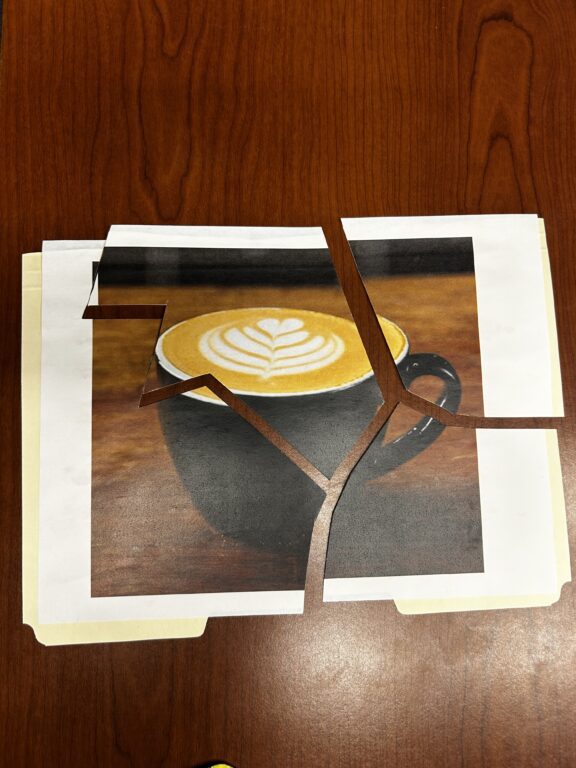
“For Pathways and my FYW course, I like to incorporate fun ways to get students into groups. Especially in the first few weeks, it’s great to have students meet each other and bring different perspectives to group discussions. So, I prefer assigning groups in creative ways to avoid students selecting the same group members or choosing groups based on where they are sitting since, they tend to sit in the same seats. One approach that I employ requires a little bit of preparation, but I think it pays off. I select an image (a mug of coffee on a table at a café, a beautiful sunrise, a beach scene, etc.), I print the images in color, glue the paper to cardstock, and then cut up the picture into puzzle pieces. I cut the image into pieces based on the number of students I will want in a group – typically 3 – 5 students per group. An added step that can be included is to write on the back of the cardstock the different roles for the group: recorder, time manager, and spokesperson. There may even be a card or two without a role and that is OK. Or, you may have other roles to include. I lay out the puzzle pieces, picture side up, but jumbled for the different images, at the front of the classroom. Students come up and pick the puzzle piece of their choice. Then, they need to find the other pieces to their puzzle and get into their group. They can flip their puzzle piece over and find out their role for the group work. If they don’t have a specific role, they are still a contributor. I like this method to get students to move around for a minute, change up group composition, and maybe start a short conversation about why they chose a particular puzzle piece. Then the group discussions can commence!
In my upper-elective courses (Nutrition, Neurochemistry, Biochemistry), I like to use the “jigsaw” method for group discussions. This one does not actually require puzzle pieces! Instead, I assign different case studies or journal articles (I can picture this applied to many different assignments). Importantly, some students are reading the same article or case study, but multiple articles are assigned for the whole classroom. One way to employ: students can select which article they want to read from the front of the class (for example, there are only 4 printed articles on topic A, 4 printed articles on topic B, and 4 printed articles on topic C). Their homework is to read the article and take notes about their observations (this could include guided questions). At the next class period, all students that selected topic A get into their group and discuss their observations (the same for topic B and topic C). They will answer a series of questions related to their topic as a group and become “experts” on their topic. Depending on the length of the class period and the length of the article and related questions, half or all of the class period could be devoted to this. The other half of the class period or next class period is when the jigsaw occurs. New groups are formed with 1-2 students that evaluated topic A mixed with 1-2 students that evaluated topic B and 1-2 students that evaluated topic C. Now, the “experts” share what they have learned within their new groups and the students gain exposure to two (or more) new topics. One example of this for my Nutrition course is students could choose between case studies about the role of the gut microbiome in diabetes, obesity, or colon cancer. We complete this during the lab period (close to 3 hours). The students first focus on one of these case studies and work as a team to answer a series of questions embedded throughout the case study. Next, new teams are formed and they end up hearing about the two other case studies and they are given the opportunity to present their observations to the new group. They also learn about how the gut microbiome is involved in many different systems. Shout out to Dr. Min-Ken Liao! We wrote these case studies together with students and so far, one of them is published through the National Science Teaching Association (NSTA) including student authors. We are working to publish the other case studies with student authors as well.”