Naming the Problem: What “Workslop” Means for Our Work and Our Classrooms
If you attended Session 2 of the BoodleBox trainings in September, you already heard this term. If you didn’t, it’s worth catching up on, because it names something a lot of us have felt but haven’t had a word for. Missed it? Access all the materials from Session 2, including the recorded session, in Box.
And speaking of BoodleBox training, if you missed Session 1, you can catch a repeat on Wednesday, Oct. 14, 2:30–3:30 p.m. Zoom link: https://zoom.us/j/93600661426?pwd=gGMstBpBkap5gDoQZ0uKJWP1d9nPhZ.1
Or, catch up by accessing the resources from Session 1.
 What is workslop?
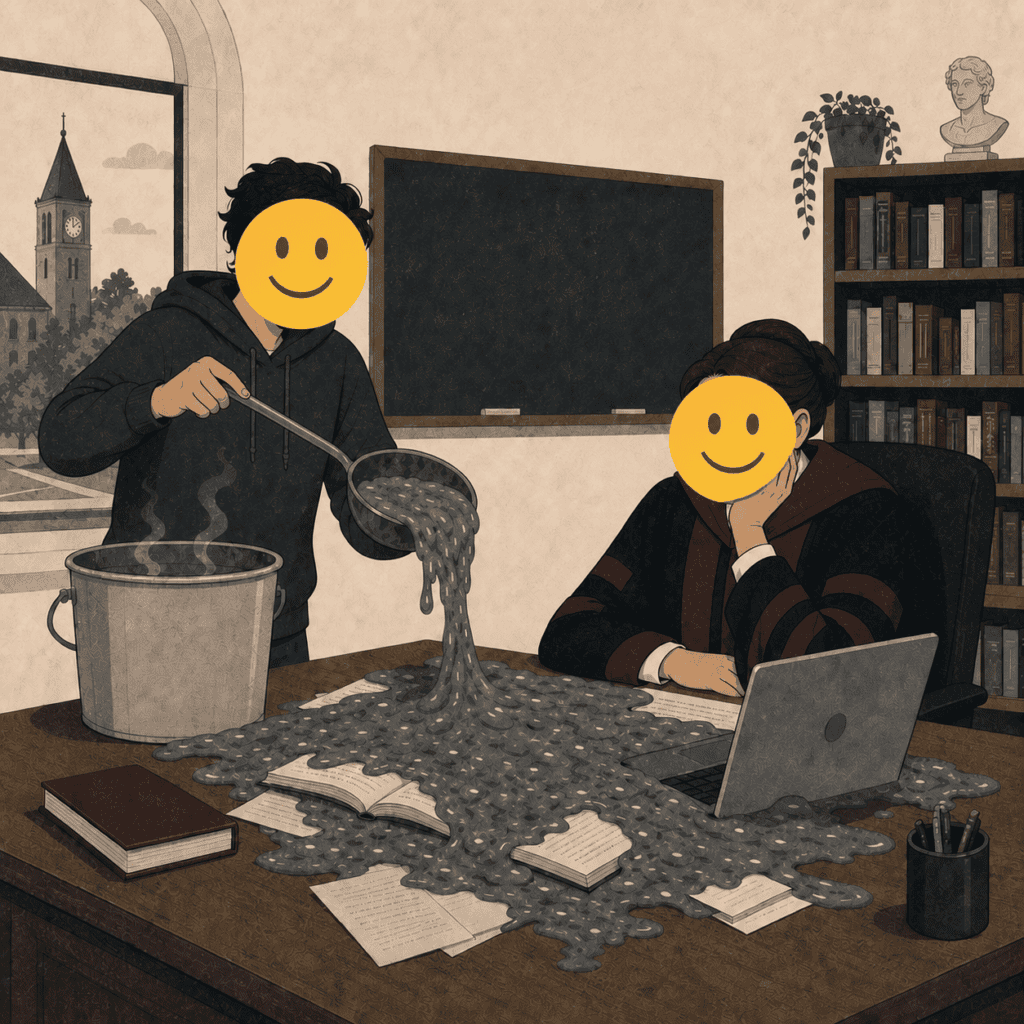
In September 2025, researchers from BetterUp Labs and the Stanford Social Media Lab published a study in the Harvard Business Review introducing the term “workslop”: AI-generated content that looks like real work but doesn’t hold up when you dig into it. Workslop is polished slides with vague numbers, long summaries that miss the true main point, and reports that read smoothly but say very little of substance. The researchers found that 40% of US employees had received workslop in just the past month (based on latest results from an ongoing survey), and that fixing or redoing it costs almost two hours per instance.
The core problem isn’t that AI produced the content. It’s that the human judgment that should have shaped and checked it never showed up. The work looks finished but isn’t.
Why this matters beyond the office
Workslop is a workplace term, but anyone who has read a stack of essays lately will recognize the shape of it: writing that hits every formal marker of a finished essay (complete sentences, transitions, a confident tone) while the actual thinking underneath is thin or absent. That’s the version we see in our courses.
This is also where this month’s Teaching Tip connects Gary Guillet’s piece on in-class assignments is built around a simple principle that we Writing Studies folks also preach: process matters more than a polished final product, and low-stakes grading protects space for students to think out loud without being penalized for it. Workslop is what happens when that process gets skipped entirely and only the finished-looking product remains. The two ideas are really pointing at the same thing from opposite directions. Remember that when you use AI to create materials used in teaching, you should acknowledge that for your students. Using AI in Your Teaching provides options for acknowledging and/or citing such AI use.
A skill built to fight it
At the September 22 AI in Action session, Chris Alvin walked faculty and staff through building “skills” in BoodleBox: reusable files that encode your own voice, standards, and habits so any bot applies them automatically, without you re-explaining every time. A skill works because it captures how you write and think, not just what task you want done. Check out this list of possible uses for skills.
That’s a direct answer to workslop. Generic prompting produces generic output that looks fine on the surface but falls apart under scrutiny. A well-built skill pushes back against that by holding the AI to your actual standards instead of its defaults.
A place to start on assignment design
If you’re rethinking an assignment with this in mind, the Assignment-Level AI Use menu, developed by Furman’s AI Strategy Task Force (AISTF), is designed for exactly this kind of decision. It walks you through each component of an assignment, understanding the prompt, drafting, getting feedback, and more, and helps you mark where AI use is off-limits, where it’s fine without disclosure, and where it has to be disclosed. The marked-up menu becomes your policy for that assignment.
Get involved
The AI in Action series continues Tuesday, Oct. 20, 3:00–4:15 p.m., in Duke Library 043. Trent Stubbs leads a session on designing assignments where students use AI, building on work he developed this summer through the AI Faculty Institute. Bring a laptop. Register here.
Claude 4.8 in BoodleBox assisted in drafting this article.