Teaching Tips with Carole Salmon
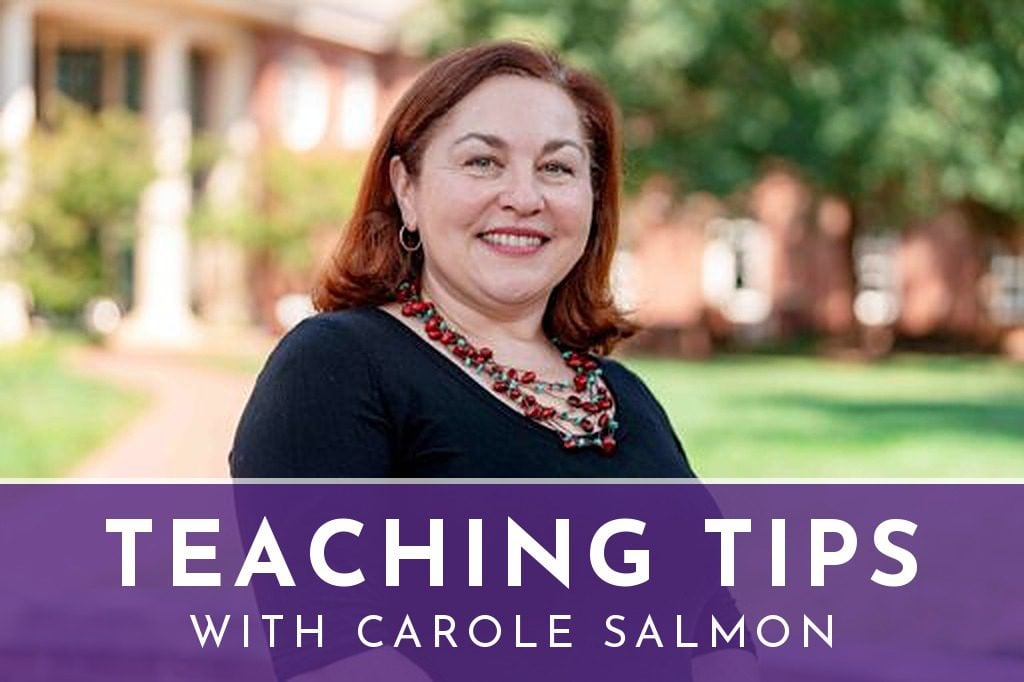 In this month’s Teaching Tips, Carole Salmon shares her creative approach to experiential learning – pairing local events and speakers with pedagogical structures to facilitate students’ deeper reflection and cultural literacy. Carole’s thoughtful activity design provided evidence of students’ critical thinking. But that’s not all! Research shows experiential activities like field trips lead to improved self-perceptions in students’ social and personal well-being (Lynch et al., 2025). If you have a creative teaching idea you’d like to develop, or think you could benefit from extra support, we’d love to hear from you in the FDC. Reach out to schedule a consult or learn more about our Teaching Development Grant.
Looking for more resources to help assess learning? Furman’s membership in AAC&U gives faculty free access to VALUE rubrics, including the Intercultural Knowledge and Competence rubric. These rubrics are a great fit for pre/post assessment, much like the approach Carole models below.
Bringing Life to an Advanced French Course: Speakers and Hockey Night!
Over the last decade of my 25-year teaching career in both French and sociolinguistics, I’ve become increasingly drawn to what’s known as the Transformative Learning theory (coined by Jack Mezirow) and related experiential approaches. I’m especially interested in how abstract concepts become more meaningful and durable when students can connect them to a lived experience, reflect critically on those connections, and then reconsider their assumptions. With these ideas in mind, in the fall of 2025, I decided to redesign my advanced French course FRN 323 Quebec Language, Culture & Civilization. Instead of only reading about how Québécois identity evolved from the 1950s to today, I wanted my students to experience those ideas more directly through real-world interactions and opportunities to speak with Quebecers. With support from an FDC teaching grant (merci, FDC J), I was able to connect theory to practice through a variety of local and virtual experiential learning opportunities about Quebec. Here is what I did:
I brought in authentic voices: I invited three local Québécois professionals to visit our class: a diplomat from Atlanta, an HR manager at Michelin in Greenville, and a nurse practitioner who teaches at Clemson. These guests spoke with the students about their pathways, both personal and professional, as native French speakers from Quebec. I also organized small group Zoom conversations between groups of 4 students in our class and some young francophone professionals in Quebec who discussed their careers in law, teaching, architecture and banking, as well as how they define their own Quebecois identity (all contacts in Quebec were from my own network, and students met on Zoom for their conversation with a Quebecois without me, so they could exchange freely).
I took the entire class to a Greenville Swamp Rabbits hockey game: To help students explore how sports (here, specifically hockey), cultural symbols, and politics intersect, I designed this experience around a three-phase structure, loosely following the Transformative Learning theory. Students completed a three-part assessment: a pre-event questionnaire on their expectations and prior knowledge regarding hockey’s cultural significance in Quebec; an in-game observation with prompts to complete at the Bon Secours Arena, and an in-class post-game reflection, the following day. These three stages allowed me to measure each student’s growing understanding of Quebec’s evolving identity. From pre- to post-activity, I was able to observe their developing critical thinking and deepening curiosity about the Québécois identity we had explored in class.
Building in structured reflections before and after these experiences made a real difference. Students weren’t just observing—they were analyzing, connecting ideas, and engaging more deeply with the course themes through a personal experience (many students said that they had never attended a live sports game). The impact of real-life encounters with expatriated guest speakers, Zoom conversations with Quebecers living in Canada, as well as attending a hockey game in Greenville was deep and tangible, and my students’ reflections confirmed my observation of the classroom’s increasing engagement after each visit, conversation, and the hockey night.
For faculty in any discipline, pairing accessible local events with structured observation tools and authentic guest interactions (in-class or virtual) can be a highly effective way to deepen engagement and foster lasting cultural literacy, especially if the course is taught in a language other than English. In many ways, this is also a part of Furman’s TFA promise.
Carole Salmon, Ph.D.
Professor of French and Linguistics, MLL
References :
Association of American Colleges and Universities. (n.d.). VALUE rubrics. Retrieved October 1, 2026, from https://www.aacu.org/value/rubrics
Lynch, R., McCormack, O., & Hennessy, J. (2025). Exploring teachers’ and students’ views and experiences of field trips. Journal of Adventure Education & Outdoor Learning, 26(3), 702–720. https://doi.org/10.1080/14729679.2025.2530091
Mezirow, J. (1997). Transformative learning: Theory to practice. New Directions for Adult and Continuing Education, 1997(74), 5–12. https://doi.org/10.1002/ace.7401