Summary of America and the World, Sept. 18, 2026: President Alexander Stubb ’93 H’17 and General Joshua Rudd ’93 Return to Furman
Watch the full event on YouTube!
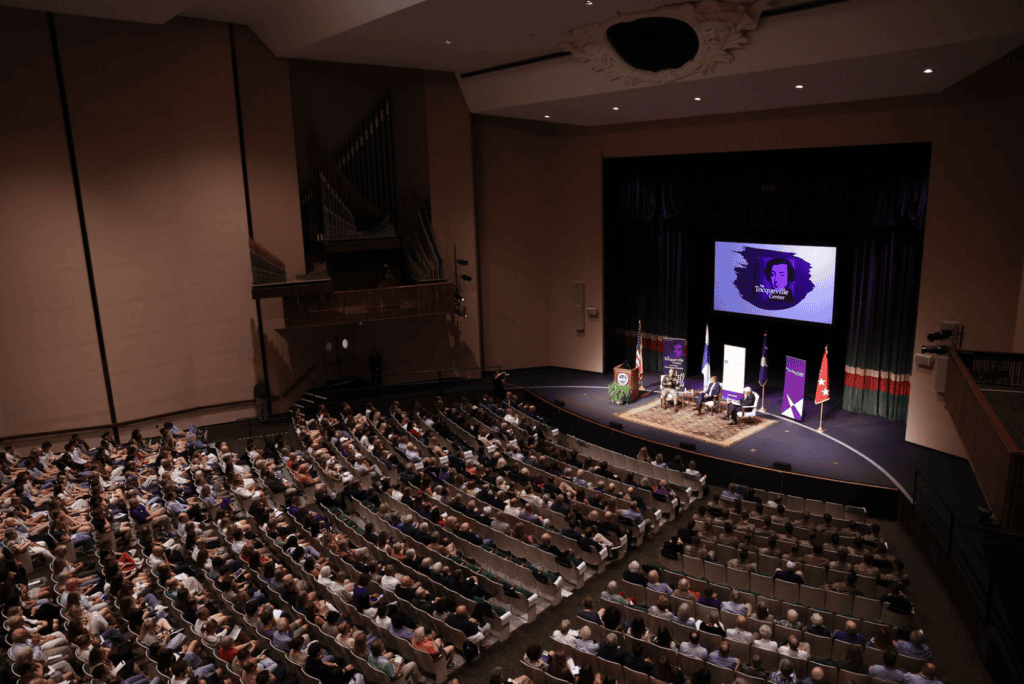
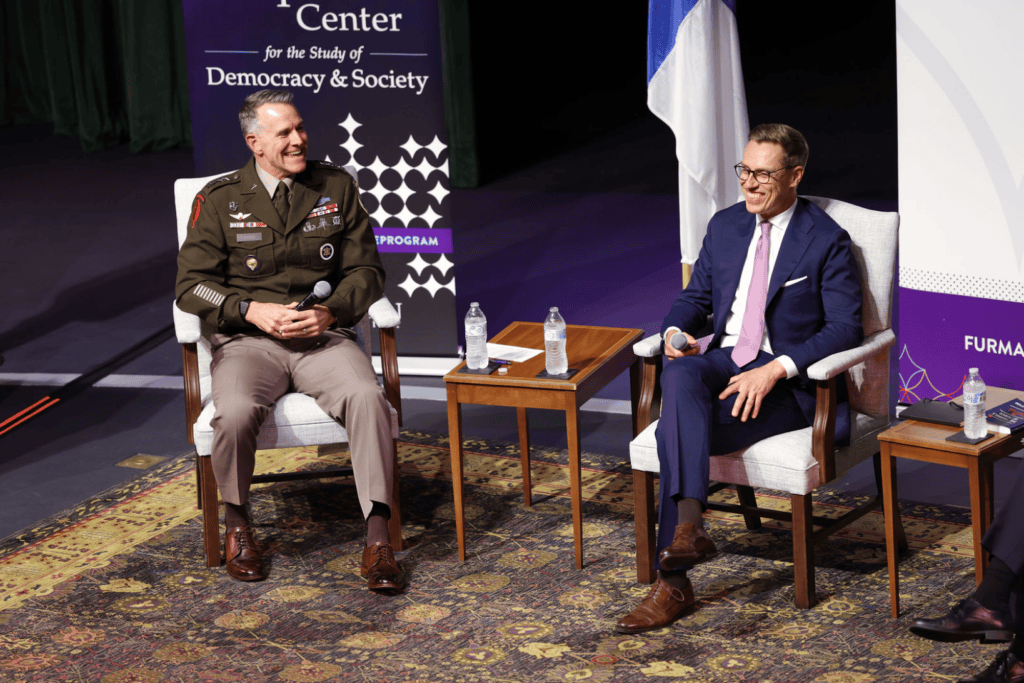
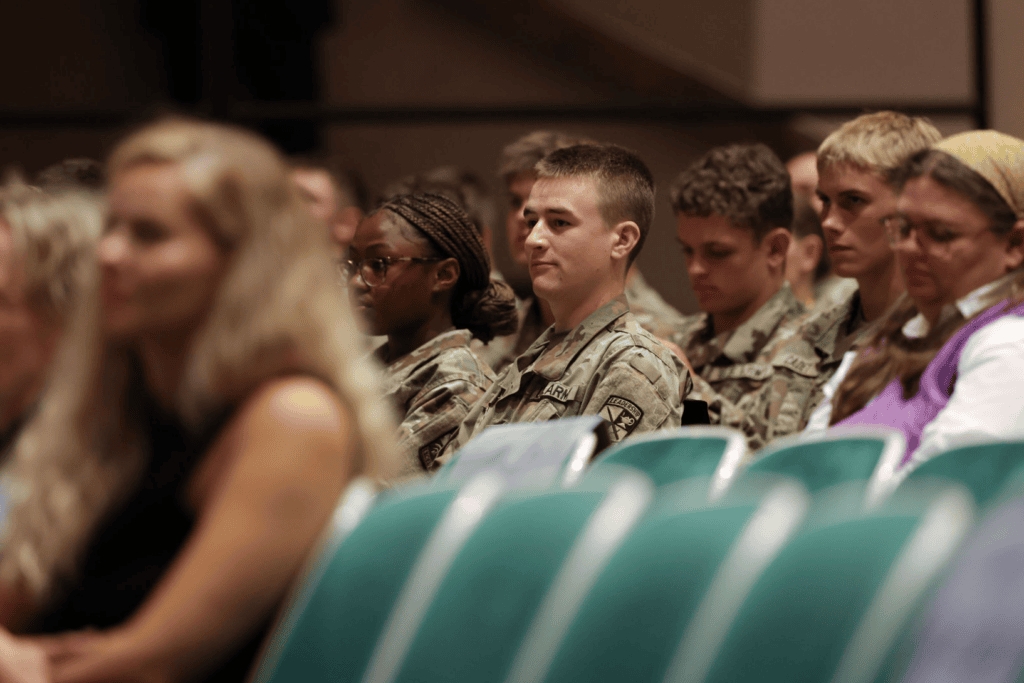
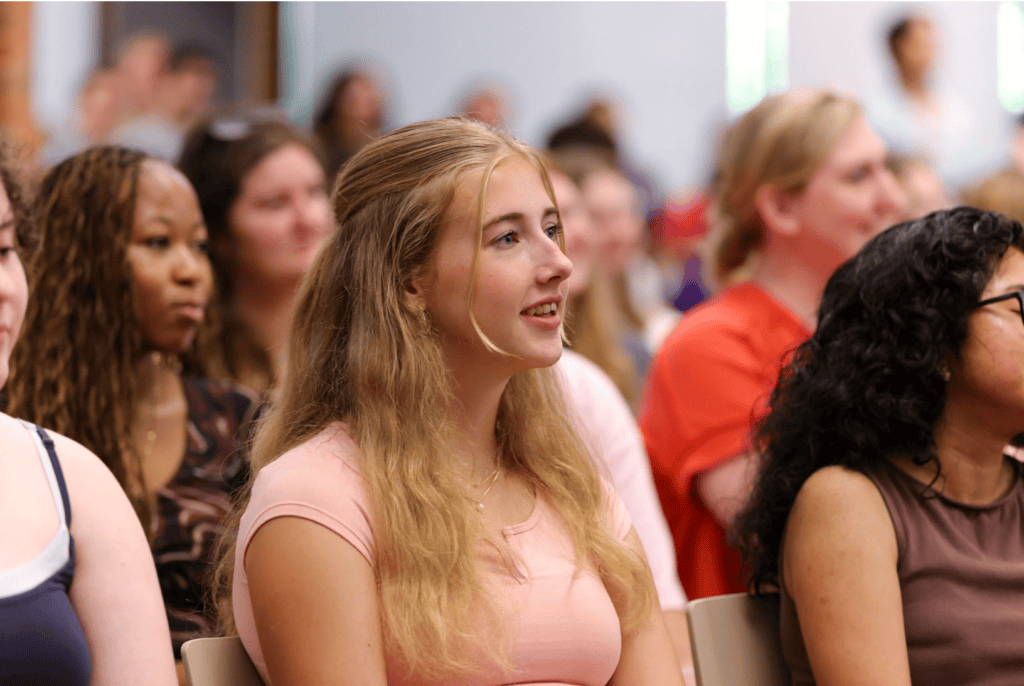
On September 18, two members of Furman’s Class of 1993 came home. Finnish President Alexander Stubb ’93 H’17 and General Joshua M. Rudd ’93, Commander of U.S. Cyber Command, Director of the National Security Agency, and Chief of the Central Security Service, spent the day with students, then took the stage that evening for America and the World, the Tocqueville Center’s first event of the academic year, in front of more than 1,400 people in McAlister Auditorium.
Brent Nelsen, director of the Tocqueville Center for the Study of Democracy and Society, moderated. He also once taught them both. “Little did I know when I walked into a Plyler classroom in the spring of 1991 that two of the students in that International Political Economy class would in three decades be world-class leaders with global responsibilities,” he said. “If I had known, I would have assigned another paper.”
Nelsen admitted he still had the final grade sheet. “I just want to say to the young people in this room,” he added, “you do not need to get an A in international political economy to become the president of Finland or a four-star general in the U.S. Army.”
A full day on campus
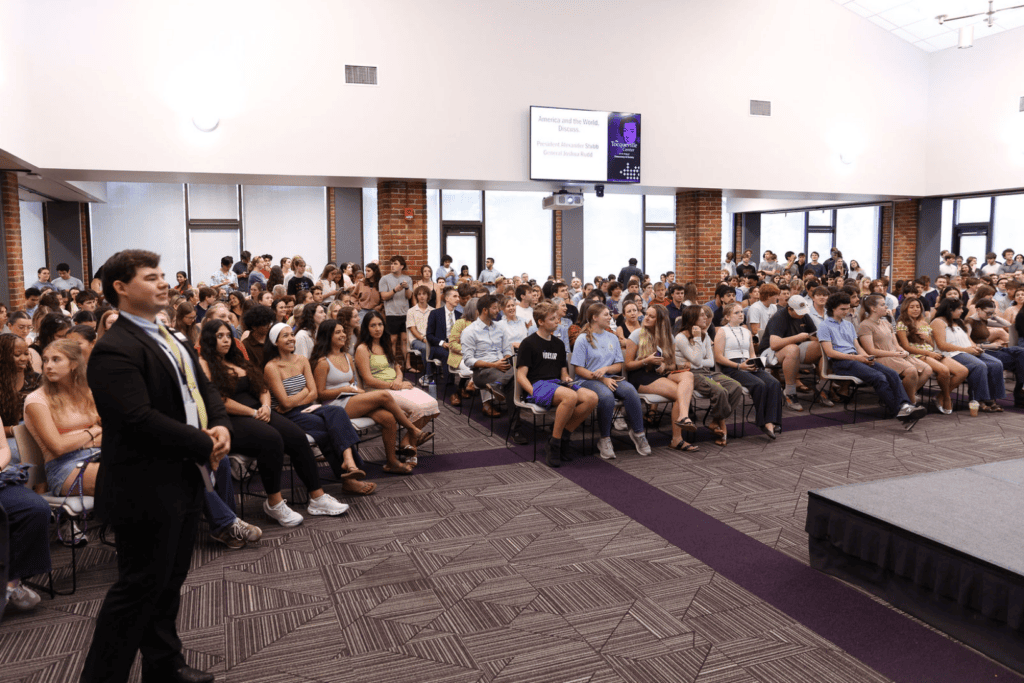
The day began with business. That morning, Rudd and Furman President Elizabeth Davis signed an Educational Partnership Agreement between Furman and the NSA, and Rudd spoke to Furman’s ROTC cadets.
Later, students and faculty crowded into the Watkins Room for a standing-room-only conversation that moved from Russia’s war in Ukraine and the demands of leadership to artificial intelligence and the history connecting Stubb’s family to Finnish independence. Tocqueville Fellows, along with invited students from ROTC and the Riley Institute, met the two alumni again at a reception hosted by the Tocqueville Center.
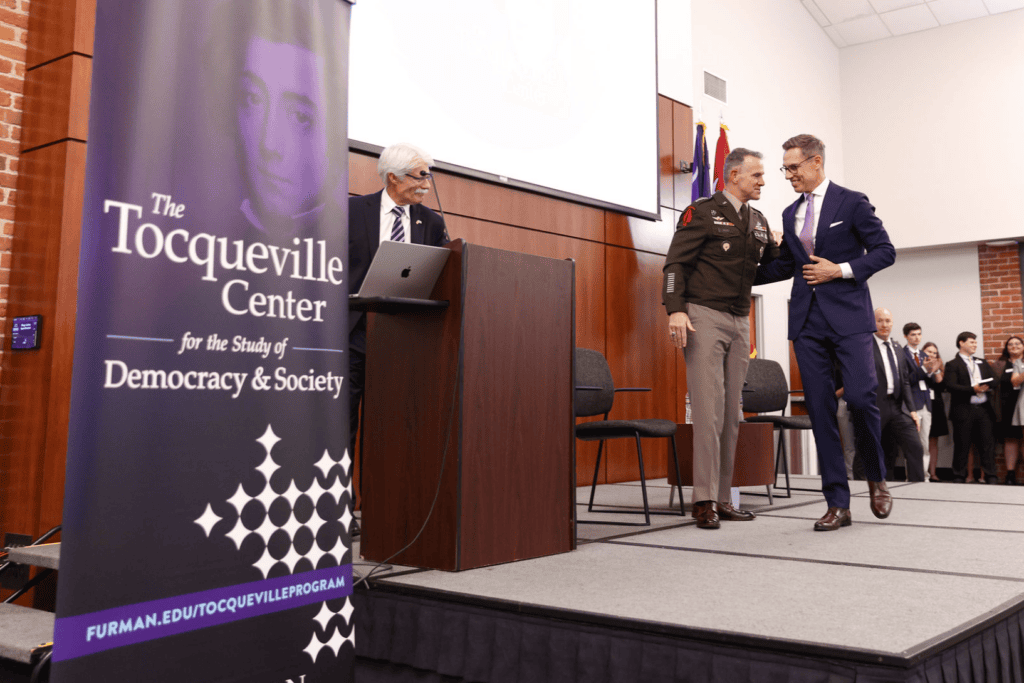
Opening the evening program, Davis summed up how far the two classmates had traveled. “One would go on to lead a nation, the other one would help defend one,” she said. “They shared a class in a major, yet the paths they took from here could hardly have been more different.”
Two paths from Furman
Neither man arrived at Furman with his future mapped out. “I came to Furman not being very academic, wanted to become a golf professional,” Stubb said. “I very quickly realized that I didn’t have Phil Mickelson’s hands and got really excited in studying.”
Stubb went on to earn a master’s degree from the College of Europe and a Ph.D. from the London School of Economics. He has served as a member of the European Parliament and as Finland’s Minister for Foreign Affairs, Prime Minister, and Minister of Finance, among other roles, and in March 2024 became Finland’s thirteenth president. He is also a scholar of international relations and the author, most recently, of The Triangle of Power: Rebalancing the New World Order.
Rudd planned to spend a year at Furman and then seek an appointment to West Point. Instead he joined ROTC and met the woman who would become his wife. He was commissioned on a scholarship he expected to pay back in about four years. “I came in as a logistician. I became a special operator. I thought that was enough,” he said. “9/11 happened. It changed every one of our lives and it absolutely changed the trajectory of my life.”
Rudd extended his service, deployed to Afghanistan and Iraq, and later served as Deputy Commander of U.S. Indo-Pacific Command. He was confirmed in March to lead Cyber Command and the NSA. He acknowledged he was “a bit of a non-traditional pick,” and recalled telling senators during his confirmation: “I don’t have a traditional SIGINT cyber background, but I’ve been a consumer of the trade and inextricably dependent on what those two entities deliver.”
“A world of disorder”
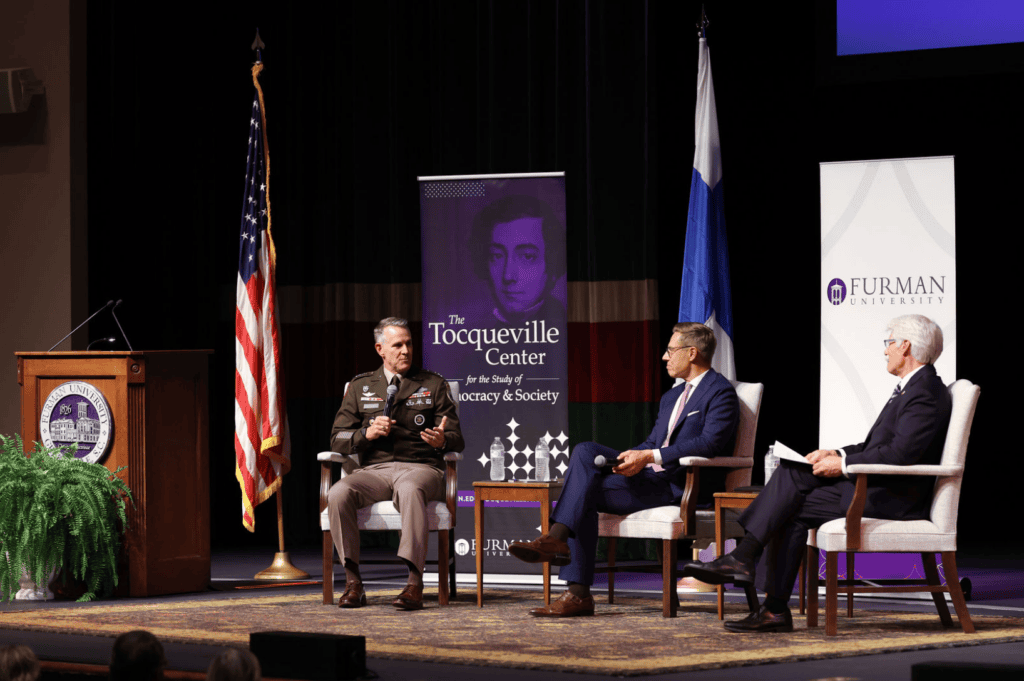
Stubb framed the evening by comparing the world he and Rudd entered as freshmen in 1989 with the one facing students today. In 1989, the Berlin Wall fell and many expected the world to converge on liberal democracy, market economies, and globalization. “I’m not saying it’s a vision of darkness, but certainly we don’t live in an orderly world,” he said. “We live in a world of disorder, which has been driven by big power competition.”
He compared the present to 1918, 1945, and 1989: moments when everyone understood the world order would change but no one knew where it would go. In his view, the choice is between a multipolar world, “which is transactional, which has unholy alliances and quite often conflictual,” and a return to a multilateral world built on institutions, rules, and norms. Getting there, he argued, means giving more agency to the Global South.
He also described the limits of his own office. “I come from a small country, and foreign policy is about values, interests and power,” he said. “I have values, I have interests, but I have limited power, unlike the United States, which is the most powerful state in the world.”
Rudd described the same landscape through the lens of a joint warfighter. He assumed command at the end of March. By mid-April, he said, the strategic environment had reached what his organizations call “the AI moment.” “The frontier models are so capable and in many cases so powerful that that will dramatically change the way we have to think about defense [and] offense,” he said. “But frankly, it’s much broader than national security.”
Learning on the job
Asked what the two had learned in their new roles, Rudd half-joked that the answer was a sauna, then made a point he and Stubb had discussed together: the importance of “holistic health and fitness.” “If you want to learn and you need to learn and there’s a lot to learn, you got to take care of yourself,” he said.
For Rudd, learning starts with admitting what you don’t know. “I don’t know it all, but I want to be a learn-it-all,” he said. Much of that comes down to relationships: “learning how to find the people that know the answer to the problem you’re trying to solve.”
I don’t know it all, but I want to be a learn-it-all.
— General Joshua Rudd ’93
Stubb reached back to a Furman classroom, recalling a lesson from Ty Tessitore’s course in classical political philosophy: “The more I know, the more I know that I don’t know.” He warned that the flood of information that comes with high office is no substitute for wisdom. “You get a lot of information, but that information doesn’t make you wise,” he said. “It can actually make you stupid if you’re not able to process that information in the correct kind of a way.”
He also urged students to accept failure and to recognize the role of luck. A longtime advocate of NATO membership, Stubb had left politics believing he had failed in that cause. Then Russia launched its full-scale invasion of Ukraine, Finnish opinion turned, and he was asked to run for president. “Had that not happened, I would not be sitting here,” he said.
AI: the biggest threat and the biggest opportunity
Nelsen asked the two which posed the greater threat to world order: China, Russia, or AI. Stubb declined to choose, then argued that “AI is probably both the biggest threat and the biggest opportunity.” Combined with biotechnology, he said, it will change the economy, politics, war, and science, offering “infinite opportunities” in areas like health alongside threats ranging from bioterrorism to attacks on nuclear power plants.
He laid out three options for governments: compete, cooperate, or slow AI down. He favors cooperation, with the United States leading the West and working with allies that bring their own strengths in quantum computing, satellites, and networks. “The biggest threat is that we compete but not cooperate,” he said.
The biggest threat is that we compete but not cooperate.
— President Alexander Stubb ’93 H’17
Rudd expects “a combination of all the above” and said his lens is national security first. “I hope you would expect us to want to pursue things as quickly as we can to make sure that we’re able to leverage that for our defenses,” he said. He agreed that no single government, military, or company can manage AI alone, and he made a case for the humanities alongside technical training. Beyond the question of what the technology “can, will and should do,” he said, lies the question of “how do we really harness it for good,” and the answer depends on “person-to-person relationships, conversations.”
Alliances and relationships
Responding to an audience question about transatlantic trust, Stubb described himself as “pro-European, pro-American, therefore pro-transatlantic” and argued that NATO is in better shape than headlines suggest. Finland joined the alliance in 2023, ending decades of military nonalignment, and Stubb said its bilateral relationship with the United States is now deeper than ever. “Finland and Sweden join,” he said. “We are security providers, not security consumers.”
He pointed to Finland’s comprehensive security model, including civil defense shelters for 4.4 million of its 5.6 million people and 64 F-35s on order, as the reason he can stay calm despite sharing NATO’s longest border with Russia. “I sleep my nights very calmly,” he said.
Rudd said the political noise around the alliance does not match what he sees in his own work. He meets regularly with European signals intelligence and cyber counterparts, and he traced those bonds back to 9/11, when NATO allies fought alongside American forces. “Those don’t just go away,” he said.
Personal relationships matter too, Stubb added. Learning that a fellow Furman alumnus would lead Cyber Command and the NSA, he said, was “like Christmas.”
Stubb credited Furman, and the late Senator Lindsey Graham, with one of the more unusual chapters of his presidency: seven hours in a golf cart with President Trump. “That would not have happened was it not for Furman and was it not for Lindsey Graham,” he said. “May he rest in peace.” The round, which Graham arranged, “led to a relationship and a dialogue that I’m able to have with the President of the United States.”
Education as security
An audience member who had studied in Finland asked how much a well-educated population matters to national security in an era of misinformation and AI. “It’s almost as if the question answered itself,” Stubb said. He called education part of Finland’s comprehensive security, because “security and resilience is often also between your ears.”
He worries that people are drowning in information. “We thought that information makes you intelligent, but it doesn’t,” he said. “Information is almost like — food is good, it gives you energy, but if you eat too much, it’s not good for you.” He praised a liberal arts education for combining the humanities and the sciences, and he warned that heavy digitalization erodes students’ capacity “to sit down with a book and read.”
Security and resilience is often also between your ears.
— President Alexander Stubb ’93 H’17
Rudd used the question to announce the agreement he and President Davis had signed that morning: an Educational Partnership Agreement between the NSA and Furman. It will initially focus on AI, data analytics, and linguistics, with Chinese and Korean as the first languages. Rudd said the agency plans to “challenge and throw problems at undergraduates” and connect them with other academic institutions and industry. “We’re hopeful at the end of that process, maybe we get a little bit of talent out of the agreements as well,” he said. Asked if that meant jobs, he answered simply: “We have jobs.”
“Whether you think you are or not, you’re ready”
Before closing, the conversation turned to Furman memories. Rudd confessed to kissing his future wife under the Bell Tower. Stubb, who arrived at Furman at 21 after completing his compulsory military service in Finland, recalled being fined $100 for keeping two bottles of Heineken in his dorm fridge on what was then a dry campus. The story has a coda: he had been overcharged by $5, and when he returned as commencement speaker in 2017, he collected it from President Davis.
Nelsen then asked what advice they would give students sitting in the seats they once occupied. Rudd went first. “You’re ready. Whether you think you are or not, you’re ready,” he said. “Have confidence. Temper it with humility, but have confidence.”
He added a challenge he had given the ROTC cadets that morning, pointing to the word “excellence” on their shoulder patch. “Relentlessly pursue excellence in everything you do,” he said. “And why excellence? Because it’s attainable and never ending. So as soon as you achieve excellence, immediately the standard just got higher.”
Relentlessly pursue excellence in everything you do.
— General Joshua Rudd ’93
Stubb offered four principles he learned from his parents and passed on to his own children: “Dream, believe, work hard and succeed.” Dreaming big is never wrong, he said, even though some dreams will fail. “If you don’t believe in yourself, no one else will believe in you.” And “I’ve never seen anyone going places in life who hasn’t put in the hours at some stage.”
But he defined success carefully. It is not being a president or a general, he said, nor wealth or social position. “Success is the journey that Josh was talking about in life, which has meaning, and you are the one who defines the meaning. I think meaning often comes from helping someone else.” That help might mean supporting family, comforting a friend, doing charity work, teaching the young, or working for the security of one’s country.
I think meaning often comes from helping someone else.
— President Alexander Stubb ’93 H’17
“If you keep these four things in mind — dream, believe, work hard, succeed,” Stubb told the students, “I think at the end of the day, whether you’re a Furman alumni or not, it’s going to be all good.”