Blog
Garden Pace: How Working on a Farm Displays the Relativity of Time
As humans, we are used to experiencing time in a very specific way. Human society is structured around, unsurprisingly, human time. The average life cycle of a person stays pretty much the same wherever you go. Being that this is the case, I’ve always gone about life at a human pace, without questioning it. But what happens when that needs to change? As this year’s Student Assistant Composting Manager, I had to change my human pace to plant, and even microbe pace.
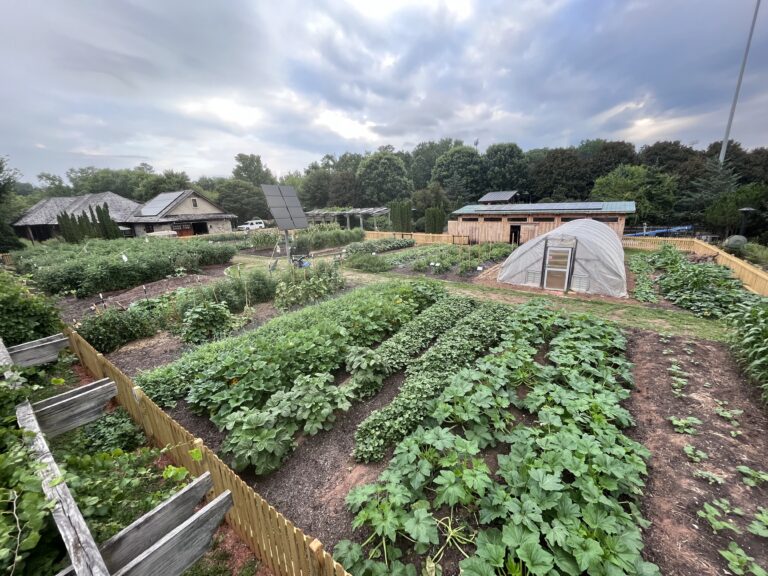 From the start of this internship, I’ve known how important it is to know the plant you’re growing and to anticipate their needs. And by “know” I don’t just mean the ability to identify the plant. I’m talking about the way you know your mother or your best friend. This kind of intimate knowing enables you to care for your plant in the optimal way. This, however, takes effort, and the ability to pace yourself like a plant would. If I want to know my plant, shouldn’t I know at what pace they operate? So, I watched and observed. Every morning I took a mental note of where the plants were at, and how that changed (or didn’t) throughout the day. Doing this enabled me to track their progress and development. Plants don’t sleep like we do. In fact, the garden never takes a break. The forces of life stay active 24/7. Knowing that it functions at that rate, I must be attentive and aware of little details as things will move slower than I am able to process.
Knowing the rate at which microbes go about their lives also became very important when dealing with compost. They often have very quick lifespans, and reproduce like crazy. Knowing this can lead to the difference between smelly compost piles and non-intrusive ones.
Putting my mind in the space of different life paces has changed how I view the world. My views on all life forms has become more and more egalitarian. It takes me out of my own self-absorbed view of the world. I have a newfound care and respect for how other life functions. No longer do I look at plants as slow, stagnant beings, but rather beings with needs just like you and I. This experience has reminded me that I don’t always have to run at a human pace. Watching the pace at which plants move reminds me to slow down and try to get more in touch with the intricate workings of life.
I didn’t know working in a garden would become so existential, but here we are. I would encourage everyone reading this to go start a garden or even volunteer on the Furman Farm! It’s not just about growing plants. It’s about seeing the world in a new light. And to me, being the curious guy that I am, this is invaluable.
 About the Author: Kevin Amon is the 2026 Student Assistant Composting Fellow. Kevin is from Pennington, New Jersey, and chose this fellowship because of his interest in waste management and sustainable food systems. He just recently got into martial arts and is really enjoying it. Kevin recently graduated with a degree in anthropology, and is looking forward to applying what he learned in the classroom out in the field.