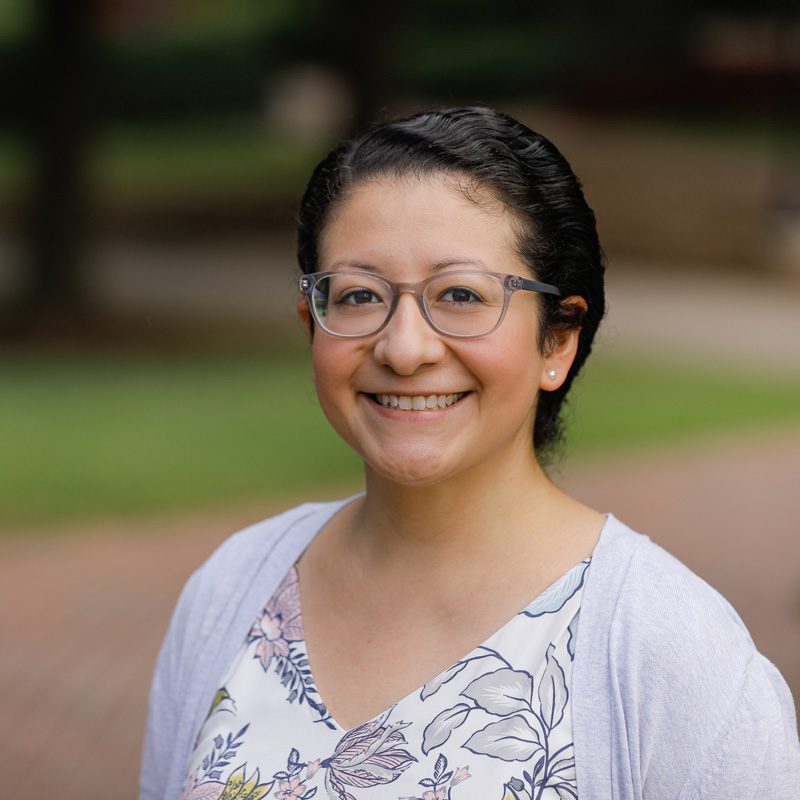
Veronica Flores
Associate Professor of Psychology and Neuroscience
- Email: [email protected]
- Phone: 864.294.2431
- Office: Johns Hall, 206L
Dr. Flores’ interest in Psychology and Neuroscience began as an undergraduate at UC San Diego. Although she started college with a different major, she ultimately decided to switch to Psychology after taking and enjoying classes in Neuroscience and Behavior and participating in sensory systems research. After earning her B.S., she worked as a Research Assistant at the Joslin Diabetes Center in Boston, MA, where she continued to explore different areas of Psychology. With guidance from her mentors, she decided to attend graduate school at Brandeis University where she earned a M.S. in Neuroscience and a Ph.D. in Psychology. Her research blends her interest in Psychology and Neuroscience and focuses on the impact of experience on taste processing and development using rodent models of learning. Dr. Flores has supervised numerous undergraduate research projects and is always willing to chat about her research with any interested students!
Dr. Flores is equally passionate about teaching and mentoring and has served as a mentor and advisor for both Psychology and Neuroscience majors as well as for students under various scholarships including the Furman Hearst Fellowship and S-STEM Scholars program. She was the recipient of the Alester G. Furman, Jr. and Janie Earle Furman Award for Meritorious Advising in 2024. Dr. Flores currently teaches Learning and the Brain, Introduction to Psychology, Sensation and Perception, Animal Behavior, and Multisensory Integration and Processing.
During her spare time Dr. Flores enjoys sipping coffee, trying new foods, spending time with her many pets, traveling, and spending time outdoors with her spouse.
Education
- Ph.D., Brandeis University
- M.S., Brandeis University
- B.S., UC San Diego
Research
Humans and animals alike are pretty good at deeming foods as “delicious” or “disgusting” thanks to the strong relationship between taste and survival. However, our diverse experiences with foods are far more complex than these two descriptors; most of our experiences fall somewhere between and without consequence. What we might not often consider is how our individual experiences with tastes – even with those that are unremarkable or incidental (“meh”) – influence how we make future decisions and associations about novel tastes.
Dr. Flores' current research considers how these incidental taste experiences impact learning about new tastes across development. Her work has shown that animals who have taste experience are better taste learners and this impact is reflected in neural activity. Most recently, her lab has shown that even incidental taste experiences occurring early in development through the mother can impact taste processing in offspring. Her interdisciplinary research in Psychology and Neuroscience can help to form bridges between fields by developing animal learning models that are more representative of the diverse human experience with food and taste.
Dr. Flores uses several behavioral neuroscience techniques in her lab including chemogenetics, immunohistochemistry, confocal laser scanning microscopy, and behavioral assays in a rodent model of learning. Much of her research has involved dedicated work from dedicated undergraduate assistants who have presented their findings at various conferences and have even published novel findings alongside her. She is always open to talk to students interested in joining her lab and research!
Publications
- Flores, V. L., Tanner, B.+, Katz, D. B., & Lin, J. Y. (2022). Cortical taste processing evolves through benign taste exposures. Behavioral neuroscience, 136(2), 182–194. https://doi.org/10.1037/bne0000504
- Tanner, B.+, Gemmell, H. M.+, Reifsnyder, K. C.+, Headley, K.+, Maier, J. X., & Flores, V. L. (2026). Taste exposure during different developmental phases impacts aversion learning in adult rats. Behavioral neuroscience, 140(3), 190–200. https://doi.org/10.1037/bne0000648
- Flores VL, Parmet T +, Mukherjee N, Nelson S, Katz DB & Levitan D. (2018). The role of the gustatory cortex in incidental experience-evoked enhancement of later taste learning. Learning & Memory. 25(11):587-600 PMID: 30322892. (+ Undergraduate)
- Flores VL, Moran A, Bernstein M +, Katz DB (2016). Preexposure to salty and sour taste enhances conditioned taste aversion to novel sucrose. Learning & Memory. 23(5):221-8 PMID: 27084929. (+ Undergraduate)
- Flores, V. L., Tanner, B+., Katz, D. B., & Lin, J. Y. (2022). Cortical taste processing evolves through benign taste exposures. Behavioral Neuroscience, 136(2), 182–194. PMID: 35049318 (+ Furman Undergraduate Student)
0