News from campus and beyond
The Joke That Nearly Didn’t Land
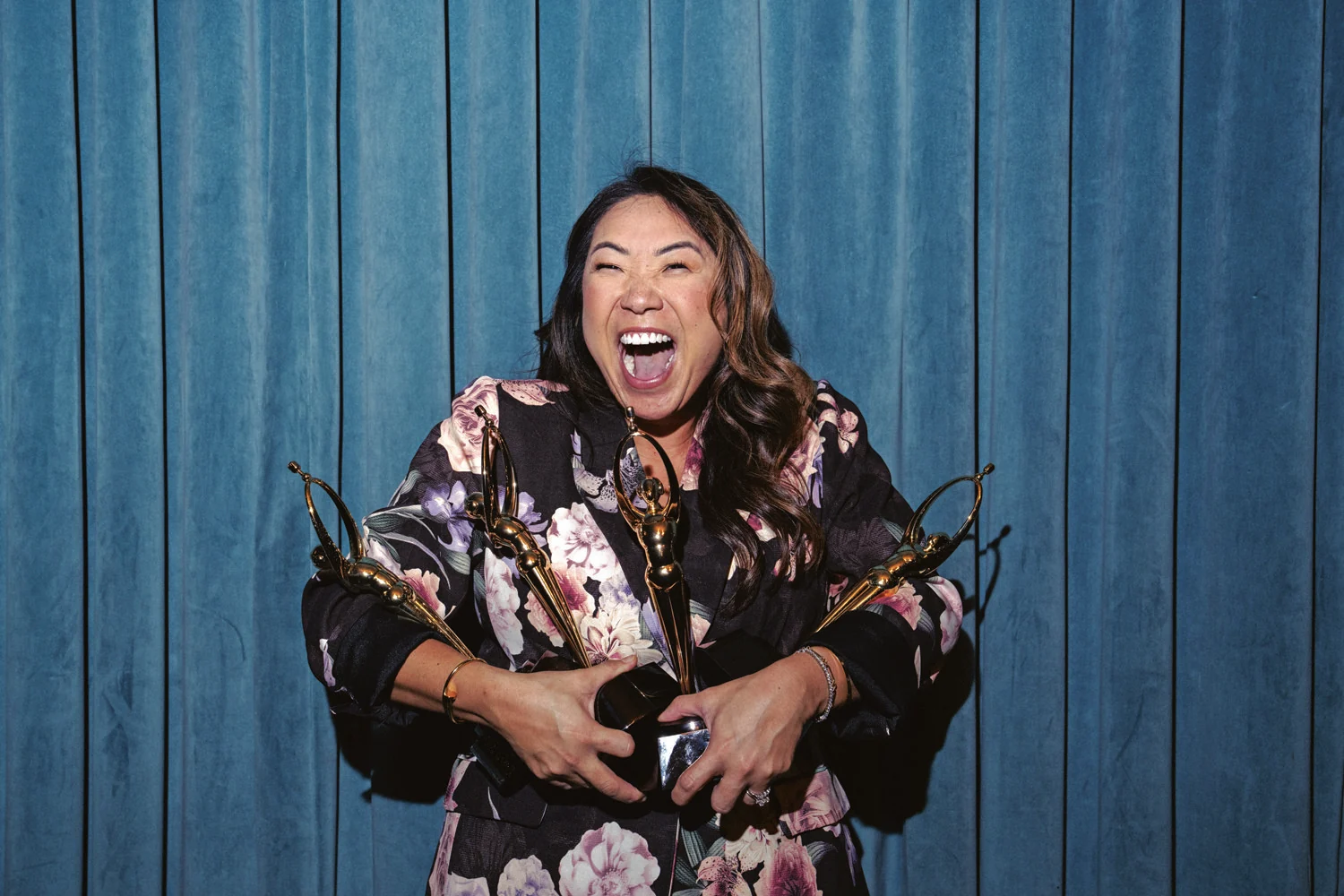
Jodi Tovay ’05 celebrates her award-winning podcast with trophies from The Ambies.
Jodi Tovay ’05 never planned to become the face of an award-winning podcast.
She certainly never imagined standing onstage to accept iHeartPodcasts’ 2026 “Best Crime Podcast” award, the Ambie for Podcast of the Year or watching a project she spent nearly a decade building get optioned by Universal for a limited television series. And she certainly never thought a rainy night in Scotland would alter the course of her career.
But that is exactly what happened.
The Furman communication studies graduate built “Wisecrack” into one of the most talked-about podcasts in the industry by doing something most executives told her not to do: mixing comedy with true crime. Along the way, she carved out a career defined less by a straight line and more by persistence, reinvention and an unusual willingness to embrace uncertainty.
“If someone tells you don’t do it, maybe you should,” Tovay says.
That philosophy has followed her since her days at Furman.
Building a career without a blueprint
Tovay came to Furman from Atlanta largely because of the campus itself. The lake, the proximity to home and the sense of community all appealed to her. Once on campus, she immersed herself in communication studies and student leadership opportunities such as the Furman University Student Activities Board (FUSAB) and orientation staff, experiences that ultimately helped shape the way she approached storytelling and self-promotion.
At the time, Furman’s communication studies program leaned more theoretical than practical, but Tovay found value in learning how people communicate and how stories influence audiences. Just as importantly, she learned how to position herself in rooms where she had no natural connections.
“No one in my family works in entertainment,” she says. “The hardest part, for me, was trying to get people’s attention and saying, ‘I’ll take a chance on this random person from the South who has no connections whatsoever in media.’”
She found creative ways to stand out. To land an internship with MTV and Viacom, Tovay mailed recruiters a customized game of Operation with her résumé and GPA attached. The unconventional approach worked, launching her into an industry she admits she entered without the traditional credentials.
Still, she kept moving forward. Tovay spent years inside major media companies like Viacom and Warner Bros. Discovery, bouncing between marketing, sales, development and production roles while slowly learning every corner of the business. Rather than becoming frustrated by the constant pivots, she embraced them.
“I think just loving storytelling is the most important thing,” she says. “And being willing to always be a learner.”
That mindset proved critical as the media industry transformed around her. Documentary and reality television opportunities shrank, mergers reshaped the industry and many longtime colleagues left entertainment altogether. Tovay adapted again, gradually moving toward documentary and crime storytelling – genres that better matched the curiosity she carried since childhood.
“As a little girl, I was either a journalist or a detective,” she says. “So now I guess I’m a little bit of both.”
The storm that changed everything
Tovay’s career turning point came unexpectedly during a theater project in Scotland. She ducked into a comedy show simply because it was raining and she needed a place to dry off until it passed.
Onstage was British comedian Edd Hedges, whose stand-up routine centered on an intensely personal and tragic story that somehow managed to make audiences laugh without diminishing the seriousness underneath it.
Without giving too much away, Hedges’ story began with a visit to his home village for a charity event and ended with a double murder in a home next to his parents’ house committed by his childhood bully. Not exactly typical fodder for a stand-up routine, let alone a podcast.
Most people would have walked away shocked, shaking their heads and perhaps entertained. Tovay walked away wondering if there was something larger hidden inside the story.
Building a brand
Initially, the concept was not a podcast at all. Tovay and her collaborators envisioned a stand-up special with documentary elements and even pitched the idea to Netflix before COVID shut down much of the entertainment industry. As projects stalled and budgets tightened, the team found itself rejected repeatedly.
A podcast became the only realistic option.
Even then, the idea sounded risky. Combining comedy and true crime challenged nearly every conventional rule in the industry. Tovay had spent years hearing executives insist that the genres simply did not belong together.
“I was always pitching ideas that were funny crimes or scam crimes,” she says. “And I was often told crime and comedy don’t mix.”
Charles Forbes, Tovay’s longtime collaborator and creative partner, shared some of that hesitation early on.
“At first, I was reluctant,” Forbes recalls. “It took a lot of convincing from Jodi to attempt to combine such polar emotions.”
But Tovay remained convinced there was something powerful in allowing audiences to experience both at once.
A story worth chasing
Creating “Wisecrack” required far more than creative vision. It demanded years of research, difficult interviews and painstaking investigative work. Tovay traveled to England, fought for records, hired legal help to obtain information and slowly built trust with the people connected to the story – especially Hedges himself.
“My initial reaction was hell no,” Hedges says of turning his story into a podcast. “This story is something that’s deeply personal to me and my family.”
The process of convincing him took years. COVID unexpectedly strengthened that relationship, forcing the project into a slower, more collaborative pace. Over time, suspicion gave way to trust.
“It took a long time,” Hedges says. “But I felt like we were in the best hands possible.”
Forbes saw firsthand how relentless Tovay became during the process.
“There is no harder worker in the game,” he says. “She eats, sleeps and breathes story development. Her commitment to a story makes me a better writer.”
That persistence shaped the final product. Rather than inserting herself heavily into the narrative, Tovay intentionally stepped back and allowed listeners to sit with uncertainty, emotion and contradiction. The podcast became less about solving a crime and more about understanding the complicated people surrounding it.
That structure helped “Wisecrack” stand apart from traditional true crime storytelling. Audiences were not simply searching for answers. They were examining grief, trauma, humor and humanity all at once.
“I think people are drawn to comedy and true crime for many of the same reasons,” Forbes says. “They want to viscerally connect with a story, whether they’re screaming from laughter or screaming from fear.”
Finding light inside the darkness
For Tovay, the success of “Wisecrack” ultimately validated something she had believed for years: tragedy and comedy are not opposites. They co-exist constantly in real life, even if media often tries to separate them.
“That’s not the human experience,” she says. “Darkness can’t exist without light, and light can’t exist without darkness.”
The podcast resonated because it embraced that tension instead of avoiding it. Listeners found themselves laughing one moment and unsettled the next, pulled along by Hedges’ storytelling and Tovay’s careful pacing. Critics praised the project’s originality, and the industry quickly followed with awards and adaptation deals.
Now, “Wisecrack” is headed toward a scripted television adaptation with Universal and producers connected to the hit Apple TV series “Severance.” Tovay sees the expansion not as an endpoint, but simply another version of storytelling.
“I think just loving the story is the most important thing,” she says. “And being agnostic to the medium.”
Even with the growing attention, Tovay still sounds more comfortable behind the scenes than in the spotlight. She laughs about wanting to disappear back behind the microphone someday, returning to the invisible creative role she always preferred.
“I like being Oz,” she says. “The invisible hand behind the scenes is where I prefer to be.”
For now, though, the spotlight keeps finding her – proof that sometimes the stories nobody expects are the ones audiences connect with most.