For alumni and friends
of the university
of the university
The Contrary Investor

Ravenel Curry ’63, founder and co-chief investment officer of Eagle Capital Management, LLC, walks down Park Ave in Manhattan to the company’s office. Photos by Nathan Gray.
Ravenel Curry ’63 immediately spotted a problem.
Walking to work one summer morning in the early 2000s from his home in Midtown Manhattan to his office at Eagle Capital Management, a young fruit vendor, whom he had gotten to know over the years, was wearing a Boston Red Sox hat. Most people would have passed by without a second thought, but some might have caught a glimpse of that red ‘B’ and dismissed buying anything from the young man. After all, this was Yankees territory.
Curry couldn’t ignore it, and he couldn’t let the vendor risk a day of sluggish sales because of a hat. So, he called up his wife, Beth, and asked her to bring him a hat from home before she came to work. Beth brought the hat to Curry, and he immediately went to that vendor, gave it to him and said with a smile, “You don’t want to lose a sale over a hat.”
This story – told by his daughter, Caroline Curry – gives you a sense for who Ravenel Curry is. Little things matter, we should take care of others and, sometimes, seemingly insignificant decisions can affect the success of a business.
“I often look at things in a different way than most,” says Curry, calling himself a “contrary investor.”
The Strength of Community
That “different” philosophy started as early as Curry can remember. Growing up in Greenwood, South Carolina, community involvement and personal initiative were woven into daily life and Curry embraced that along with his parents and sister Cathryn.
His father, Ravenel B. Curry Jr. ’37, was a Furman graduate and managing partner of Citizens Trust Co., a business his father, Col. Ravenel Curry, Class of 1910, owned in the 1920s and ’30s. Both men, Curry said, were deeply engaged in civic work and truly excelled at growing their community.
“My father probably spent half of his day doing civic things,” Curry recalls. “That’s what he really loved, and he knew that a thriving community would also help the business he took over from his father.”
As a teenager, Curry followed in those footsteps, balancing afternoons at the YMCA with summer work running a local playground and coaching youth sports. But it was business – not ballfields – that most fascinated him. He was always looking for a new way to challenge himself and make a little money in the process.
“I had a newspaper route. I sold soft drinks to construction workers. Later I tried selling peaches from Beth’s family’s farm in South Carolina up in New York City. Most of the businesses didn’t work, but some did,” he says. “It became a sport for me.
Taking the First Steps
Like his father, grandfather and great-grandfather before him, Curry graduated from Furman University. As a fourth-generation legacy, there was never a question that Furman would be a part of his future and where he would continue to build his appreciation for community and life.
“I had extraordinary professors at Furman in economics, history, English and political science, and they opened my mind to ideas I had never encountered,” Curry reflects. “I made some deep friendships with smart and thoughtful people that have lasted
our lives.”
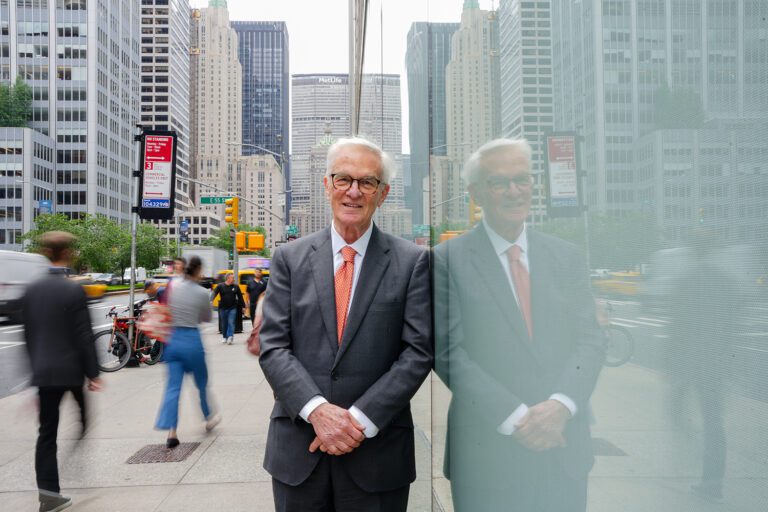
Ravenel Curry ’63, founder and co-chief investment officer of Eagle Capital Management, LLC, is pictured here on Park Ave in Manhattan where the Eagle Capital offices are located.
He continued a variety of side ventures at Furman, from selling socks to students to offering perfume he’d purchased on a summer trip to Paris in the dorms around Christmas. Each was a new experience that showed him what he wanted to do and, more importantly, what he didn’t want. It also taught him lessons about business, finance and working with people.
“I was focused on learning and trying new things,” he says.
That clarity of purpose began to crystallize during graduate school at the University of Virginia, where a professor changed the course of Curry’s life by urging him to spend a summer working in New York.
“I was going to work construction that summer and had never envisioned living in New York,” Curry remembers. “But after talking it over with Beth, I decided to try another adventure. It was quite different from what I thought.”
A Career Built on Vision and Patience
Curry’s summer internship opened his eyes and introduced him to an even greater variety of people and ideas.
“I learned so much just by listening. There were so many experts around me,” he says.
The internship turned into a job in the research department at J.P. Morgan. Curry initially thought he’d learn about financial research so he could be more helpful when he returned to Greenwood. But he discovered the brokerage business and decided to learn more about that before heading home. Before he knew it, he and Beth had established roots and started a family in Summit, New Jersey.
Curry dove into investment research – his preferred side of the investment world. He worked at several firms and even brought his family south to Charlotte, where he managed the Duke Endowment. Along the way he established his way of investing. One steeped in patience and analysis with a long-term focus.
In 1988 he and Beth founded Eagle Capital Management with a commitment to the kind of deep research that could set them apart. At Eagle their philosophy was, and remains, finding great management teams and good businesses in the midst of change and undervalued by the investment community. If successful, this results in faster company growth and higher valuation – a double positive.
“We looked for clients who shared this long-term focus and cared more about long-term returns – over the next five to 10 years, not monthly,” Curry says. “I recognized that the investment risk is greatest when agreement is greatest; we can be contrarian.”
Building the business took a long time. Most investment managers might have given up, but Curry was patient and determined.
“In retrospect it was fortunate that my parents were frugal, so they could afford to stay committed to their long-term vision even when the market moved against them,” Caroline says. “During periods when investors are nervous, many start to trade more often, but Eagle’s culture is to stay calm and look through the noise to find the next opportunities.”
Solving Problems at Their Root
As his success grew, Curry turned increasingly toward philanthropy, but he approached it in his own way. Through the Beth and Ravenel Curry Foundation, Curry uses some of the same principles they use in investing – find good leaders who want to solve problems at their root and who can use the gift to have a growing and outsized, long-term impact.
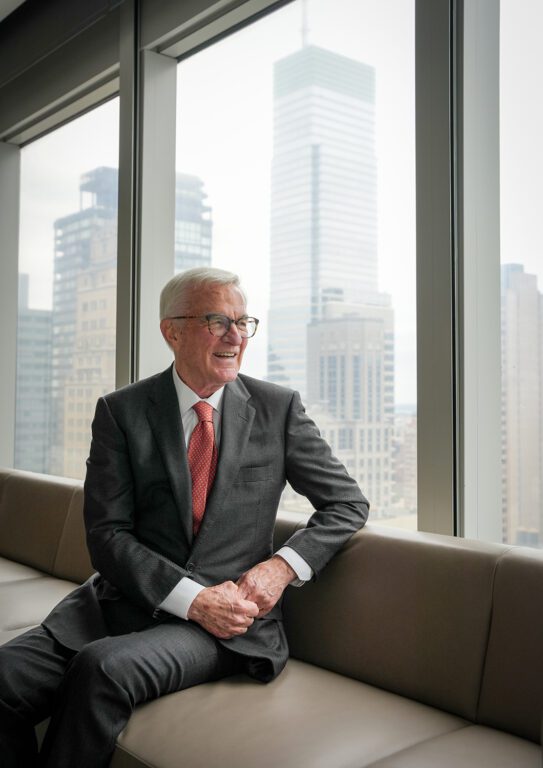
Ravenel Curry ’63, founder and co-chief investment officer of Eagle Capital Management, LLC, is pictured here on at the Eagle Capital office in New York City.
That led him to education reform, with a focus on charter schools. Since the 1990s, he has backed school choice initiatives for children in cities such as Newark, Milwaukee and especially New York. “We’re becoming a knowledge economy,” he says. “And yet we’re not educating the bottom half of society. Education is the civil rights issue of today.”
He demonstrated his enthusiasm for higher education in Furman by creating a scholarship fund for five deserving students. One of the students his foundation helped was Rebecca Norman ’05.
“I met him at a dinner for all the scholarship recipients, and I connected with him immediately,” Norman recalls. “He wanted to have conversations with us. He could sit there and talk with you for hours, and he was genuinely interested in what you had to say.”
Norman would stay in touch with the Curry family her entire time at Furman and after graduation. She sent birthday cards and would visit any time she was in New York. It made an impact on her life, but possibly even more so on Curry’s. Each time they caught up, he would ask when she was going to come work for him at Eagle.
And she did. For eight years, Norman worked at Eagle Capital until she moved back to Illinois to be closer to her family. “Here is a successful person who wanted to find out how he might be wrong way more than hear how he might be right,” she says. “He is humble, curious and always learning something new; he has had an impact on me both personally and professionally.”
Curiosity Continues
Well before sunrise, Curry has four newspapers delivered to his door and it’s only a few moments later that he’s retrieved them, poured a cup of coffee and has started digging into the news of the day. He takes The New York Times and New York Post for a glimpse into the events that shape New York and the world, and he reads The Wall Street Journal and the Financial Times to see how those events might change the economic markets.
When he’s not in his office poring over economic data or a company report, he can be found exchanging book recommendations with employees or catching up on their lives during a hallway conversation or over a snack break with a big glass of water and bowl of popcorn.
“Ravenel approaches his whole life the same way,” says Adrian Meli, Eagle Capital’s co-CIO. “He interacts with his employees, his nonprofits, his foundation and his family with the idea of doing the most good. He’s one-of-a-kind and he’s created a culture that’s about learning and spending time with people.”
Giving to Do Good
To Curry, “doing the most good” involves giving of his time and his money — all of it. In 2023 he signed “The Giving Pledge,” a commitment to donate 99% of his wealth. It’s a pledge he takes seriously and one that extends to Furman University through scholarship and a $10 million donation to renovate Timmons Arena, which reopened on Aug. 25, 2025.
“It has been a true pleasure getting to know Ravenel,” says Jason Donnelly, vice president for intercollegiate athletics at Furman. “His historic commitment to supporting Timmons Arena is a powerful reflection of his love for his alma mater and his belief in enhancing the student experience and elevating Furman’s national competitiveness. We are incredibly grateful to Ravenel for his enduring legacy of leadership.”
He serves on the boards of two think tanks, the American Enterprise Institute and the Manhattan Institute; the Duke Endowment; the New York Historical Society; and Success Academy, a large network of charter schools. He received the Manhattan Institute’s Alexander Hamilton Award in 2017. He was named a Carl F. Kohrt Distinguished Alumni at Furman in 2022 and came to Furman with his family to accept the honor. Beth died in 2015; the couple were married for 52 years. But his wife, Jane Moss; children, Boykin, Caroline and Marshall; and his seven grandchildren joined him on campus for the celebration and to cheer on the Paladins at a basketball game. He also served as a trustee at the Genetics Endowment of South Carolina, founded by Roger Stevenson ’62, a Furman friend, and the New York Hall of Science, and is a member of the Council on Foreign Relations.
“I won’t ever retire,” Curry says. “I am fortunate to have a profession that I love.”
Still Learning, Still Walking
Now in his 80s, Curry still walks to his office in Manhattan every day. He still passes fruit vendors and souvenir stands, and he would still give a hat from his own collection if he thought they needed it.
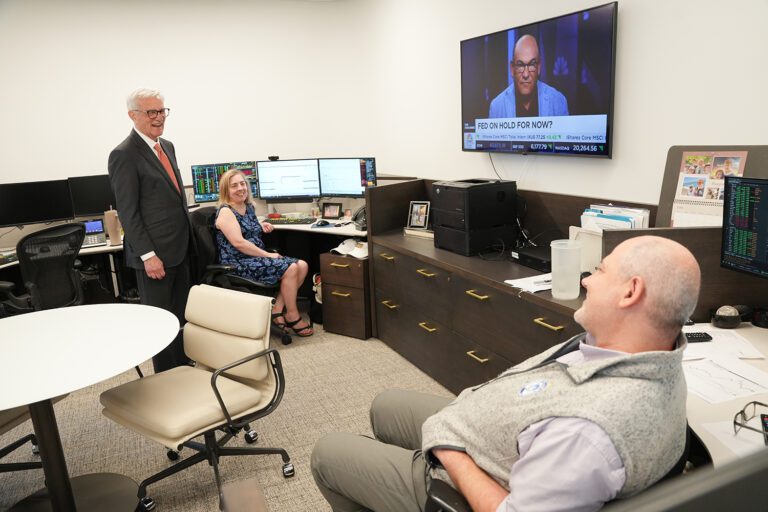
Ravenel Curry talks with employees of Eagle Capital in the trading room.
Curry is often the first to arrive at work and the last to leave. Even during the worst of the COVID-19 pandemic in New York City when most firms went remote, he made sure his office was considered “essential” and continued to work every day in the office, alongside his son Boykin and their COO. In Eagle’s trading room, there is a large television, where he’s been spotted cheering for Furman when watching an occasional basketball game. He enjoys work and inspires the 40+ employees at Eagle every day; they all buy into the community that’s been built over 37 years.
“It’s just fun,” he says. “Ideas are fun. Making something better is fun.”
His guiding philosophy has remained consistent across decades and disciplines: find purpose, invest with vision and solve problems at their root. It’s passed on to his three children, it’s helped students and it’s motivated employees.
“If you love what you’re doing, you’ll be more productive,” he says. “You’ll help the economy. You’ll help other people. That’s the whole point.”