News from campus and beyond
Leading by Example
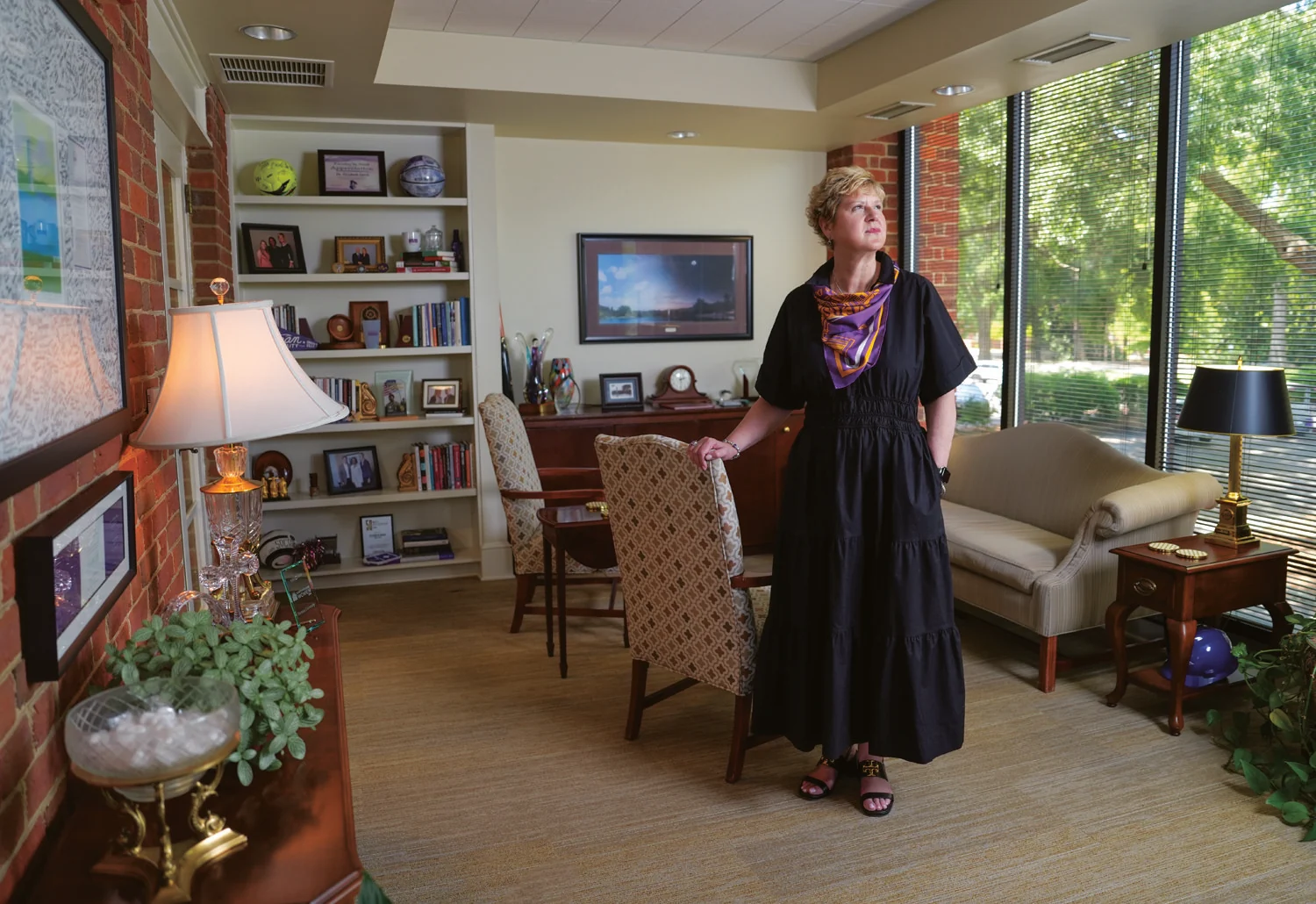
President Elizabeth Davis. Photo by Nathan Gray/Furman University
TWO HUNDRED YEARS RARELY MOVE IN A STRAIGHT LINE.
They bend, stall, surge and sometimes stumble. Furman University’s story is no exception. The university has had good reason to look back and trace the decisions, setbacks and breakthroughs that carried Furman from its earliest days to the institution it is today. That kind of reflection only means something if it’s honest.
To mark this milestone, we sat down with seven members of Furman’s leadership, each of whom has shaped the most recent chapter of the university’s history: President Elizabeth Davis, Provost and Vice President for Academic Affairs Beth Pontari, Dean of Faculty Jeremy Cass ’00, Vice President for Enrollment Management Emily Schuck, Vice President for Student Life Connie Carson, Vice President for Development Shon Herrick and Board of Trustees Chair Cindy Davis ’84.
Across seven conversations, each leader speaks about the moments that tested the university from enrollment pressures and shifting expectations in higher education to the balancing act between tradition and change. Their perspectives differ by role, but together they form something larger: a portrait of an institution that has never stopped asking how to serve its students and community better.
President Elizabeth Davis. Photo by Nathan Gray/Furman University
President Elizabeth Davis
When President Elizabeth Davis arrived at Furman University more than 12 years ago, she saw a place deeply committed to undergraduate education but still searching for the clearest way to tell its story. Today, as she prepares to depart Furman at the end of the 2026-27 academic year, Davis believes the university has established momentum moving forward and found both its voice and its direction.
“What attracted me to Furman initially was the unwavering devotion to undergraduate students,” Davis says. “The teacher-scholar model was so appealing to me.”
That philosophy remains at the heart of Furman’s identity, but Davis has spent more than a decade helping the university sharpen its focus, strengthen collaboration and think more boldly about its impact. Under her leadership, Furman built The Furman Advantage into a defining institutional philosophy. One designed to ensure every student experiences rigorous academics, mentorship, research, internships and intentional career preparation.
“We want our students to have a good launch,” Davis says. “Not just figure it out after.”
Davis acknowledged that higher education, particularly at liberal arts institutions, has not always adapted quickly enough to changing student expectations. Early in her presidency, she recognized Furman needed to become more intentional about connecting classroom experiences with life after graduation.
The university responded by creating clearer pathways for students while preserving the flexibility and exploration that define a liberal arts education. Furman’s emphasis on collaboration across academic affairs and student life became central to that evolution.
“We can do it because we can collaborate across campus,” Davis says. “That willingness to work together and for one another was a newer piece to the puzzle.”
Building that culture proved especially important during the COVID-19 pandemic. Looking back on that most challenging time showed Davis that Furman’s ability to navigate that crisis without shutting down campus stemmed from relationships and trust that had already existed.
“You don’t build culture in a crisis,” she says. “Either you have it or you don’t.”
The path has not been without challenges. Davis has overseen difficult decisions involving athletics, financial restructuring and the shifting realities of higher education. She speaks candidly about those moments, including the criticism that often accompanies leadership.
“Sometimes you’re trying to find the least bad thing to do,” she says. “But I’m proud to have been as transparent as possible about those decisions and acknowledge how hard they were in the moment.”
Still, Davis views those moments not as setbacks, but as necessary parts of positioning Furman for long-term success. She points to the university’s recent transformation planning process as a turning point that reframed Furman’s future not as a story of cuts,
but of growth.
That growth extends beyond traditional undergraduate education. Davis has championed Furman’s institutes, innovation initiatives and community partnerships as ways to expand the university’s reach throughout Greenville and beyond. Programs tied to sustainability, entrepreneurship, leadership and community health now play a larger role in Furman’s identity.
“My legacy,” Davis says, “will be about challenging this fabulous institution to imagine itself bigger.”
Not bigger in size, she quickly clarified, but bigger in impact.
As Furman prepares to move forward without Davis in the driver’s seat, she believes the university is uniquely positioned to thrive because it has stayed rooted in its mission while remaining willing to evolve. For her, the future of Furman lies in continuing to innovate without losing sight of what made the university special in the first place: close mentorship, meaningful experiences and a deeply connected community.
“We can stay true to ourselves,” Davis says, “but also think of ourselves in a bigger way.”
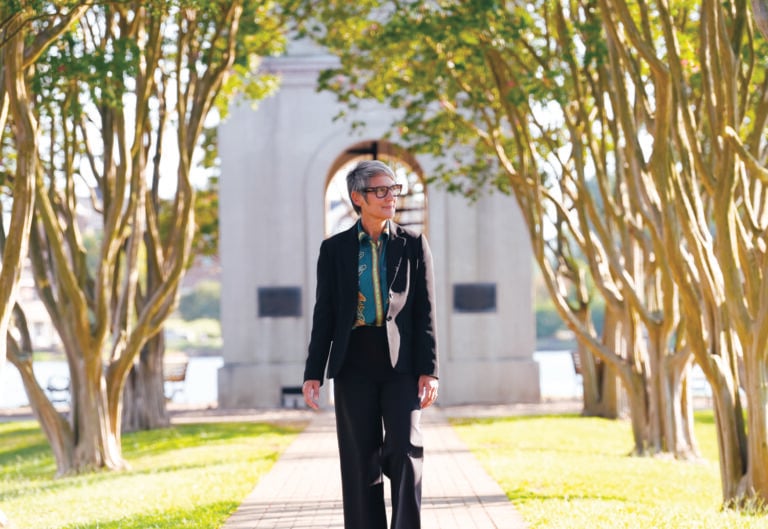
Beth Pontari, Vice President for Academic Affairs and Provost. Photo by Nathan Gray/Furman University
Beth Pontari, provost and vice president for Academic Affairs
As Furman Provost and Vice President for Academic Affairs Beth Pontari reflects on Furman University, she does not describe a straight line of success.
Instead, she talks about challenge, uncertainty, reinvention and the common goal across the institution to keep moving forward together.
For Pontari, Furman’s Bicentennial arrived at exactly the right moment – not simply as a celebration of the university’s past, but as a reminder that institutions endure by adapting without losing sight of who they are.
“We have always stayed true to ourselves. We have always been student-centered, we have always had a staff and faculty that goes above and beyond, and we have always strived to create and build a lasting culture of success and exceptionalism,” Pontari says. “We have always known and have always believed in the impact of a Furman education.”
As provost, Pontari has helped lead Furman through one of the most turbulent stretches in modern higher education. Financial pressures, enrollment challenges, shifting public perceptions of colleges and the lingering effects of COVID-19 forced universities across the country to confront difficult questions about their future.
Pontari believes those pressures ultimately created clarity.
“You have the most opportunity when things are the hardest,” she says. “It sounds crazy, but the hard decisions and facing our obstacles gave us all the understanding and the courage to kind of come out and say we have got to go for it all on liberal arts.”
That mindset – acknowledging setbacks and challenges while refusing to retreat from them – became central to how Pontari views leadership and institutional growth. She openly discussed moments when initiatives missed the mark, including campus frustration surrounding outside consulting work and strategic planning efforts that arrived during an especially difficult season.
“Sometimes as a leader you have to fail to find that success,” Pontari says. “Those things that went awry or went sideways or just didn’t come out the way we thought they would, we tried, we listened to faculty and staff, and we adjusted.”
Rather than seeing those moments only as setbacks, Pontari views them as necessary parts of progress. She believes Furman’s willingness to honestly assess itself has helped position the university for its next chapter.
“Now we know what we have to do,” she says. “There’s no more wondering.”
The renewed sense of purpose has fueled Pontari’s optimism about Furman’s future. She sees the university entering a new era with a clearer understanding of its strengths, especially the value of a liberal arts education in a rapidly changing world shaped by artificial intelligence, evolving careers and growing societal complexity.
“Everything that’s happening with AI, it is fueling a liberal arts moment now,” she says.
Pontari also believes Furman’s future success will depend heavily on collaboration across the university. She points to the importance of shared ownership and a faculty, staff, administration and alumni network working together toward overall excellence rather than in silos toward individual goals alone.
She credits much of Furman’s progress to people willing to trust one another, communicate openly and embrace difficult conversations. Even during periods of tension, she believes the university community consistently rises to meet challenges together.
“Our faculty and staff, despite the challenges and despite hard years, we always rise to the occasion,” she says. “We always exceed what’s asked of us.”
Looking ahead, Pontari envisions a Furman that is financially stronger, more nationally recognized and even more accessible to students from a wide range of backgrounds. The next challenge will be expanding scholarship opportunities while continuing to deliver a transformative liberal arts undergraduate education that builds off the foundation set by The Furman Advantage.
Most of all, she wants Furman to fully realize the potential she knows has always existed and get others to recognize what she and the rest of the university’s leadership already know.
For Pontari, the answer lies not in abandoning Furman’s identity, but in leaning more deeply into it – a university confident enough to evolve, courageous enough to learn from failure and collaborative enough to shape its future together.
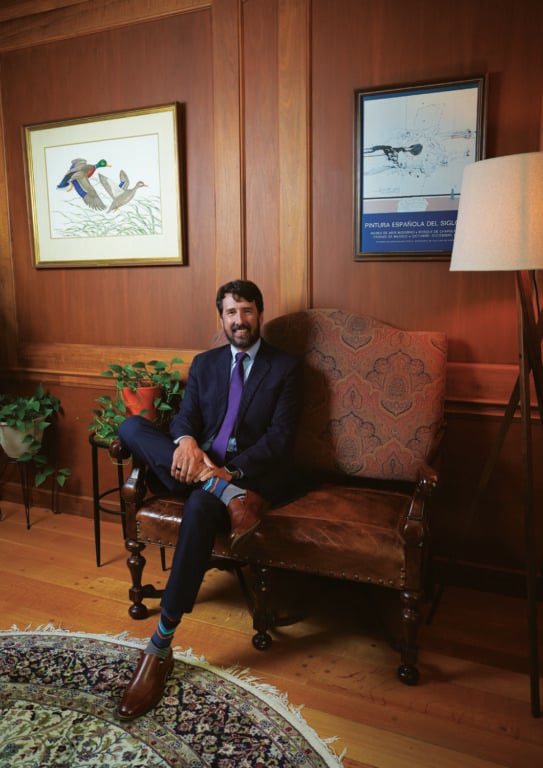
Jeremy Cass, Dean of Faculty. Photo by Nathan Gray/Furman University
Jeremy Cass ’00, dean of faculty
When Furman University closes the chapter on its Bicentennial Celebration at the end of the year, Jeremy Cass ’00 sees the institution’s future not as a dramatic reinvention, but as a continuation of the values that have defined it for generations.
“I want it to look the same and I want it to look different,” says Cass, Furman’s dean of faculty. “My priorities on the one hand are really exactly the same – just leaning into what we do best.”
From Cass’s vantage point overseeing undergraduate education, Furman’s success stems from a longstanding commitment to liberal arts education, meaningful faculty mentorship and a willingness to evolve without sacrificing identity. He believes those strengths position the university well for its third century.
“The need and value for a liberal arts education is just so evident right now,” Cass says. “Our faculty invest deeply in their students’ learning; encourage them to develop their critical thinking skills, their analytical skills, and helping them learn how to write and communicate in different ways to different audiences.”
Cass points to Furman’s culture of mentorship as one of the university’s defining characteristics. Faculty members regularly involve undergraduates in research, scholarship and creative work, often weaving those experiences directly into their own professional pursuits.
“The willingness of our professors to pause and invest in the undergraduate student because of the belief in the value of that kind of teaching and mentoring, I just think it’s truly inspirational,” he says. “I think it does set us apart.”
That student-centered philosophy helps Furman adapt to changing student interests and a rapidly shifting higher education landscape. Cass highlights the university’s expanding slate of interdisciplinary majors and minors, flexible pathways for double majors and evolving advising systems as examples of Furman responding thoughtfully rather than reactively.
“Thanks to the tireless work of our faculty and staff, we found a way to be, at once, really traditional in the liberal arts space and, at the same time, innovative in the liberal arts space,” Cass says.
He sees Furman’s general education curriculum as central to that mission. Rather than focusing narrowly on career preparation, Cass believes the university succeeds by exposing students to broad experiences that prepare them for lifelong learning and adaptation.
“We should continue to produce college graduates that are prepared for a lifetime of learning,” he says. “If you look at the pace of change in the world right now, we are kidding ourselves if we think the world a college graduate enters into is going to stay the same. Thanks to the efforts of our first-rate faculty and staff, our agile learners leave here ready to adjust, adapt and grow, no matter their post-Furman setting.”
As national conversations increasingly question the value of higher education and the liberal arts, Cass believes Furman’s model remains not only relevant, but necessary.
“I think the liberal arts are higher ed’s saving grace,” he says. “We need to be teaching young people how to function in the world, drawing from different disciplines and ways of thinking.”
For Cass, Furman’s future depends on continuing to refine and strengthen what has worked for decades: rigorous academics, engaged learning and a community deeply invested in students’ growth.
“That’s what our faculty have been doing,” he says. “That’s what we should keep on doing.”
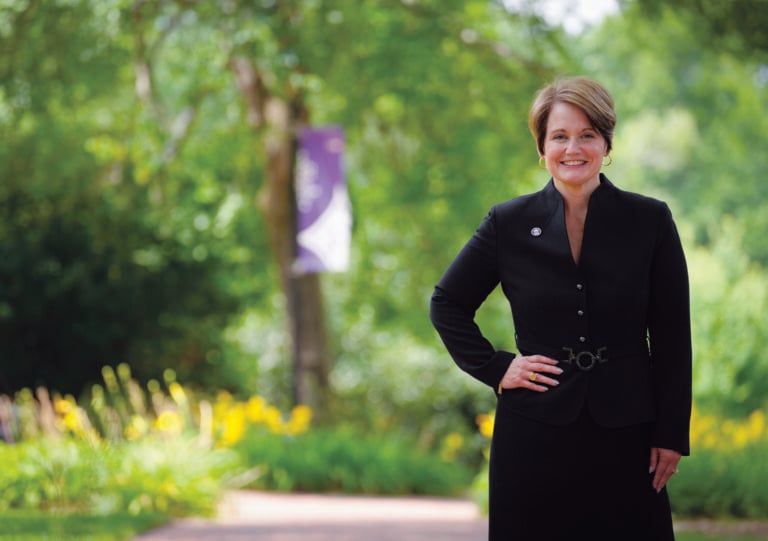
Emily Schuck, vice president for enrollment management. Photo by Nathan Gray/Furman University
Emily Schuck, vice president for enrollment management
When Emily Schuck, vice president for enrollment management, looks to the future of Furman University, she believes it will be shaped by a willingness to evolve while remaining grounded in the qualities that allow Furman to excel.
“We’re leaning into who we are and what we do really well,” she says. “What are we willing to focus on that others cannot? That’s our advantage.”
From her perspective leading recruitment and admissions efforts, Furman’s success depends on authenticity, collaboration and a deep understanding of today’s students. Schuck believes higher education has entered a new era – one where students and families increasingly analyze the value of a university experience and expect institutions to demonstrate clear purpose.
“The narrative has really changed around higher ed,” Schuck says. “Now we must be able to demonstrate our worth and our value to tomorrow’s students. What will they be prepared for on the other side of four years at Furman?”
That question drives much of the university’s enrollment strategy. Furman has intentionally created space for leaders across campus to think beyond immediate enrollment cycles and focus instead on long-term sustainability and growth.
“We not only need to be thinking about the current cycle, but we need to be thinking three years, five years, 10 years down the road,” she says. “That starts from the top down and we must challenge each other to think that way.”
Schuck credits Furman’s collaborative culture with helping the university navigate an increasingly competitive and volatile time in higher education across the country. During the past two years, she has been involved in cross-campus conversations and strategic planning efforts encouraging departments to approach each challenge with creativity, not fear.
“We’ve shifted our culture to really lean into experimentation and learning and courage,” she says. “We’re saying to each other, ‘Let’s not think about why we can’t. Let’s think about how we could.’”
That mindset shapes everything from financial aid strategy to campus visits. Rather than trying to imitate larger universities, Furman focuses on refining the personal, relationship-driven environment that defines the institution.
“The personalized interaction matters,” Schuck says. “We can’t be everything to everyone, but we know what we’re really good at, and that’s undergraduate education.”
In her mind, recruitment success extends far beyond enrollment numbers. She sees admissions as the beginning of a much larger relationship between students and the university community.
That emphasis on connection also includes alumni, who Schuck describes as an increasingly important part of the recruitment process. Furman has expanded alumni involvement in admitted student events and networking opportunities, helping prospective students envision their own future within the Furman community.
“They are the living, breathing examples of what the Furman education provides,” Schuck says.
After more than 22 years of progressive leadership experience in higher education, she believes the university is uniquely positioned to grow thoughtfully while staying true to its mission. The university’s goal of expanding enrollment while maintaining its close-knit residential experience reflects that balance between ambition and identity.
“We’re setting the course for the next 200 years,” she says. “Our role is to grow and understand the students of tomorrow and ensure Furman aligns with those needs in an authentic way.”
For Schuck, that future depends on continuing to build a campus culture centered on curiosity, collaboration and belonging.
“We will persevere. That’s who we are.”
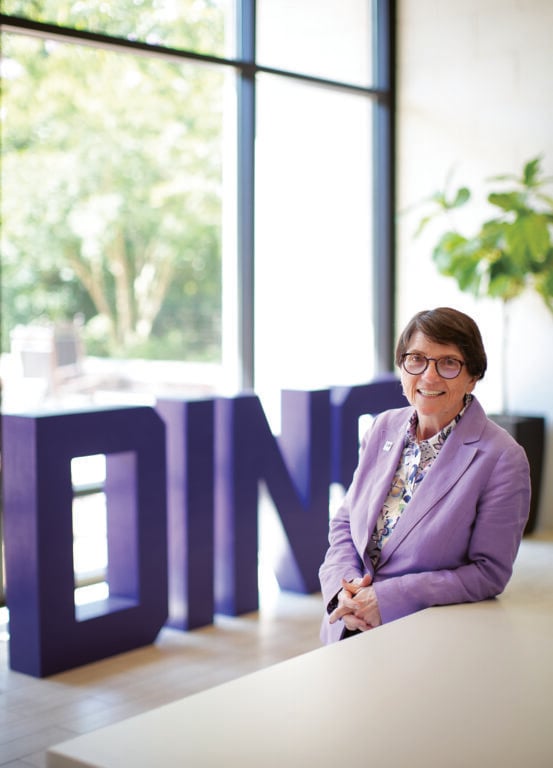
Connie Carson, vice president for student life. Photo by Nathan Gray/Furman University
Connie Carson, vice president for student life
Connie Carson, vice president for student life, has been a part of the Furman experience for nearly 20 graduating classes. She has seen leadership transitions, evolving trends in higher education and changing needs of the student body. And in that time, she has learned that the future of Furman University will depend on something deeper than new buildings, strategic plans or enrollment numbers.
It will depend on people learning how to thrive together.
During nearly two decades in student life leadership, Carson has helped guide Furman through enormous change in higher education. From the rise of student mental health challenges to the lasting social effects of COVID-19, she has come to believe that the universities best positioned for the future will be the ones willing to evolve while keeping human connection at the center of the student experience.
“What’s kept me here is seeing change and growth and the investment in the people,” Carson says. “Furman really does care about its people.”
Long before colleges across the country fully recognized the growing mental health crisis among students, Carson and Furman leaders already were studying it. The university’s resiliency study eventually became a foundation for The Furman Advantage and a broader campuswide effort to integrate academics, advising, wellness and student support.
“We were like, ‘How do we get ahead of this curve?’” Carson says. “If you come to Furman and you get into Furman, you should be able to leave Furman a better version of yourself.”
That work fundamentally changed how Furman approaches student life. Carson describes today’s university as far more collaborative and interconnected than the Furman she joined in 2008.
“The Furman I came to was poised to take the next necessary steps to strengthen the student experience,” she says. “This leadership made the leap that followed possible.”
Now, as Furman continues to look ahead to the next several decades, Carson believes the university’s future will revolve around creating a thriving community – one that supports not only students, but faculty, staff and alumni as well.
“The question I am constantly asking is, ‘What are we going to do about well-being?’” Carson says. “How can we impact well-being for future people of the world and citizens that are coming out of Furman so that they have better practices themselves?”
She sees Furman continuing to build personalized systems that help students navigate college academically, socially and emotionally. That includes everything from four-year advising programs and intervention systems to emerging technologies designed to connect students with campus resources more quickly.
But Carson believes the biggest challenge facing higher education actually may be helping students rediscover that community after years of social disruption.
“Humans are social,” she says. “You don’t come to college to not engage.”
After COVID, Carson noticed students arriving on campus eager for connection but often lacking confidence in social settings. In response, Furman began adapting student organizations, recreation programs and leadership opportunities to better match how students interact today.
She points to the rapid growth of outdoor recreation, student organizations and new forms of campus engagement as signs that students still deeply want community – even if they build it differently than previous generations.
Carson marvels at how Furman’s size and culture uniquely position the university for the future. While larger institutions often struggle to create individualized experiences, she sees Furman’s smaller scale as an opportunity to remain nimble, innovative and student-centered.
“We were able to be really customizable in our services,” she says. “We should really take advantage of who we are.”
Just as importantly, Carson sees collaboration as the engine that will continue driving Furman forward. She credits partnerships among faculty, student life staff, trustees, alumni and university leadership for creating many of the university’s most successful initiatives right alongside the students themselves.
“It was integrative from the top down, the bottom up and everywhere in between,” she says.
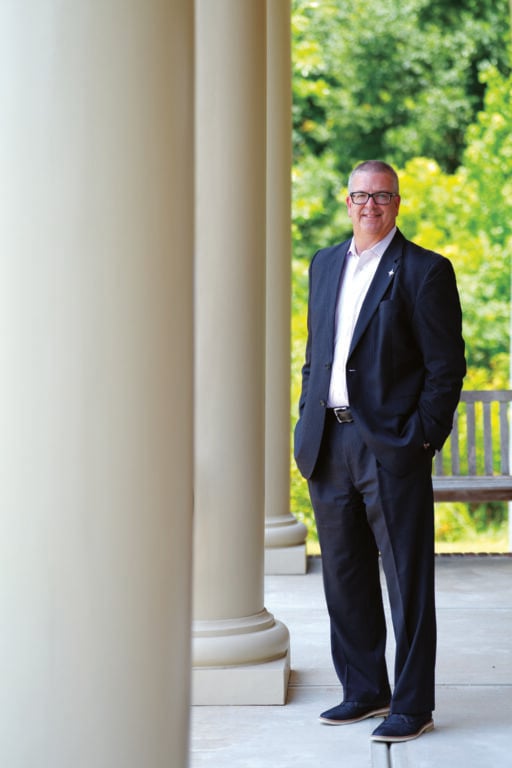
Shon Herrick, vice president of development. Photo by Nathan Gray/Furman University
Shon Herrick, vice president for development
After more than three decades in higher education, Shon Herrick still believes in the transformative power of a college education.
That belief is personal.
A first-generation college student himself, Herrick knows how a single opportunity can change the course of a life. Now, as Furman University’s vice president for development, he spends his days helping create those opportunities for the next generation of students.
“People invested in me nearly 40 years ago,” Herrick says. “Because others invested in me, I’ve had the opportunity to do the work that I’m doing. Now I get to reinvest in the next generation of students.”
It is one of the reasons he remains energized about Furman’s future.
Coming off the success of the Clearly Furman campaign and following several years of record-setting fundraising, Herrick sees an institution with momentum and a community eager to help it continue moving forward.
“When you look at what has happened in the last five or six years, our alumni, parents and friends have really risen to the challenge,” he says. “We have people who believe in what we’re doing and believe in what Furman stands for.”
For Herrick, fundraising is never simply about dollars. It is about relationships.
His team connects donors with students, alumni with faculty, and families with the experiences that shaped their students’ Furman journeys. Few moments capture that better than introducing a scholarship recipient to the person whose generosity made their education possible.
That focus on access will define much of Furman’s fundraising future. While university priorities may evolve with new leadership and changing needs, Herrick sees scholarship support as a constant.
“Scholarship will always be a priority,” he says. “Our particular attention going forward is focused squarely on scholarship and access.”
The work is not without challenges. Like many institutions, Furman must navigate shifting perceptions about higher education and explain the value of a liberal arts education in an increasingly skeptical environment.
Herrick believes the answer is simple: tell the real story.
“If you’re willing to have a conversation with us and to share what our students are doing and the impact that our faculty and staff are having, I think you’ll see that Furman is a great investment,” he says.
Sixteen years after returning to Furman, Herrick remains convinced the university’s greatest strength is the people who care deeply about students. It’s something, in his mind, that has always set this place apart from anywhere else.
“If there’s someone out there who says, ‘I want to make a difference,’ this is a place that will do that.”

Cindy Davis, Chair, Board of Trustees. Photo by Owen Withycombe/Furman University
Cindy Davis ’84, board of trustees chair
Board of Trustees Chair Cindy Davis ’84 wouldn’t be at the forefront of Furman’s leadership if she didn’t believe it’s entering one of the most important – and promising – moments in its history.
She’s there because higher education faces enormous challenges nationwide, from declining enrollment trends to financial pressures and shifting student expectations. But Davis says Furman’s willingness to adapt early, invest strategically and stay focused on its mission has positioned the university to thrive while many others scramble to react.
“Furman has really been on its toes leaning in,” Davis says. “So many other universities are back on their heels and now they’re reacting.”
That proactive mindset helped shape Furman’s recent transformation plan, which Davis described as a road map for growth rather than retreat. The university strengthened academic offerings, introduced new majors, expanded experiential learning opportunities and sharpened its approach to enrollment, marketing and financial aid.
“We’ve got a great product,” Davis says. “We’re connecting with people differently, we’re smarter on how we’re allocating our marketing resources, and we’ve become much more strategic with our financial aid.”
Davis points to Furman’s combination of rigorous academics, close faculty mentorship and hands-on learning as a major advantage in an increasingly crowded higher education landscape. She believes the liberal arts model, which was once viewed by some as outdated, is becoming more valuable in an era shaped by rapid technological change.
“We’re teaching them how to think, not what to think,” Davis says. “Those critical thinking skills, those human engagement skills, those reasoning skills, I think we’re seeing the need for the pendulum to swing back to those basics.”
Furman’s success, Davis says, comes not only from strategy but from people. She repeatedly emphasized the passion of Furman’s faculty, and the transformational experiences students receive once they arrive on campus.
“I have been enormously impressed with the caliber of professors we have at Furman and how passionate they are about teaching these students,” she says. “That does not exist in most places.”
The university also has made significant investments in campus life and facilities, including updated housing, expanded mental health resources and the newly renovated Timmons Arena. Davis, a former executive at Nike, believes those improvements help create the kind of vibrant experience that continues to attract students despite a difficult national enrollment climate.
Still, she acknowledges Furman has faced challenges. Colleges across the country are navigating what Davis calls “one of the most significant times of transformation for higher education.” Furman has had to evolve its messaging, rethink how it communicates outcomes and become more intentional about meeting student and family needs.
“No one’s immune from it,” Davis says. “But we are strategically positioned, we’ve got a direction, we’re executing on it and we’re adapting.”
Looking ahead, Davis sees even more opportunity. She believes Furman’s institutes and graduate offerings could expand the university’s reach far beyond traditional undergraduate education by serving lifelong learners and community partners throughout the region.
Furman’s future, she says, ultimately rests on staying disciplined while continuing to dream bigger. The university’s Bicentennial celebration honored two centuries of history, but she believes the next chapter may be even more transformative.
“We’ve done a lot of work to know what we need to do,” Davis said. “Now it’s about continuing to strengthen what makes Furman special and building toward what comes next.”