News from campus and beyond
Mary-Mitchell Campbell ’96 embraces the “what ifs” through a positive lens
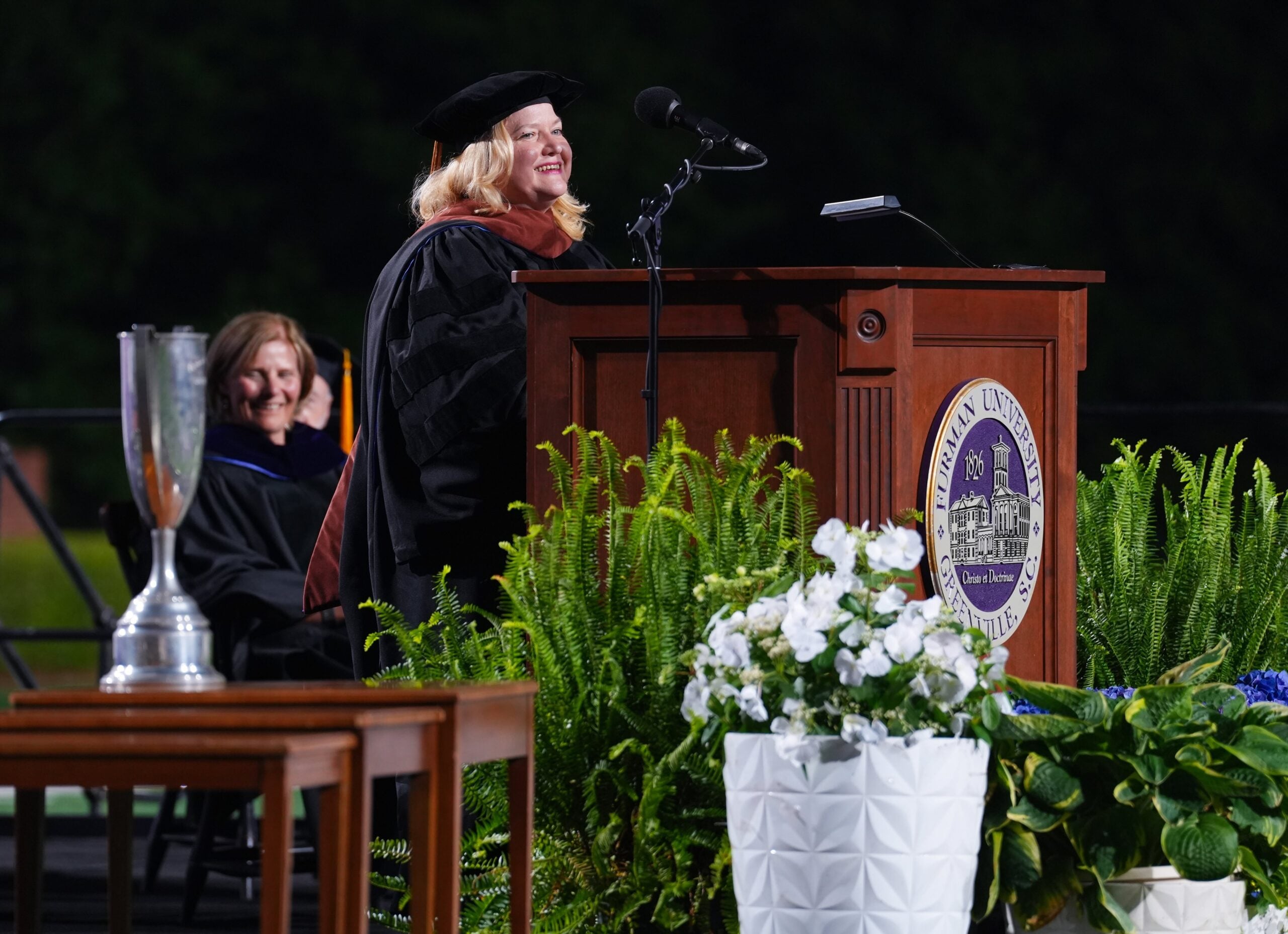
Mary-Mitchell Campbell ’96, acclaimed musician and volunteer, gave the commencement keynote address at Paladin Stadium on May 9.
It’s been quite the month of May for Mary-Mitchell Campbell ’96. She took over conducting duties on Broadway’s “Death Becomes Her.” She received the Isabelle Stevenson Tony Award for her impressive and intensive theater and performer’s advocacy work. And, on May 9, she returned to her alma mater, Furman University, for the first time in nearly a decade to give the Commencement speech for the bicentennial class of 2026.
It’s all in a month’s work for Campbell. She’s the kind of person who, when asked, pretty much has to say “yes.” Whether it’s taking over musical direction on a Broadway production for a friend in need, running Kristin Chenoweth’s Broadway Bootcamp each summer in Oklahoma or jumping on stage in front of 560 graduates to inspire them into their next step of life, Campbell gives of herself. And it all started at Furman with a class she didn’t even need in the first place.
Things will never be the same
“I took a social problems class here that radically rocked my world,” Campbell said. “It changed everything. Literally like a dividing day of pre-that class and after that class.”
The course exposed her to systemic inequities and the realities many communities faced just beyond Greenville’s most visible spaces. Campbell toured mill villages, saw the stark disparities in infrastructure and began to understand how deeply systems could shape opportunity.
“Once I fully understood that, I was like, ‘This is crazy. We should be doing more,’” she said.
That realization became the foundation for a career rooted not only in artistic excellence, but also advocacy and service. While at Furman, Campbell founded the Pauper Players, a student theater organization that combined performance with philanthropy, raising money for community organizations through productions staged on campus.
Nearly 30 years later, the organization still thrives.
For Campbell, one of the most meaningful moments came when Pauper Players eventually supported Arts Ignite, the nonprofit arts organization she founded in 2005.
“I was like, ‘Oh, this thing that I started in college is now fundraising for this thing that I started as an adult,’” Campbell said. “That was a very full-circle moment.”
Getting the call
That sense of reflection has followed Campbell throughout this season of her life. Returning to Furman carried special emotional weight as she balanced Broadway productions, nonprofit leadership and preparations to accept one of theater’s highest honors. Campbell recently learned she would receive the Isabelle Stevenson Tony Award, an honor recognizing humanitarian and advocacy work within the theater industry.
“I had completely been like, ‘Oh yeah, getting a Tony? That’s not my journey,’” she said. “Then they called and said, ‘You won the Isabelle Stevenson Tony this year,’ and I just paused and went, ‘What?’”
The recognition arrives after years of balancing what Campbell jokingly describes as “too many jobs.” In the past year alone, she worked on multiple Broadway productions, conducted shows, led concerts, oversaw nonprofit initiatives and continued mentoring performers across the country.
Still, she approaches success with the same perspective that guided her when she first moved to New York after graduation. Despite encouragement from professors to pursue graduate school and more stable opportunities, Campbell felt compelled to chase Broadway, even if failure waited on the other side.
“I’m not scared of failing,” she said. “I’m scared of not trying.”
Speaking truth to the next generation
That mindset became a central theme of her Commencement address. Campbell encouraged graduates to embrace uncertainty, remain open to growth and understand that fulfillment rarely comes from awards, titles or professional milestones alone.
“There is no finish line,” she said. “There is no external thing that’s going to make you happy.”
Instead, Campbell believes purpose comes from connection, community and a willingness to keep showing up for others. They are the same lessons she first learned in a Furman classroom decades ago.
As she stood before Furman’s bicentennial graduating class, Campbell represented far more than Broadway success. She represented curiosity, compassion and the willingness to pursue passion even when the outcome remains uncertain.
And for Campbell, coming back to Furman felt less like revisiting the past and more like honoring the place where so much of her future first began.