For alumni and friends
of the university
of the university
Letter From the President: Furman endures across centuries
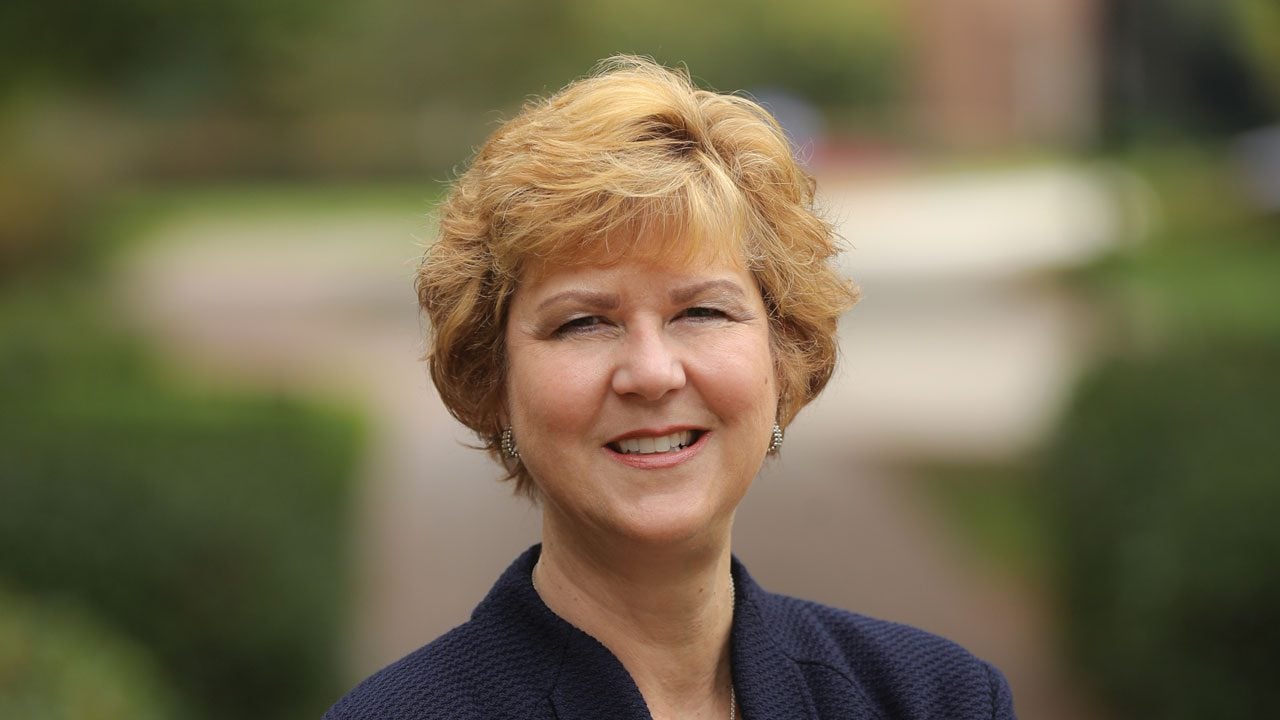
Elizabeth Davis / Photo by Jeremy Fleming ’08
On March 19, 2015, as I was getting ready to deliver my inauguration address, I stepped into McAlister Auditorium, and my knees buckled.
As executive vice president and provost at Baylor University, delivering public speeches to thousands of people was a normal part of my job, and I did so, mostly, without a hitch.
But at that moment, the enormity of my new job hit me. Every aspect of Furman University, a 189-year-old institution, was my responsibility. I was worried less about implementing changes and innovating the curriculum as I was about breaking what had been built. With a cursory look at our beautiful campus, our excellent faculty and staff and our stellar students there didn’t appear to be a single blemish.
This year, as we celebrate Furman’s Bicentennial, it’s worthwhile to remember that our beautiful campus and remarkable achievements didn’t just sprout from the ground in perfect form. Remembering the hurdles we’ve overcome helps us appreciate our resilience in the face of current challenges. It reminds us to stay true to our values and vision as previous generations of leaders have done. It also gives us confidence to try new things, aware that the path to progress and excellence is rarely perfect.
The university’s beginning wasn’t exactly auspicious. Edgefield, South Carolina, in 1826, was a small town of 300 people when the South Carolina Baptist Convention established the Furman Academy and Theological Institution there. It had been a lawless town, and duels on the courthouse steps were common. After three years the campus relocated to Santee, and again in 1837 to Winnsboro before moving to Greenville in 1851 as Furman University.
One can imagine the uncertainty and tenuous nature of a Furman education if the faculty and staff picked up and moved every few years. But leaders remained committed to their vision, and in Greenville the university found its footing on the banks of the Reedy River. That didn’t make it immune to hardship.
Since the beginning, Furman struggled with finances. In 1922, President William Joseph McGlothlin proclaimed that “the fundamental difficulty at Furman is the lack of money” and “the supreme need is endowment.” Debt skyrocketed 321% between 1925 and 1928, and enrollment dropped 20%. Faculty salaries were below average and arguments about the cost of athletics ensued.
Still, Furman endured. In 1924 the university became a named beneficiary in James B. Duke’s indenture, receiving an initial amount of about $2 million. One hundred years later, The Duke Endowment continues to make transformational gifts to Furman, allowing us to offer students unique advantages.
In 1975, Moffett Kendrick, the vice president of Development at the time, reported that Furman’s gift income had fallen behind 74% from the prior year. This June, we will conclude the Clearly Furman campaign. As of March 1, you have committed more than $490M, exceeding our historic goal. Because of your support, we believe this campaign can and will surpass more than $500M, making it one of the most successful ever completed by a liberal arts institution. During the course of the campaign, giving from the Paladin community has increased year over year – from $20 million to more than $50 million annually.
In 1992, after the split from the South Carolina Baptist Convention, students transferred, others decided not to enroll, and Furman lost approximately $1 million annually from the SCBC. By 1994, then-President David Shi said that “significant retrenchment” was necessary. The setback was temporary. Today, Furman is recognized as one of the most innovative universities in the country with one of the best first-year experiences for students.
In 2015, I found my footing pretty quickly, literally and metaphorically, and we set about implementing difficult but important initiatives, like The Furman Advantage and our reckoning with slavery in the “Seeking Abraham” project.
We’ve grown from a small-town, startup, nomadic academy into one of the best liberal arts and sciences universities in the country. We will continue to move forward and make challenging and transformative decisions. As we improve our competitive position in the higher education landscape, we do so confidently knowing that Furman University is resilient and strong, not in spite of our challenges but because of them.
Here’s to our next century!