For alumni and friends
of the university
of the university
History on Film
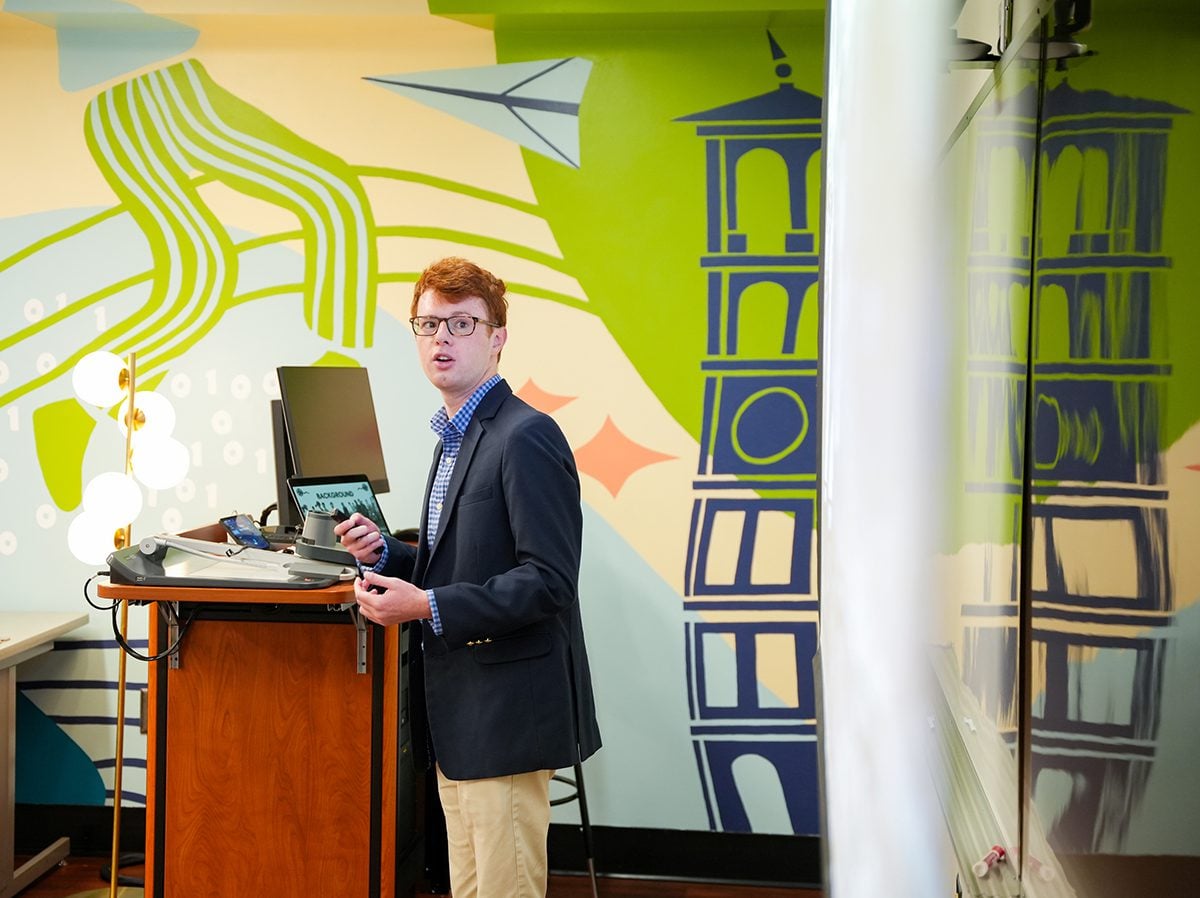
Cole Kennedy ’25 discussed his documentary film about his great-grandfather accepting the surrender of a Japanese garrison on the Philippine island of Cebu near the end of World War II, presented in Furman Hall during Furman Engaged, April 11, 2025.
Wandering through his grandfather’s office and perusing the black-and-white photos of soldiers and officers, Cole Kennedy ’25 felt like he grew up in his family’s personal military history museum.
The snapshots from World War II captured soldiers talking to one another on a base in the Philippines, and an officer in dress uniform at a ceremony. Medals and other curios kept by the family over the years are neatly displayed throughout his grandfather’s office. In a place of honor sits a long, slender katana sword resting in a black scabbard.
Right below it, a photo told its story, showing the moment a Japanese military officer surrendered that sword to Kennedy’s great-grandfather, U.S. Army Lt. Gen. William H. Arnold.
“A simple family artifact can lead to a story that changes how I look at my family’s history,” Kennedy says. That artifact was the start of Kennedy’s quest to tell his family’s story and uncover this little-known part of World War II history. These relics had always flooded Kennedy with a sense of pride in his family, but months of research and interviews gave him a deeper respect for his great-grandfather’s historic role.
Arnold was a major general in 1944 when he was assigned as commander of the Americal Division – now known as the 23rd Infantry Division (Americal) – which he led through combat operations in the southern Philippines. He accepted the first surrender of a large-scale Japanese garrison on Cebu Island on Aug. 28, 1945, days before the formal Japanese surrender on Sept. 2, 1945, which marked the end of World War II.
Kennedy was driven to tell his great-grandfather’s story, and when he came to Furman, he sought guidance from communication studies instructor Mary Sturgill. When Kennedy told relatives he was working on a documentary, his grandfather, retired Army Col. Joseph C. Arnold, “brought over all his father’s photo albums and biographical documents” and connected him with relatives who could point him toward more information about the lieutenant general.
Kennedy’s research into oral histories, interviews with World War II historians and a book on the Americal Division produced a 10-page biographical timeline of William H. Arnold’s life and career. Sturgill taught Kennedy how to professionally edit and frame his shots, and with these skills he was able to produce the 18-minute documentary film “Victor
II: Cebu.”
“Witnessing Cole’s storytelling journey unfold here at Furman – from clarifying his initial ideas and supporting his research to collaborating on production logistics and creative presentation ideas – has truly been rewarding,” Sturgill says.
Kennedy put those skills to work piecing together the historical record and new interviews with historians. He was able to breathe new life into the family photos and artifacts. While reading through a transcript of a conversation Arnold had with another military officer, Kennedy said his great-grandfather had been “looking for a map of Cebu with the rest of the Americal Division’s leadership” moments before Japanese forces launched a surprise attack against the American troops. In a flash, Arnold was “shooting out the window to repel a Japanese assault,” Kennedy says.
Through engaged research supported by faculty mentors passionate about enabling student success, Kennedy was able to find a deeper, more personal connection to his own family’s history and explore the greater historical context his relative was a part of.