For alumni and friends
of the university
of the university
A Life of Justice
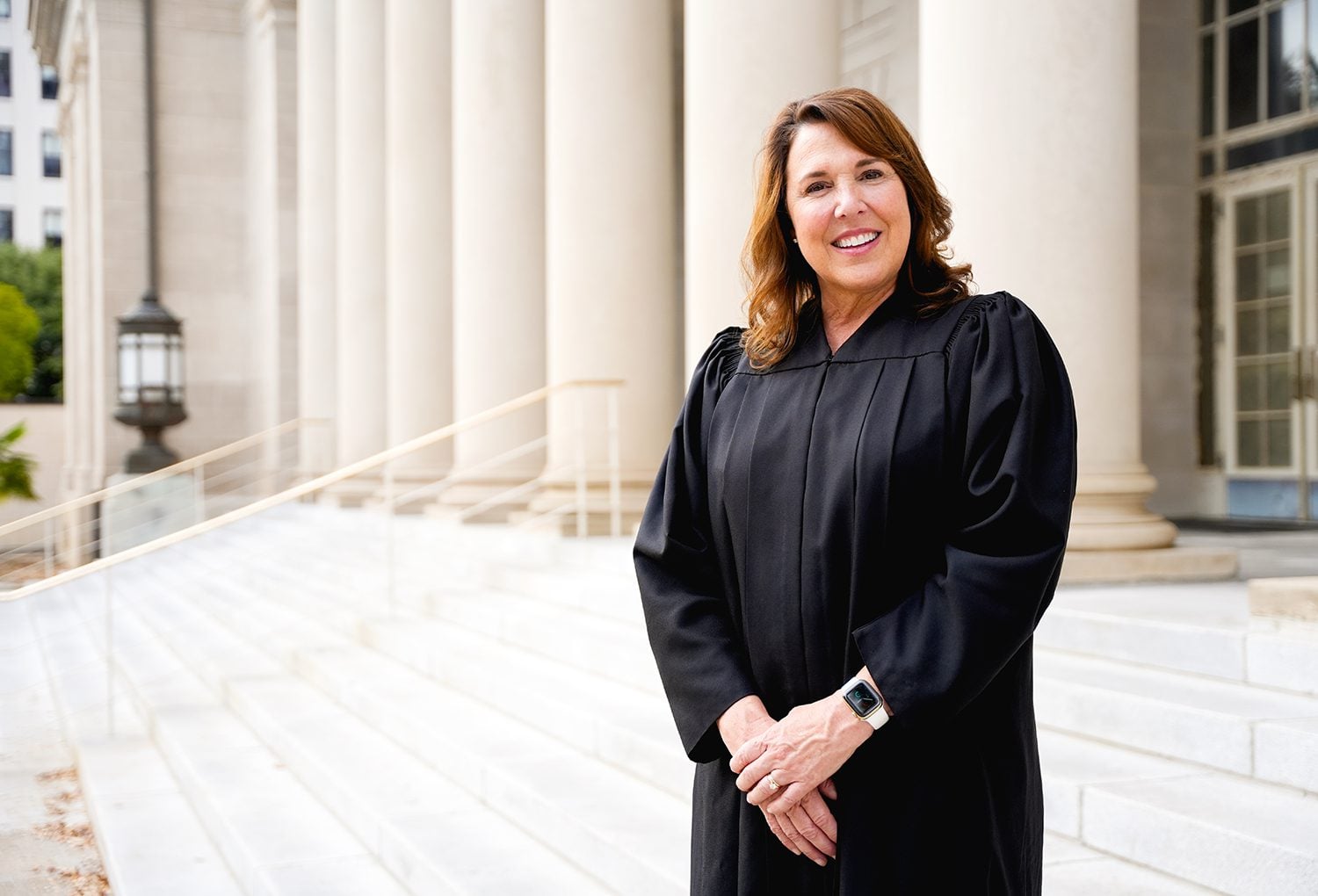
South Carolina Supreme Court Justice Letitia Verdin ’92 at the courthouse in Columbia, South Carolina. Photo by Nathan Gray, Furman University
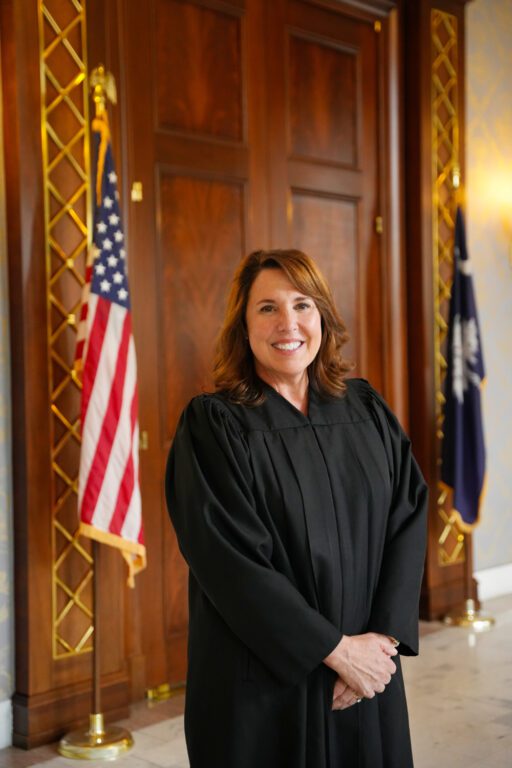
South Carolina Supreme Court Justice Letitia Verdin ’92 at the courthouse in Columbia, South Carolina. Photo by Nathan Gray, Furman University
At 5 o’clock every evening, Angela and Harry Hamilton gathered their three girls around the dinner table in their modest brick ranch-style home on Quincy Road in Seneca, South Carolina, before Harry left for a ballgame or a play or a meeting at the high school that he led as principal for 28 years.
Eventually, Felicia, the oldest, also became principal of Seneca High. Blythe, the youngest, worked for the federal government around the world. The middle daughter, Letitia, graduated from Furman in 1992 with a degree in biology, encouraged by her parents toward medical school. But, largely because of those family dinners, her path diverted to law, and in June 2024, Letitia Hamilton Verdin became the third woman ever elected as a justice on the South Carolina Supreme Court.
Verdin and her husband Chuck, an attorney specializing in probate, corporate and tax law, and Murphy, their 3-year-old Frenchton, live in a tasteful, almost understated home on a quiet street in the woods around Travelers Rest. Their twin sons, Eli and Zack, graduated one-two from Travelers Rest High School and will graduate from Clemson this spring.
The associate justice is unfussy. She has a quick, warm, easy smile. Her accent echoes her rural roots and she’s a hugger. She listens intently, and she’s curious enough to Google a guest’s background. She’s someone you want to sit with and talk sports, cooking or gardening (she’s a certified master gardener), and someone you trust to hear and rule on the most serious legal cases in South Carolina.
A Wake-Up Call to Do More
In the 1980s, Seneca was a stop on the way to somewhere else, Lake Keowee or northern Georgia. Angela taught history and English at the junior high. And, between her and Harry, they knew most of the families in town. They sat around the dinner table talking about which families were having hard times, which students needed help at home or in the classroom, and how to help them. The girls learned that many children grow up in difficult, sometimes horrible, conditions.
One evening, talk turned to a popular student who had committed suicide and the kinds of services the other students and teachers would need to cope with the tragedy. Verdin was in elementary school, but she knew the student’s death was a wake-up call, “that we should be looking for signs to do better in our community.”
“There are so many situations where we have to stand up for people who can’t, who otherwise wouldn’t have anyone to speak for them,” she thought. She wanted to be someone who would take on other people’s problems and make them her own so she could solve them. She thought about being a lawyer.
Her parents thought lawyering was too rough and tumble, and they tried to snuff out any glimmer of interest in law. They wanted Letitia to become a physician, so, after graduating as her high school valedictorian, she enrolled at Furman as a biology major.
Furman Nudges Her Forward
She volunteered with the Collegiate Educational Student Corps, which became today’s Heller Service Corps. One of her tasks was spending afternoons with children who had been taken from their homes temporarily. She was getting first-hand experience with situations like the ones her parents talked about at dinner.

Justice Letitia Verdin ’92 talks with her clerk Jen Madsen ’92 in her office at the South Carolina Supreme Courthouse in Columbia, South Carolina on Tuesday, October 29, 2024. Photo by Nathan Gray, Furman University
The notion of law school appeared randomly in her first-year English class. Judy Bainbridge, who taught at Furman from 1976 until 2007, would have her students debate topical issues, from federal policy to the Environmental Protection Agency to Supreme Court judges.
One day, Verdin debated and shined. Class ended, and she got up to walk out of the room. “Letitia, do you have a moment?” Bainbridge had seen through Verdin’s veil. She called her student back and talked with her for 15-20 minutes. “You’d make a good lawyer,” Bainbridge told her.
“I’m planning on going to medical school,” Verdin told her, ever the good daughter. “I really like science and I’m planning on majoring in biology.”
The lawyering notion stayed with Verdin while she finished her biology degree, then went to Clemson as a graduate student in biochemistry. But she wasn’t satisfied. Science might have brought her to the dance, but she was in love with the law.
She took the Law School Admission Test, without telling her family. Only after she was accepted to law school at the University of South Carolina did she break the news to her parents. From that point on, her parents “completely supported me,” she says.
In law school, Verdin again found herself helping others, as a volunteer at the Columbia Women’s Center, a domestic violence shelter. She worked the front desk and drove women to their Alcoholics Anonymous and Narcotics Anonymous meetings and talked with them about their circumstances.
“From that time on, I began to change my interest and focus. I wanted to do something in the public service area of law,” Verdin says. After graduation she worked in the solicitor’s office on crimes against children. “I found that work very challenging emotionally, legally, intellectually, but I also found it, most of the time, very rewarding.”
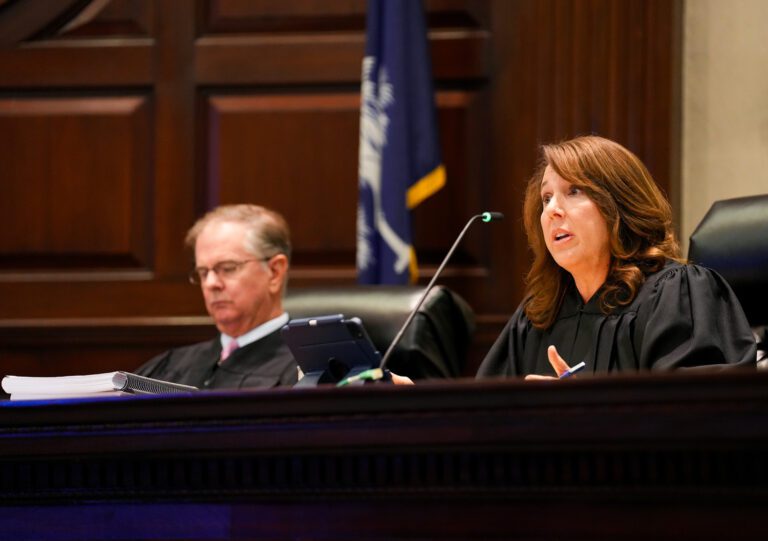
Justice Letitia Verdin ’92, right, hears a case with Justice George James Jr. and other justices (not pictured) during a South Carolina Supreme Court session on Tuesday, October 29, 2024. Photo by Nathan Gray, Furman University
Judgment Calls
State judges in South Carolina are elected by the legislature. There’s a short period when candidates campaign legislators, with very strict rules, and a long list of candidates is narrowed to three. If it’s clear that one candidate has an advantage, the other two candidates usually drop out. Such has been the case with each of Verdin’s campaigns for the bench.
She was elected to the Family Court in the Upstate in 2008 and found it, at first, intimidating. There are no juries in Family Court, it all comes down to the judge.
“I ran for this job, I wanted this job, then all of a sudden, I had to come face to face with, ‘could I do this job’? It’s a transition from being an advocate to being impartial and listening,” Verdin says.
In her first case behind the bench, she felt like the most nervous person in the room. It was a straightforward divorce in a generic courtroom in Spartanburg. But it “was the most important thing in their lives right at that moment.”
Higher Courts
In 2011, Verdin was elected to Circuit Court, the first woman judge on that court in the Upstate. She liked interacting with lawyers and the public and took pride in focusing on each case, each problem, one at a time, and making it her own to solve.
In early 2023, Verdin was elected to the Court of Appeals. But in 2024, then-Chief Justice Don Beatty retired from the Supreme Court and Justice John Kittredge was chosen to be chief, leaving Kittredge’s seat open.
Go for it, friends told Verdin. The South Carolina Supreme Court had been without a woman justice since Kaye Hearn retired the year before. (Jean Toal was the first woman elected as a state Supreme Court justice, in 1988.)
Being an effective Supreme Court justice requires reading piles of briefs and voluminous research and being able to swing from legal intricacies in topics as disparate as insurance to the death penalty.
Reflective Jurist
Verdin subscribes to advice Hearn handed her, which Hearn received from retired Circuit Judge Julius Ness: Be able to go home at night, look yourself in the mirror and like what you see.
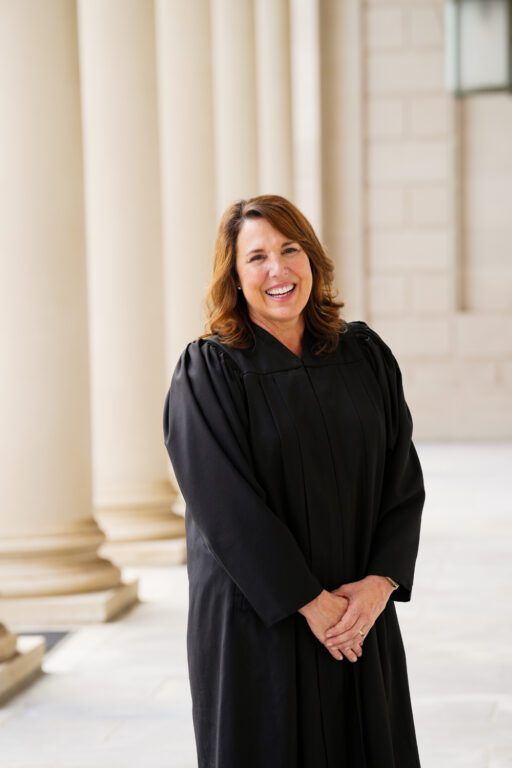
South Carolina Supreme Court Justice Letitia Verdin ’92 at the courthouse in Columbia, South Carolina. Photo by Nathan Gray, Furman University
Hearn has no doubt Verdin will shine. “She was always one of the stars of the state court judiciary because of her work ethic and demeanor,” Hearn says. As a circuit judge “she was not often reversed by the appellate court.”
Verdin’s colleagues say she’s hard-working and highly intelligent, but they emphasize one trait: a positive demeanor. She’s so likable.
“When she was on circuit and family court, she had a way of making even the criminal defendants before her feel seen,” says Jennifer Madsen ’92. She’s known Verdin since their first semester at Furman. They met briefly, and the next time they saw each other Verdin remembered Madsen’s name. They were in law school together, one year apart. Now, after working in the appellate court for 27 years, Madsen is Verdin’s chief clerk.
At her investiture, retired Judge Edward Miller said, “Her genuine and infectious good nature and her common-sense approach to handling cases made it extraordinarily pleasant to work with her, to the point that defense attorneys had to check themselves to make sure they weren’t selling out their client or giving away the farm when dealing with her.”
When Verdin sat on the Circuit Court, inmates thanked her for their sentences as they were led from the courtroom in handcuffs, Miller said.
Justice Hearn says there still could be room for Verdin to grow on the highest court. “I think she would be a great chief justice if she wants to do it.”
For now, Verdin is looking at each case, one at a time. Taking on each problem as her own, solving it according to the law. Her job also requires a lot of time in the community, giving speeches and making appearances. And she spends as much time as possible mentoring young lawyers.
At home, Verdin’s late nights on the Circuit Court meant that Eli and Zach learned to cook for themselves. Chuck, Verdin jokes, is still learning. But aspirations seemed to have skipped a generation. Both sons have been accepted to medical school.