For alumni and friends
of the university
of the university
Math and the Mouse

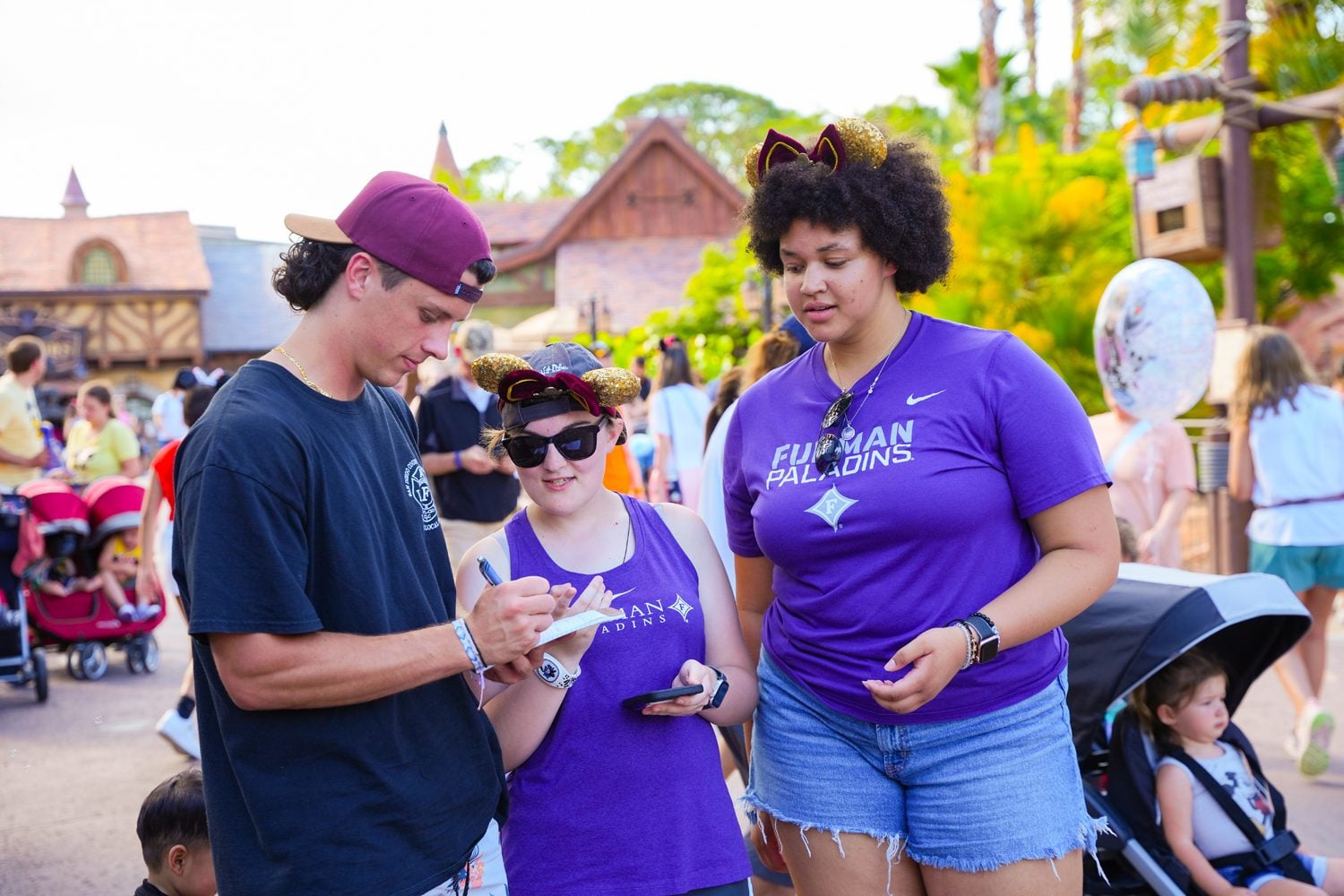
From left, Ellis Edinkrah ’25, Morgan Carns ’25, Savannah Bailey ’27 and Emily Fowler ’25 take a selfie after buying Mickey Bars at Disney World during the Math and the Mouse May X 2024. Photo by Nathan Gray, Furman University.
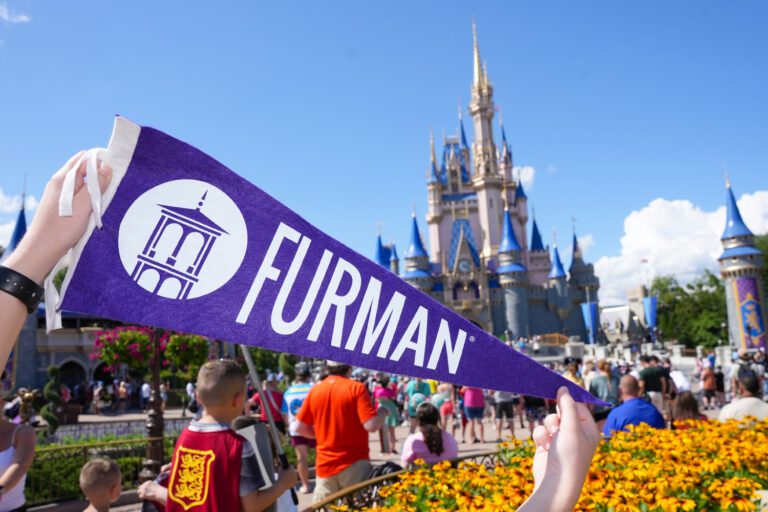
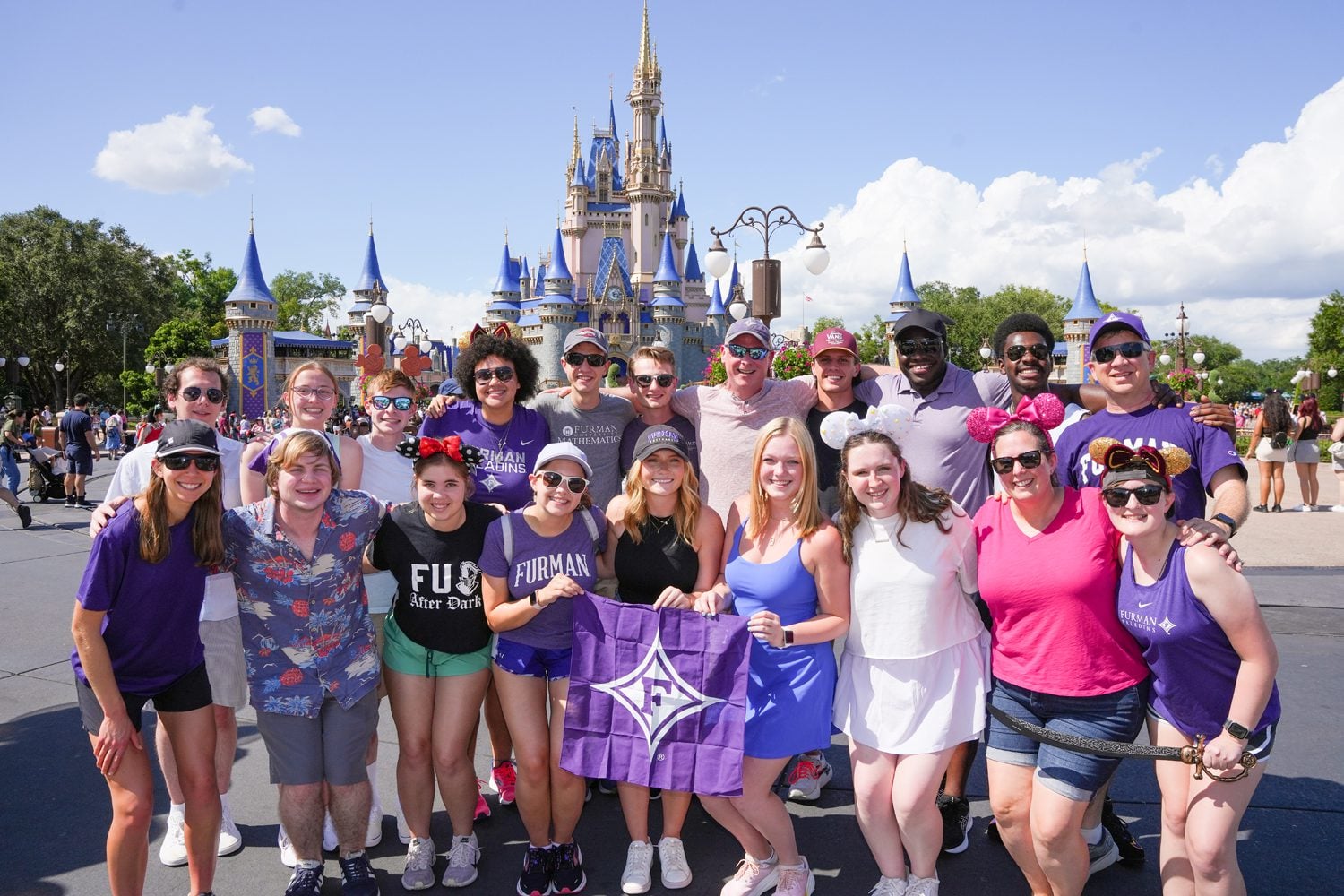
The Furman flag at the Magic Kingdom in Disney World in Orlando, Florida. Photo by Nathan Gray, Furman University.
AS A VACATION REVIEW, it’s a bummer. But it has a five-star ring to it when you’re talking about an education.
“When the class ended, I told my parents that I was tired of Disney but not tired of the math,” says Ella Morton ’20.
Furman’s Math and the Mouse, a May Experience course, marked its 10th anniversary with a sixth visit to Walt Disney World this past spring. Morton went to Orlando, Florida, with the class in 2018.
Those three weeks helped her establish a community of peers who supported her through the rest of her mathematics major and deepened her relationships with professors who served as mentors beyond her years in Greenville.
Besides that, “if you traced the path that put me in my current career, it almost certainly began at Math and the Mouse,” she says. “Math and the Mouse was my introduction to operations research, which is what I went on to study in graduate school. And my experiences in graduate school led me to my current position at Apple.”
“We’re impacting real decisions in students’ lives,” says Kevin Hutson, one of the three math professors who lead the course.
‘Who uses this?’
Hutson, Liz Bouzarth and John Harris ’91 have been working together, and with students, for more than a decade to predict college basketball tournament upsets for ESPN and The Athletic. The three professors took their first 12 students to Disney in 2014.
Bouzarth was relatively new to Furman, but she’d been visiting Disney since she was a child. On a recent trip, she’d been “struck by the complexity of the theme parks and the resorts, how much there was for an adult to think about,” she says.

Furman students and math professors participating in the Math and the Mouse May X spend time in the Magic Kingdom at Disney World on Monday, May 20, 2024. Photo by Nathan Gray, Furman University.
Hutson had been thinking about theme parks, too, as he looked for ways to help students apply classroom theory to real-life problems.
“Sometimes students walk away from those classes thinking, ‘What did I just learn? Who uses this?’” he says.
Hutson studies the mathematics of decision-making in business settings, developing tools that use math to produce optimal solutions.
His example has all the hallmarks of a textbook story problem: If Disney employs about 50,000 people in Florida and needs about 10,000 of them in the parks on a given day, and if those employees must change roles during each day to maintain safety standards, how do you make the schedule?
“It turns out that you can mathematically model that,” Hutson says.
Students leave the class with practical insights about how math applies in the theme park industry. But they also gain a broader view of applications across fields, from sports to business to health care.
Each class has met with Disney professionals from a variety of departments. Learning how these people use mathematical modeling can expand students’ ideas of how their own skills apply in the real world.
“Your career might look different by topic but you’re actually doing some similar things,” Bouzarth says.
And because math is more than numbers and formulas, students also build intangible skills. Harris uses the expression “creative wondering.”
“Studying math just helps you learn how to think,” he says.
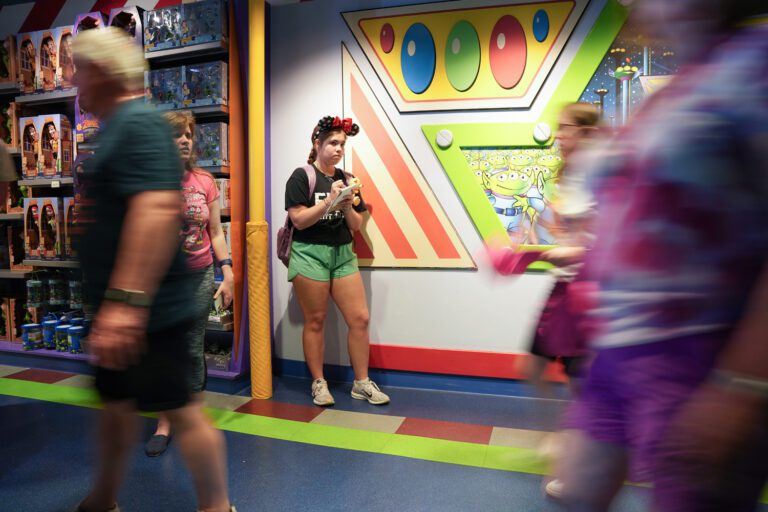
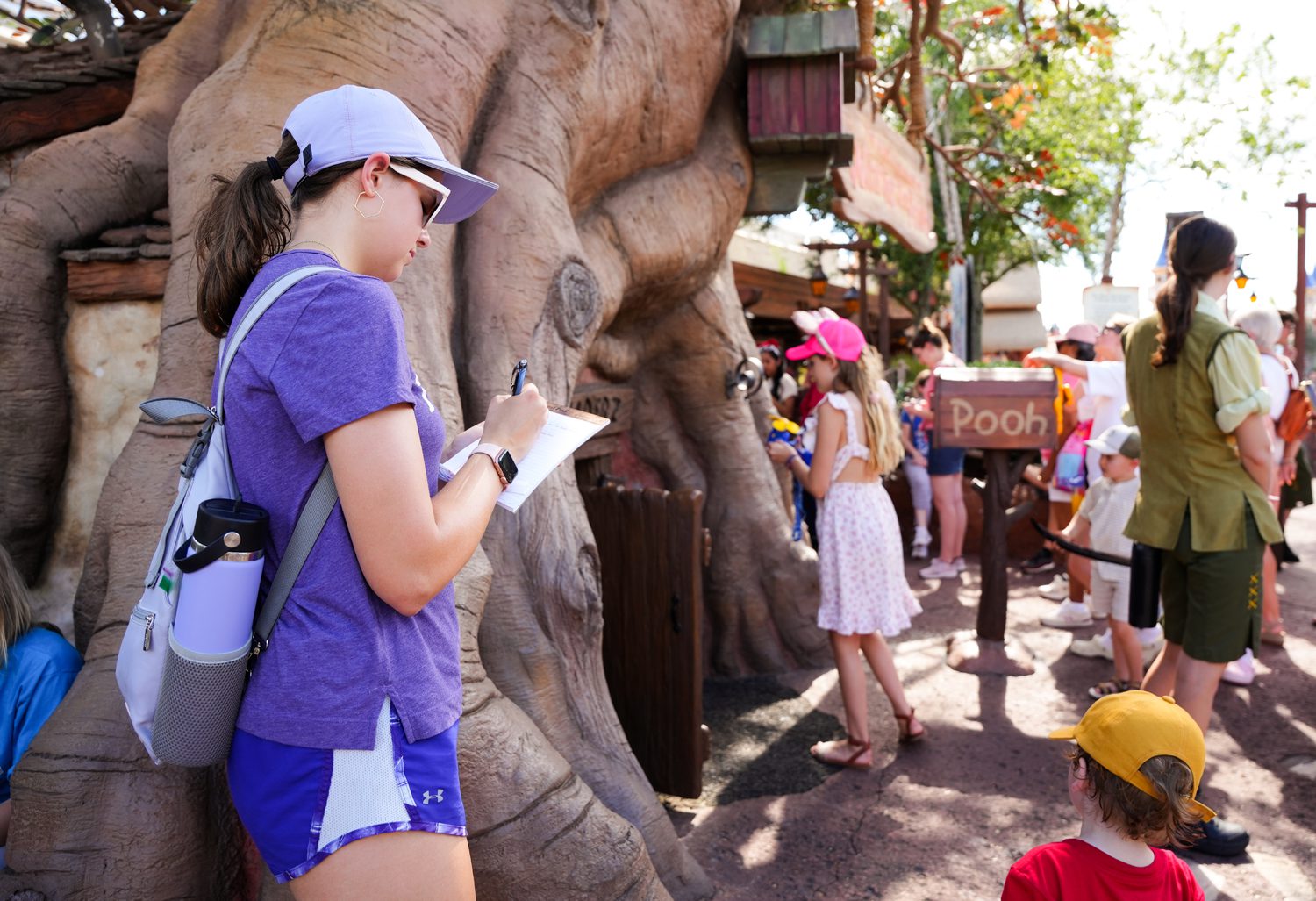
Hannah Paulson ’27 takes data at an attraction at Disney World. Photo by Nathan Gray, Furman University.
‘Being curious’
Math and the Mouse starts with a scheduling problem much simpler than Disney’s: Students develop a system to schedule a restaurant’s staff, accounting for busier and lighter times of day while also giving employees necessary breaks.
They ease their way into Disney’s orbit by using wait-time data for key rides to determine ideal locations for mobile concession stands, applying clustering algorithms and data visualization tools.
The park also is inspiration for student-initiated projects in which class members identify a question and then try to figure out how math can help answer it. Their teachers encourage them to wonder, to notice, to think creatively about what works and what doesn’t.
Students have applied math to employer-side problems such as how to give the greatest number of visitors a personal experience with luminaries such as Mickey or Cinderella.
“A guest should never accidentally see two of the same character at the same time because that spoils the magic,” Harris says.
Students also have used math to answer guest-experience questions such as how long you might have to wait in a single-rider line. These lines have no posted wait times and simply slot in individual guests when a group with an odd number for the ride comes through the regular line.
The students collected their own data to use in probability and queueing theory.
“They creepily stood in line and counted these things for some time,” Hutson says, laughing.

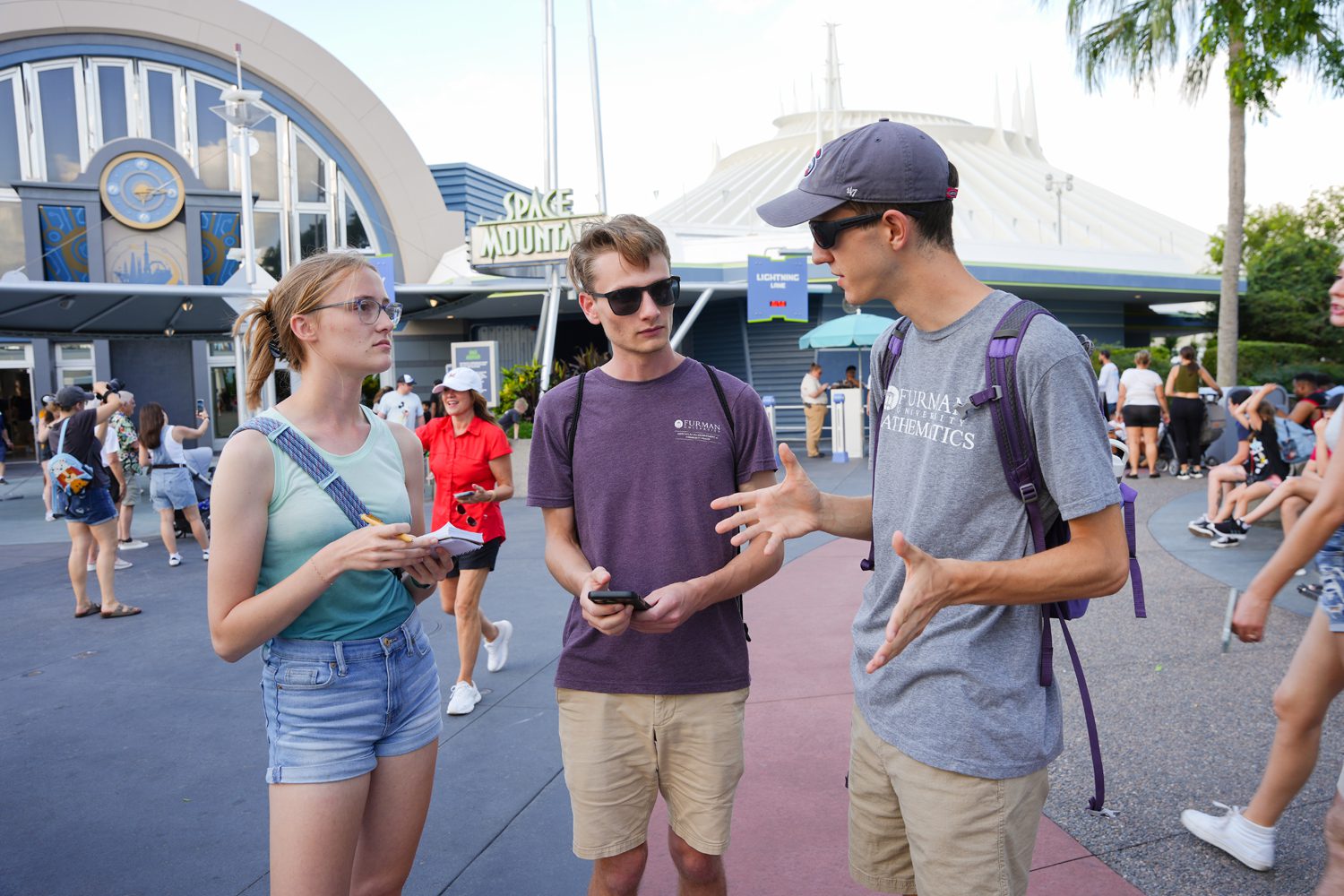
John Harris, a professor of Mathematics at Furman, talks with Jacob Robertson ’25 as he collects data at Disney World. Photo by Nathan Gray, Furman University.
Morton’s group project explored algorithms to keep parties together while more efficiently seating up to 21 guests for the Tower of Terror. The ride often runs with unoccupied seats because of its configuration.
Bouzarth’s father, Craig, developed an app for their algorithm, and in simulations the team was able to seat more guests on average than Disney was seating. A few years later, the professors learned Disney had independently developed a similar app to seat guests on another ride with a complicated configuration.
“Surprising – and pretty cool – that an idea we had (come up with) showed up in the park,” Bouzarth says.
The class culminates with a race through a dream list of attractions and rides. Teams develop mathematical plans to check everything off the list – and then put their feet to the ground to test their theories against real-world variables.
‘Incredibly fun’
After so many research-based visits, Harris can spot the groups who come to Disney without a plan.
“I feel bad for people like that, because this is not a place you can show up for the day and hope to do everything you want to do,” he says.
Len Testa is co-author of “The Unofficial Guide to Walt Disney World 2024” and president of TouringPlans.com, which uses the kind of math Furman students are doing to help travelers maximize their dream vacations. He’s met with multiple Furman classes while they’re in Florida.
His case is convincing: If the average visitor wants to take in 10 attractions on a given day, there are more than 3.5 million different ways to go about that. If you bump that number to an aggressive 25 attractions, you start talking about a number of possibilities with more than 25 zeros.
“You can actually help out tens of millions of people a year if you can solve these math problems,” Testa says.
Morton didn’t take any other May X classes, but “from stories I heard from friends I feel confident in saying Math and the Mouse is one of the most academically rigorous May X classes offered at Furman,” she says. “But the class was also, as I expected, incredibly fun.”
“There’s no other class like it,” Harris says.