News from campus and beyond
NSF grant supports novel ways to study clouds and their role in global warming

George Shields, professor of chemistry. Photo: Nathan Gray.
Climate change and its widespread impacts are widely recognized as one of humanity’s most pressing global challenges. And while the impacts are felt everywhere, the causes of global warming aren’t entirely understood. Take clouds, for example. Depending on their size and altitude, clouds can trap heat, making the Earth warmer, or repel heat, cooling the planet’s surface.
Understanding how early cloud formation happens is the aim of a National Science Foundation grant awarded to Furman University’s George Shields, a chemistry professor. The three-year, $499,590 grant funds his research on prenucleation clusters and secondary atmospheric aerosols.
Think of prenucleation clusters as the very beginning stages of aerosol formation, or the precursor to clouds. Secondary aerosols, Shields said, are spawned from small molecules in the atmosphere via gas-phase reactions, as opposed to primary aerosols that enter the atmosphere directly from sea spray, dust, smoke, biomass and industrial and agricultural activities. Secondary aerosols comprise approximately half of the aerosols in the atmosphere.
Shields explains that gas-phase complexes, i.e., prenucleation clusters, are bound together through relatively weak intermolecular forces, giving rise to copious clusters of molecules in the stratosphere.
“If you have a bunch of different molecules in the atmosphere, figuring out which molecules will form prenucleation complexes that eventually lead to aerosols is extremely difficult,” Shields said, “and it is impossible to do this through experiments.”
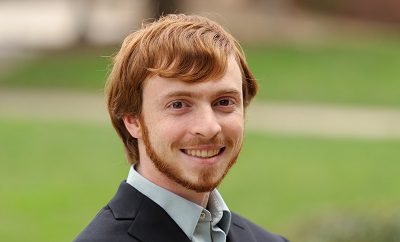
Conor Bready ’24. Photo: Jeremy Fleming.
Enter high-throughput computational chemistry, which gives scientists the computing muscle required to quickly parse the different pathways for early-stage cloud development.
“The biggest difficulty in large global warming computer models is the uncertainty related to what aerosols or clouds are doing to cool the planet,” Shields said. “So, it is essential to understand how aerosols form, which means it is essential to understand how prenucleation complexes form. Aerosols grow into clouds, and clouds help cool the planet by reflecting incoming sunlight back into space.”
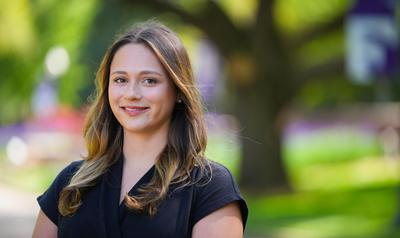
Olivia Longsworth ’25. Photo: Nathan Gray.
The grant builds on a vein of research Shields and recent graduate Conor Bready ’24, Olivia Longsworth ’25 and others published in The Journal of Physical Chemistry A and Environmental Science: Atmospheres. The funds from NSF’s Environmental Chemical Sciences division will enable Shields to work with four students per summer over the next three years in his computational chemistry lab. Shields’ crew will also collaborate with scientists at Stony Brook University and the University of California, Irvine who will lend their own experimental data to Shields’ findings.
“I’m excited my students will have a chance to interact with experimentalists at Stony Brook and UC Irvine to learn more about how science is done,” Shields said. “Teams are better than individuals, and learning how others think about the same phenomenon always leads to greater understanding and advances research.”