News from campus and beyond
Furman students help farmers fine tune approach for healthy soil and crops
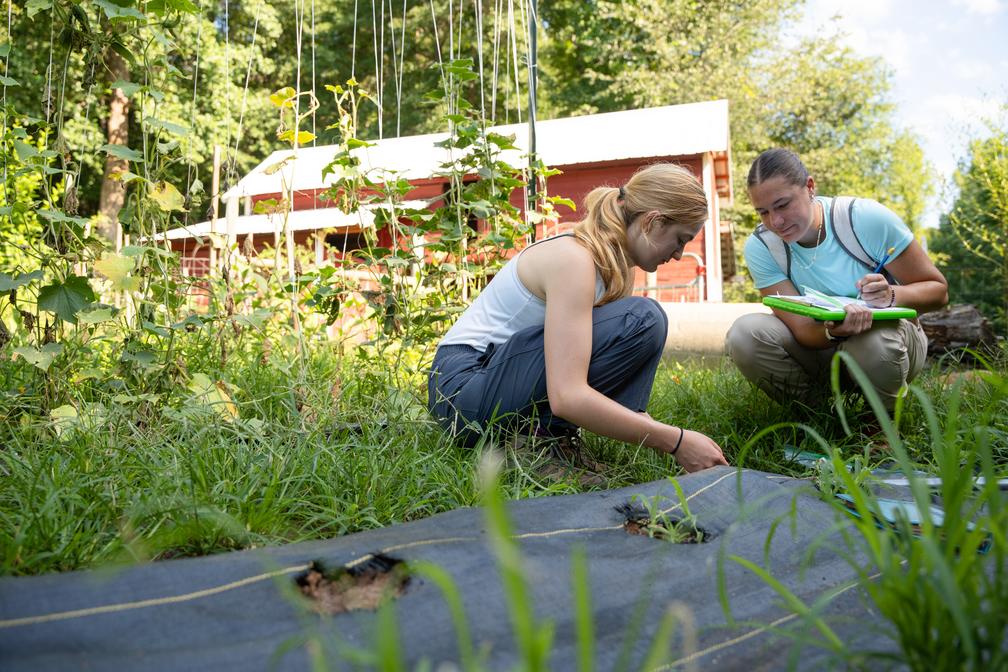
Lindsay Capps ’25 and Paige Harmon ’25 take soil samples at Feather Creek Farmstead in Marietta, South Carolina. Photo by Nathan Gray, Furman University.
If you reach down and scoop up a handful of dirt in your yard or local park, what do you see? Brannon Andersen reads soil like a book, interpreting volumes about the health of the land and surrounding vegetation.
For the last 12 years, Andersen, the Rose J. Forgione Professor of Earth, Environmental, and Sustainability
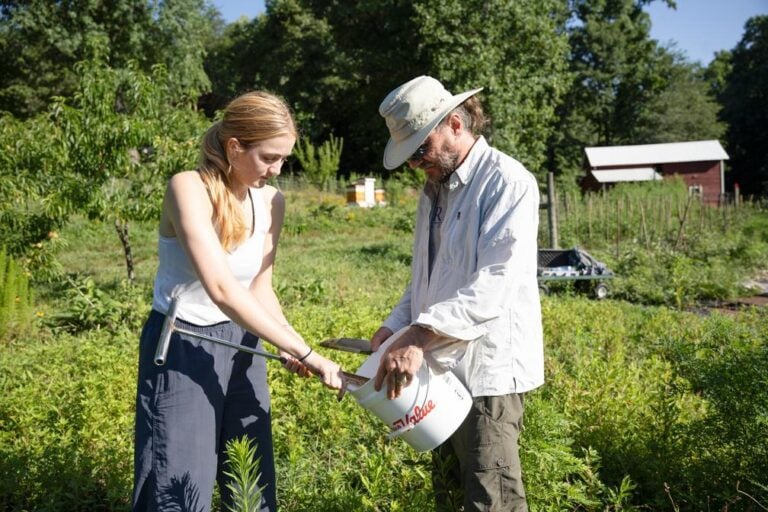
Brannon Andersen, professor of Earth, Environmental and Sustainable Sciences, right assists Lindsay Capps ’25 as she takes soil samples at Feather Creek Farmstead. Photo by Nathan Gray, Furman University.
Sciences has been working with farmers in the Greenville, South Carolina area to help them read it, too, and determine how pasture management affects soil quality and health. This summer, two students working with him, Lindsay Capps ’25 and Paige Harman ’25, are getting their hands dirty evaluating soil samples at two locations in the area that have been managed differently. Specifically, they want to know if regenerative farming practices contribute to healthier soil.
Healthy soil teems with life, which can include fungi, bacteria, earthworms and more. It is chock full of organic carbon and nitrogen, said Andersen, and typically has a pH between 6 and 7.5—not too acidic or too alkaline. Healthy soil produces more and better crops.
Regenerative farming practices – such as reduced tilling, cover crops and crop rotation and diversity – focus on enhancing soil health. Rather than plowing deep furrows in a field, reduced-till farmers use special equipment to create smaller channels for planting seeds, according to the U.S. Department of Agriculture. This practice reduces soil disturbance, which lessens erosion, runoff and the release of carbon stored in the soil.
Reduced-till farming can be a hard sell despite its natural advantage, Andersen said, because it requires the purchase of special equipment. Some of the sites where the research team is working have practiced no-till farming and other regenerative practices for a while, and others are just beginning to incorporate them.
“We’re getting in on the ground floor and getting base-level soil health data to track and see how it changes over time as they implement these more regenerative agricultural practices, that should build organic carbon and nutrients in the soil,” said Andersen.
Capps, who is double majoring in sustainability science and communication studies, is working at Feather Creek Farmstead, a small farm in Marietta, South Carolina that specializes in produce, eggs, jam and humanely raised livestock. There, she is collecting and analyzing soil samples from three regeneratively farmed fields, a forested area and a livestock area. The samples are analyzed for carbon and nitrogen content, aggregate stability, bulk density, and microbial diversity which varies depending on sample location, said Capps.
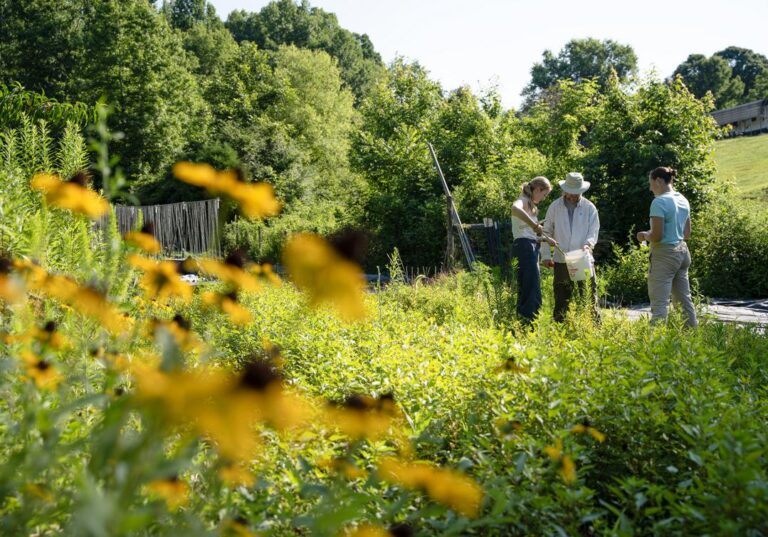
Brannon Andersen, professor of Earth, Environmental and Sustainable Sciences, assists Lindsay Capps ’25 and Paige Harman ’25 as they take soil samples at Feather Creek Farmstead in Marietta, South Carolina.
“This project has been a truly impactful experience,” she said. “It has been amazing to work closely with the faculty of the department, and I feel as though I am learning something new every day!”
Harman, who is majoring in earth and environmental science and minoring in poverty studies, is working at the Naturaland Trust agricultural demonstration site in Marietta, South Carolina, a group working to preserve land in the Blue Ridge Mountains of South Carolina. There, she is collecting and analyzing soil samples from a field that has been managed conventionally, a field that has been partly managed conventionally and partly organically, and a meadow that has been untouched for the past two years.
“This research is important because it not only provides direct feedback to the partnered farmers on how resilient their soil is, but also gives concrete evidence of what agricultural processes increase the nutrients in the soil and decrease the cost on inputs needed,” said Harman. “Learning how to produce healthier food locally will help the community have better access to more cost-effective food.”