All Blog Posts
Kate Harrington, MAP ’26 Hooding Ceremony Speech
New Master in Advocacy and Social Policy graduate Kate Harrington was selected by her classmates to speak on their behalf at the Graduate Studies Hooding Ceremony on May 8, 2026. To follow is Kate’s speech.
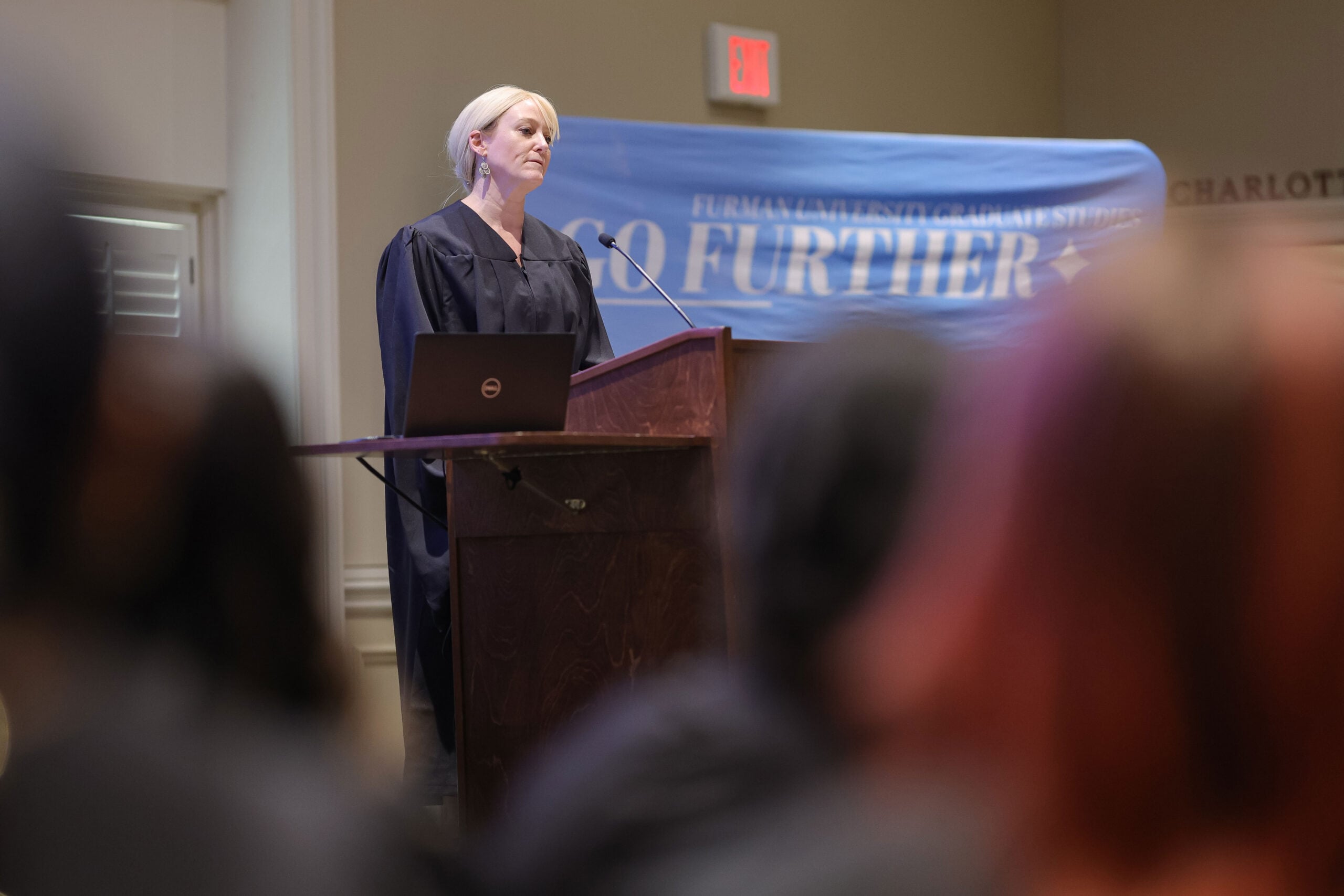 Good evening, everyone—and congratulations to my fellow graduates.
A few years ago, I learned that advocacy isn’t a theory.
It’s what you do when the system fails someone you love.
My dad was diagnosed with Frontotemporal degeneration, an early-onset form of dementia,at age 57.
I was 25—barely out of undergrad at Carolina…UNC-Chapel Hill, to be clear…and my younger brother had just finished high school.
None of us understood how much our lives were about to change.
And over time, I realized we weren’t just dealing with a disease; we were dealing with a system that didn’t know what to do with him…or with us.
I left a 12-year career as an English professor and moved across state lines to come to Furman because I needed to understand what had happened to my family and what could be done for families navigating the same realities.
At 44, after earning a second graduate degree, I’ll be moving in with my mom—which was not part of the original plan, but turns out…part of the process.
Somewhere along the way, this stopped being just about my family. It became about understanding the systems that shape people’s lives and what happens when those systems fail.
When I came into the Master’s in Advocacy and Social Policy program, I thought I was here to learn how systems work. What I actually learned… is how often they don’t.
I learned how easy it is to blame individuals for outcomes shaped by policy, by access, by power.
I learned how many gaps are built into the structures we rely on.
And I learned that change is rarely fast and rarely clean, but it is necessary.
This program was never just about coursework. The real education came from the people around me.
I’ve spent the past few years alongside colleagues who are fighting for dignity, and safety for others.
I’ve watched people working inside institutions push for accountability, fairness, and systems that actually protect the people they’re meant to serve.
They’ve asked hard questions, challenged assumptions, and stayed committed even when the work became deeply personal.
And if there’s one thing I carry forward from this program, it’s not just what I’ve learned—it’s who facilitated the learning. We were guided by professors who asked more of us than easy answers.
I especially want to thank Dr. Shaniece Criss, whose guidance and belief in me helped shape this journey in ways I’ll always carry with me.
We were challenged to think more critically, question what we assumed, and stay engaged even when the work was uncomfortable.
And in doing that, we were reminded that this kind of work isn’t about having it all figured out—it’s about showing up, asking better questions, and staying committed to doing it well.
Whether you’ll be working in classrooms, in labs, in hospitals, in communities, or inside organizations, we’re all stepping into systems that shape people’s lives in real ways. And if you’re paying attention, you already know those systems aren’t perfect. And sooner or later, all of us will have to decide what we’re willing to do about that.
The question isn’t whether these systems need to change. The question is what we’re going to do when we’re the ones inside systems.
Now we don’t just have degrees.
We have perspective—and with that, responsibility. We know how decisions get made.
We know who gets left out. And we know that “the way things are” is not the same as “the way things should be.”
I didn’t come into this field because I had a perfect plan. I came into it because something felt wrong, and I couldn’t ignore it anymore.
And I think that’s true for a lot of us.
So as we leave here, I don’t think the goal is to have all the answers. I think the goal is to stay close to the questions that brought us here in the first place.
To notice what isn’t working.
To speak up when it matters.
And to remember that the work doesn’t start when everything is clear.
It starts when we decide not to look away.
And at some point, for all of us…it becomes personal.