All Blog Posts
Bridging Generations: How Trinity Williams Combines Data and Heart at OLLI and Furman
Trinity Williams wears many different hats as a graduate assistant at Furman’s Osher Lifelong Learning Institute (OLLI). On any day, you’ll find her helping OLLI members register for classes or creating graphics and posters for an upcoming event, interspersed with occasional trips to keep the coffee bar stocked.
When she’s not working on these tasks, you’ll find her in her M.A. in Advocacy and Social Policy (MAP) classes. For Williams, the two roles are not separate. Each one informs the other.
One Conversation Gave a New Direction
Williams’ path to Furman was shaped by hands-on service in regional nonprofits and local classrooms. She learned in her undergraduate years at Clemson University that she wanted to be involved in nonprofit work. She was able to complete an internship with STRIDES, a Texas nonprofit, where she helped create graphics and conducted research. With a passion for community health, she taught a health literacy class at the Greenville Literacy Association (GLA). Williams attended the GLA’s 50th anniversary gala, where she met Shaniece Criss, director of Furman’s M.A. in Advocacy and Social Policy program, and learned about the program.
“She sold me on the MAP program,” Williams said, “I knew I wanted to get my master’s, I just didn’t know when. So, that meeting with her, I was like, ‘Yep, this is it. This is where I need to be.’ I felt like I was getting pulled in the right direction.”
Making a Difference at OLLI
As a graduate assistant in the MAP program, Williams was placed at OLLI and quickly discovered the role was a natural fit. Navigating the day-to-day rhythms of OLLI’s older adult population requires a level of patience and empathy that goes far beyond typical customer service. Williams says her guiding philosophy is simple: treat every OLLI member like family.
That same dedication to meeting people’s needs inspired her to look critically at existing processes and find ways to make them better.
Williams fulfills an important need at OLLI. The division had several important projects it hoped to complete, but staff members lacked the time to pursue them alongside day-to-day responsibilities. When Williams interviewed with OLLI director Nancy Kennedy, she found her passion could be put to use at OLLI.
“I was sold as soon as she showed me the catalog,” Williams remembers.
Williams has found her passion for community health exists at OLLI as well. She notes that OLLI gives its members a place to come together and have social relationships while enriching their minds. For senior citizens, social detriments play a large role in their health, and attending OLLI programs supports both mental and physical well-being that fosters interactions that keep their minds sharp and encourages an active lifestyle that many members already embrace.
“Because of OLLI, my research right now in MAP has a lot to do with improving health outcomes of older adults,” Williams said.
The primary project Williams worked on was updating the course evaluation that OLLI members complete at the end of each course. The evaluation was outdated, cumbersome and lacked personalization. Members had to scroll through a list of courses to find the one they had just completed. Williams updated it to create personalized links so members could only review the course they had taken. Evaluation completion rates rose, and OLLI staff were able to get a better picture of how courses were performing.
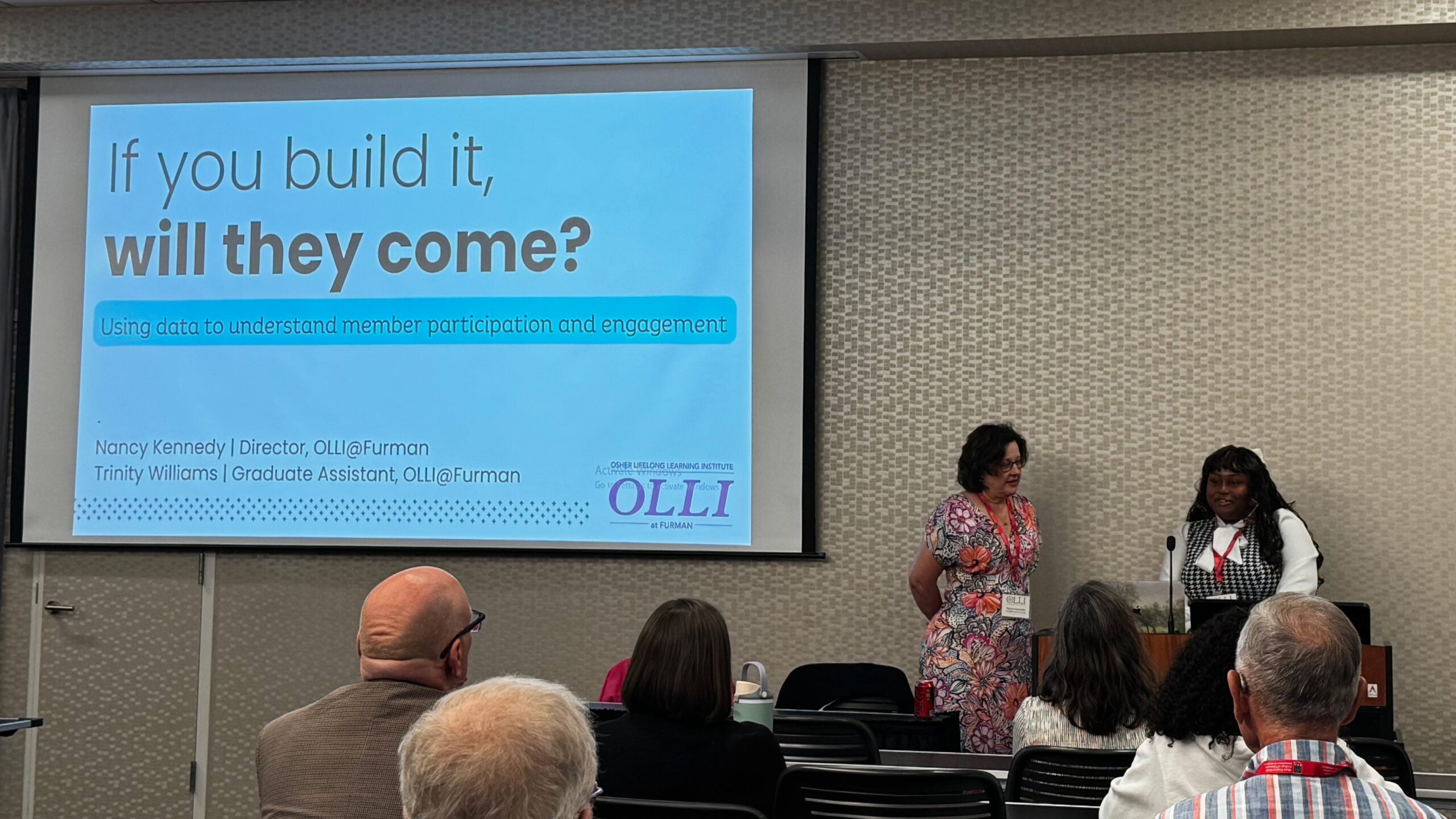 The revamped survey was such a success that OLLI director Nancy Kennedy invited Williams to co-present their findings at the Southern Regional Conference for Learning in Retirement, which sees participants from OLLI organizations in addition to other lifelong learning programs for seniors.
Standing before colleagues from institutions across the region, Williams walked attendees through her Qualtrics automation workflows. The response was immediate. Attendees from similar programs asked her to share parts of the course evaluation survey so they could emulate it, and fellow administrators lined up to ask how she managed the coding.
“I actually began to see myself as I’m starting my career,” Williams noted. “I’m a young professional. That was a really big moment for me.”
This isn’t the only data set that Williams has helped improve. She also has been involved with data collection for social events and travel attendance so that staff can see trends of who is attending which events and the popularity of events.
“I like working on things that give our full-time staff better insight,” Williams said. “I’m trying to give them the data so they can make the best possible decisions.”
Williams’ work at OLLI has had an impact on her too. Her time at OLLI has deepened her commitment to community service.
“I want to take the knowledge that I have and be able to serve my community and other people,” she said.
Her desire to serve has been both the foundation of her work at OLLI and the driving force behind her graduate studies. Williams notes that the MAP program has been just as transformative as her day-to-day work with OLLI members.
A Broader Lens
Williams says the MAP program has helped her to be more open-minded and has fundamentally changed how she sees the world. Where she once was certain that a nonprofit job was the only acceptable destination, the MAP program has consistently pushed her to look beyond what’s directly in front of her.
“I’m more well-rounded now because I feel like I’m a better listener,” Williams said. “I have better world experience and just feel like I’m wiser.”
Much of that growth has come not only from her class readings but from the conversations she has with her cohort. Her cohort includes professionals with years of real-world nonprofit experience, and their perspectives bring the course to life in ways that a textbook cannot.
“I just feel like I’m getting prepared for real life,” Williams said.
Looking Ahead
The work Williams has done at OLLI and in the MAP program has done more than just build her résumé. It has given her a clear sense of direction.
Williams plans to use what she’s learned in the MAP program and the skills she’s built at OLLI to continue helping people. She wants to focus on helping seniors or even create a space to provide resources and education for older Black women.
Williams is slated to graduate in December 2027. She says that Furman has given her more than a degree. It’s given her clarity.
“I know that I want to take care of people,” Williams said. “If I don’t end up at a nonprofit, that’s okay. But I have faith in myself. I’ll still be taking care of people, no matter what I do. I owe a lot of that to Furman.”