
Part Two: Escaping Communism, Chasing Prestige
By Brandon Inabinet, Professor of Communication Studies
My previous post offers a “trigger” as to why the new campus was built: when the land was purchased in 1949-1950, it was possible that both downtown and suburban campuses would be needed. Why? The university would enroll a larger student body after desegregation of public higher education created a wave of white enrollment for private colleges.
But there was an additional ideological factor at work, that by 1960 meant the shuttering of the downtown campus.
Plyler’s predecessor in the 1930s, Bennette Geer, had pushed a program of urban renewal and mixed-race social projects in the downtown community, aligned with Roosevelt’s New Deal. Alongside this social and racial mixing in social research, Geer’s final blow was an academic scandal that had allowed secular and humanistic questioning to transgress traditional scriptural authority in a religious course. Hiring Plyler was an opportunity for the SC Baptist Board to set Furman on a different trajectory.
Throughout the 1950s, the Baptists amplified these concerns about intermingling urban academic research and student life with concerns over the threat of communism. At the end of the decade, Duke McCall, president of Southern Seminary in Louisville, spoke to the SC Baptist Convention in November 1959 with concern over “communism’s materialistic standards,” which had allowed campus culture to become looser in morality, specifically mentioning Furman as an example.
He called for new campus fundraising as an opportunity to escape communism’s clutches. Donors could use their funds to move Furman out of the downtown environment to a new suburban campus. In fundraising campaigns like these, Baptists could help fight the “great struggle between communism and democracy” as a “control of the mind, especially the young or immature mind. Our Christian Colleges are increasingly essential in fighting this evil and in maintaining our bulwark of freedom.”
In the same year, Dean Francis Bonner wrote to President John Plyler, among other “progress updates” the following: “XVII. Use of old Men’s Campus. Will be abandoned (I hope). No need of it is foreseen unless Science Building will be needed for brief time.” With that note from the Dean, all men’s classes were transferred to the new campus in 1958, women would join in 1961, and the old buildings demolished in the early 1960s. Furman would be fully suburban.
Urban spaces were declining throughout the 1950s as the automobile allowed the middle class and affluent citizens to escape proximate interracial lives. Being a part of white suburban growth and consumer demand created for southern Baptists the feeling of success over communism’s degrading influence—alcohol, drugs, and criminality, as well as racial equality and interracial marriage.
A 2013 article published by the Poverty and Race Research Action Council (PRRAC) showed that the effects of white flight were increasing in effect rather than decreasing. White students continued to abandon various open-access forms of higher education for increasingly selective college tiers and gaining the advantages those schools provide. Prestige by rankings, formed by endowment per student, became a way to segment the college market and prevent socio-economic and racial equality.
Higher completion by graduates on these rural and suburban landscapes means higher earnings, which means higher intergenerational wealth to transfer to heirs, who attend private schools with complementary co-curriculum and extra-curricular opportunities, which create legacy admissions.
As a result of decisions like these, the United States has the least intergenerational educational and income mobility among advanced nations.
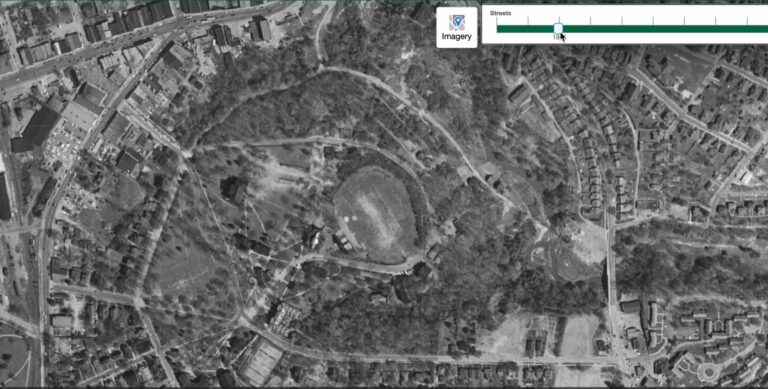
Map Caption: The aerial photography from Greenville’s Historical Imagery Viewer shows the old Furman University campus in 1955, 1965, and 1975. In 1955, campus would have been fully active as the first buildings were being constructed on the new suburban campus. The large circle in the middle is Manly Field (used for various sports other than football, which is played nearby in Sirrine Stadium), and to its left are Judson Alumni Hall, Carnegie Library, Richard Furman Hall (also called Old Main), and James C. Furman Science Building. South (below) these buildings are the campus infirmary, residence halls, and the President’s home, near the tennis courts. The entire area with trees/forest is university property, surrounding by Main and August Streets (on the north and east), Haynie Sirrine residential community (on the south), and the future College Street corridor (on the west). In 1965 view shows the entire campus demolished, with additional forest overtaking the demolition site. In 1975, the University Square Shopping Mall is built on the old college site, showing the expansive use of the property for parking.

EDITOR’S NOTE
___
This essay is a community submission in response to the Placing Furman project.
We have reserved space for your words on the Placing Furman site to feature short responses (up to 750 words). You may send them directly to [email protected] and/or you may contact us to explore themes or specific topics you would like to address.
In the spirit of thoughtful dialogue, we promise to review and reply to each submission you send us.
We reserve the right to publish the most productive and thoughtful essays. In cases where we are not sure we can publish your ideas, we may ask for revisions or clarification
We don’t seek to censor; we invite disagreement. But we are an educational institution, so we intend to publish pieces that are meant to provoke reflection, not anger.
Our goal is to foster a constructive conversation. Please, tell us, what does our project,
Placing Furman, mean to you?