Data Science Major

Table of Contents
Why study Data Science at Furman
Data science turns data into answers across business, medicine, economics, the environment, psychology and anywhere people generate it. Furman teaches you the methods and the harder questions behind them like where the data came from, who it leaves out and who the answers serve.
- Apply it in a field you choose. The major requires an elective from outside math and computer science, so you carry your data skills into a discipline like biology, economics, the environment, business or psychology.
- Ethics in the core. Every major takes Digital Dilemmas, on fairness, privacy and the social weight of data.
- A path you shape. The compact 12-course structure leaves room to double major, and it’s designed to pair with fields like natural science, business, economics or psychology.
Take your first steps by contacting admissions or reading more about how to apply.
Learn by doing
Data science examples and the full data workflow start in your very first programming course. Then you go further with:
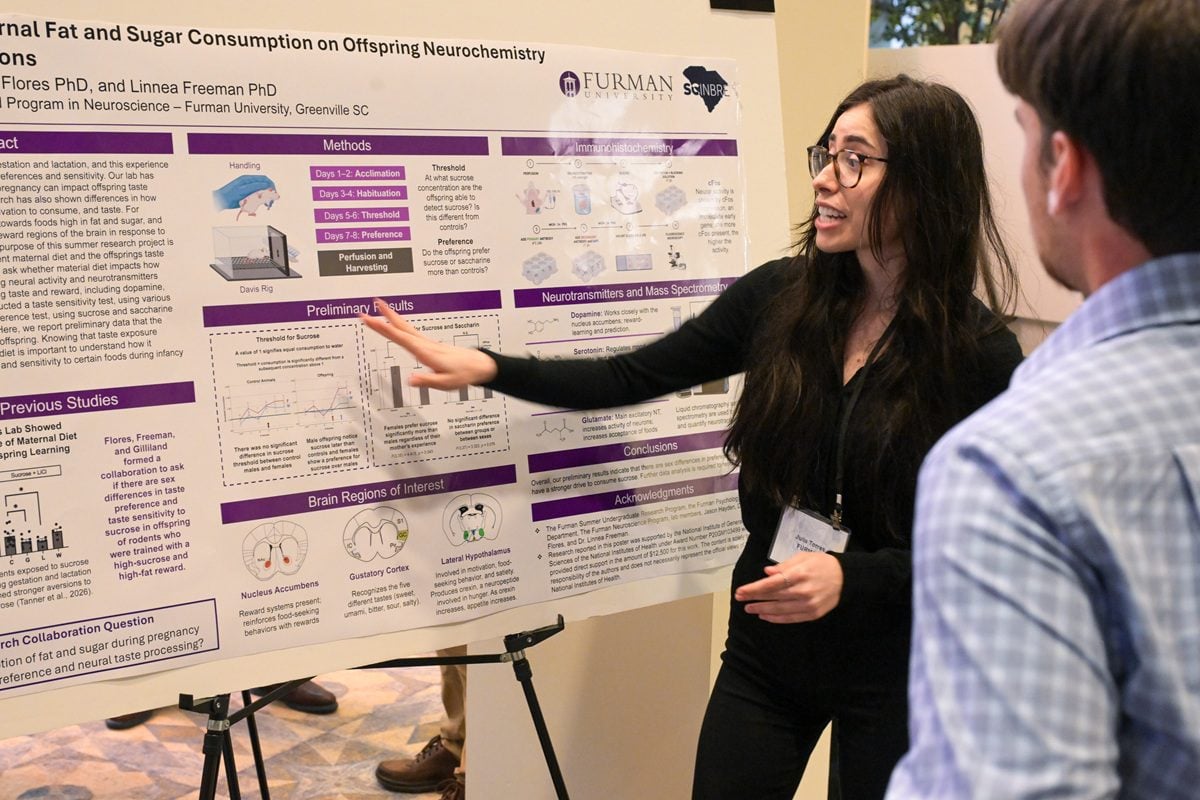
- A funded summer of research with faculty on highly interdisciplinary projects using large, complex datasets. For example, you can apply machine learning and AI techniques to analyze massive bioacoustics datasets of animal vocalizations, bridging data science with ecological and biological research. Other summer research projects include applying computational models to accelerate drug discovery, performing EEG analysis to decode neural signals, or mining pop culture datasets to trace and analyze media trends.
- Data-focused internships: BMW, Michelin, Baron Capital, Capgemini, ScanSource, Red Ventures
- A capstone built on real data.
- Purposeful Pathways career prep including career treks, employer site visits and a showcase where students present their research and internships.
These are the kind of hands-on experiences that are harder to come by at a larger university.
Plan a visit to Furman’s beautiful campus or start your application today.
How will you learn?
The major is 12 courses across five tiers, where the core builds your methods and the electives put them to work in a field of your choosing. Across the major you learn the whole data pipeline, from collecting and cleaning data to modeling and deploying it, working with databases, the cloud and streaming data.
- Machine Learning with Big Data. Mine massive datasets of text and images and build models that run in the cloud.
- Introduction to Data Mining. Master foundational data mining and computational techniques (CSC-272) to discover patterns, wrangle datasets, and draw insights from real-world information.
- Databases. Learn database management systems (CSC-341) to design, query, and manage large-scale data infrastructure that powers modern applications.
- Digital Dilemmas. The ethics core: who data serves, and who it can harm.
- Your applied elective. Take data into another field, from geographic mapping and remote sensing to empirical economics, data analysis in psychology and analytical chemistry.
Through your electives and capstone, you can go deep in areas like machine learning, databases, large-scale data systems or domain-focused analytics.

Careers for Data Science majors
Data science is one of the fastest-growing fields in the country and demand is booming in technology, healthcare, finance, government and consulting.
Opportunity
Data scientist, machine learning engineer, data engineer, quantitative analyst, research scientist or AI/ML specialist.
What you’d work on
Real problems across industries: artificial intelligence development, drug discovery, risk assessment, recommendation systems and operational optimization.
Outlook
Data scientist roles are projected to grow 34% from 2024 to 2034, with about 23,400 openings a year and a median wage of $112,590 (U.S. Bureau of Labor Statistics).
Demand
The global data science platform market is projected to grow from $33 billion in 2023 to $423 billion by 2032, and the global consulting firm McKinsey projects that demand for skilled data scientists could outstrip supply in the U.S.
Common Employers
Data Science courses

Data Science Major FAQ
A Bachelor of Science that teaches you to collect, analyze, model and communicate data responsibly. The major runs 12 courses across five tiers, with statistics as the foundation, machine learning and databases at the core, plus a required elective that applies data science in another field.
The major prepares you for roles like data scientist, machine learning engineer, data engineer, quantitative analyst and research scientist, in industries including technology, healthcare, financial services, government and consulting.
Nationally, the U.S. Bureau of Labor Statistics reports a median wage of $112,590 for data scientists, with the top 10% earning more than $194,410, and projects 34% job growth from 2024 to 2034.
Computer science builds breadth across computing and software. Data and Decision Analytics centers on business analytics and decision support. Data science sits between them, applying data-driven modeling and machine learning across scientific, social and technological domains.
Yes, and the major is designed for it. The 12-course structure pairs with natural science, business, economics, health sciences or psychology. However, students may only choose a single major from the Computer Science Department.
Your faculty and mentors
Your professors research machine learning, data mining and visualization, and every summer a funded program puts you on their projects.

Andrea Tartaro

Chris Alvin

Rebecca Drucker

Syed Fahad Sultan

Saugat Pandey