
By Brandon Inabinet, Professor of Communication Studies
Furman had been strategically situated by Vardy McBee on the hill above the city, across the river from his home. This modern acropolis would distinguish the Upstate as a place of high values and learning. White men of privilege would receive a great education there, finding wives across town at the women’s academy, while leased enslaved laborers would use their winter reprieve to help staff the institution. Just beyond Main Street and campus, the land gave way to cotton plantations.
Then came the Civil War and Reconstruction for this area around the university, which would become known as the Haynie-Sirrine neighborhood (for the names of the major streets in the area).
In 1887, a businessman named T. C. Gower bought 1.5 acres on Choice Street (later University Ridge) for $149. The lots were purchased from Margaret M. Carson and had been part of the Thruston cotton plantation. Over the next eight years, the property was subdivided and sold to four African American persons for a total of $280: Thomas Brier, a blacksmith who owned a shop on West Washington Street; Elias B. Holloway, a postal carrier; Jeremiah W. Seawright, a horseshoer; and James A. Brier, a teacher. Until his death in 1895, Gower kept doing this business of purchasing other portions of Carson’s land, subdividing, and reselling.
Aerial photography shows that the neighborhood was packed. White and Black families comingled block-by-block next to a busy downtown. Given the student population, there wasn’t a clear class difference either. Married white students were crammed into trailers on the old baseball field; veterans bunked in army-provided mobile housing so they could fulfill GI bill-funded education. Faculty and staff, even top administrators, lived in-between. Poor and middle-class Black families walked over the Main Street Bridge to get to a business district on Spring Street, two blocks off Main, segregated from the white businesses on Main Street.
Along the same street as these African-American families were the homes of Furman’s President, professors, and top administrators. The relationships varied, from the interviews Katy Watkins and I conducted last summer. Son of the President, John Plyler Jr., remembers playing various pickup games with Black children in the neighborhood, and watching Jesse Jackson, of nearby Haynie Street, practice with the Furman football team.
Another resident of the street, Nancy Bourne, remembers a slightly different story as a faculty daughter. Although she could play with Black children when she was very young, at a certain age, her mother asked her to no longer hang out with her African-American childhood friend. Nancy would later find out that friend had become pregnant at an extremely young age.
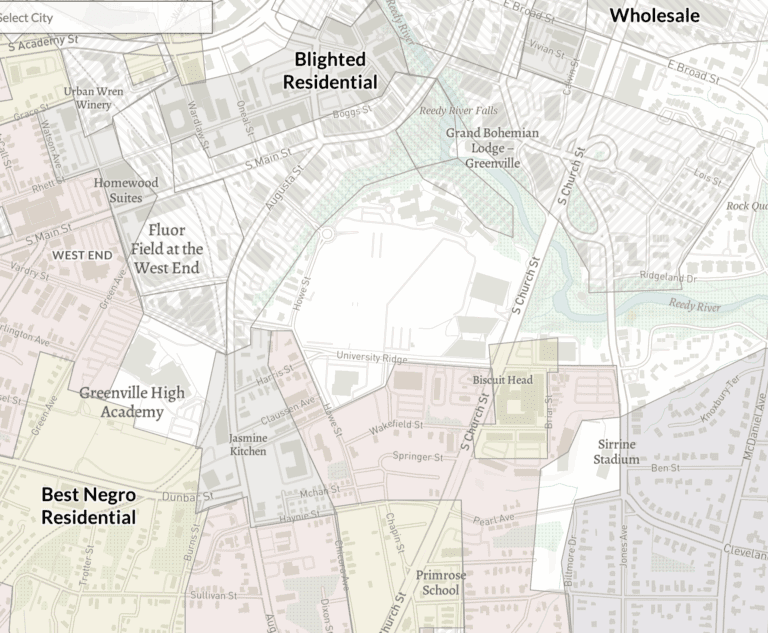
Never in the record do we see any reference, positive or negative, to the Haynie-Sirrine community or the employees who worked in the surrounding communities. Only the personal interviews, US Census (pasted below), and real estate map make the case so clear that the university left a mixed-race neighborhood that serviced campus.
Faculty and staff moved to areas like San Souci (a previous country club, now cheaper land prices as wealth moved to Greenville’s south along Main Street and Augusta Street) and the neighborhoods specifically designed for them by Furman’s donors and trustees (Stratford north of campus surrounding builder’s Charles Ezra Daniel’s White Oaks Estate and Duncan Chapel Road developments).
Meanwhile, staff and residents without intergenerational wealth would continue to make payments as contract buyers downtown, unable to leave declining neighborhood before their properties were paid for in full; if they did, they would lose everything they had invested. Lower paid cooks and janitors likely retired, tried commuting for a bit, or otherwise looked for new employment in the declining community.
Dean Bonner’s 1958 note remarking on the closure of the downtown campus and move to the new campus ended, “XXI. Janitorial service. Plans are to use some student help.”
Haynie-Sirrine, as the 2002 community master plan explains, went into a precipitous decline after the university’s departure, with significant rates of crime, vacant homes, and abandoned lots. The aerial viewer shows that each decade homes in the area were demolished until less than a quarter remained in the 2000s. Even just from 1990 to 2020 (the years for which we have data), the area’s African-American population crashes from 700 to 106. Meanwhile, gentrification takes over in 2010, and the white population grows from 188 in that year to 501 in 2020. Now, with construction of a billion-dollar development at the old Furman University site, the city anticipates Haynie-Sirrine to be one of the most densely populated areas in the city—with the high-rise apartments ascending from acres worth many, many millions.
Perhaps even just a few of the grandchildren and great-grandchildren of Furman University’s “houseworkers” or “janitors” might be able to be rewarded by these changing markets, against all of the trends in the data.
Image Caption: Richmond Mapping Inequality: Redlining in New Deal America offers this image detail on Haynie-Sirrine. The lower half of the image shows yellow “Best Negro Residential” and red “Fair Residential” (the average U.S. white housing market) mixed within the same streets and blocks.
Census District 23-69 of Greenville, SC in 1950 U.S. Census. Special thanks to Kathleen “Katy” Watkins (Communication Studies, ’26) for the transcription of this census data.
| Name | Age | Race | Gender | Address | Position at Furman |
| Sarah Lowrey | 52 | white | female | From Haynie St Northward on Auguste St (U.S. 25) 613 Apt 8 | Speech Prof. |
| Columbus Andrews | 64 | white | male | From Haynie St Northward on Auguste St (U.S. 25) 613 Apt 3 | Sociology Prof. |
| McDonald Held | 40 | white | male | From Haynie St Northward on Auguste St (U.S. 25) Apt 3 D12 | Head of Speech Dept. and Prof. |
| Lewis Hill | 27 | white | male | From Haynie St Northward on Auguste St (U.S. 25) 613 Apt 2 | Econ Teacher |
| Tally Childress | 64 | white | male | Off Thurston Stadium Graham Field, Apt 24, Dwelling 48 | Mechanics Master |
| Robert Rakestraw | 22 | white | male | Trailer Court off Wakefield St at End of Houseton. Trailer 4, D69 | College Lab. |
| James McQueen | 30 | white | male | Wakefield St. Proper. House 105, D 85 | Athletic Coach |
| Gordon Harrison | 29 | white | male | Wakefield St. Proper. House 103, D 86 | Language Teacher |
| Aaron Rutledge | 30 | white | male | Wakefield St. Proper. House 101, D 87 | Counselor/psych Teacher |
| Authur Sledd | 55 | white | male | President St. from Wakefield. Apt 300 D 91 | Chem Teacher |
| Robert Daniel | 61 | white | male | President St. from Wakefield. Apt 300 D 92 | Head of English |
| Reece Blackwell | 47 | white | male | Univ Ridge H 322 D 97 | Math Teacher |
| Albert Tibbs | 49 | white | male | Univ Ridge H 324 D 98 | Head Dean |
| Albert Reed | 41 | negro | male | Univ Ridge H 412 D 110 | Fireman Boiler |
| Gladys Chappel | 30 | negro | female | Wakefield St. H 413 D 131 | Maid |
| Thomas Sleigh | 68 | negro | male | Wakefield St. H 403 D 139 | Janitor |
| Lawrence Chappel | 21 | negro | male | Wakefield St. H 412 D 151 | Janitor |
| Alex Chappel | 19 | negro | male | Wakefield St. H 412 D 151 | janitor |
| Charley Summers | 49 | negro | male | 103 Springer St. D167 | Janitor |
| Will Fuller | 55 | negro | male | 300 Wakefield St. D171 | Janitor |
| Andrew Fuller | 18 | negro | male | 300 Wakefield St. D171 | Gardening |
| Arnold James | 26 | negro | male | Houseton St. Apt 7 D 187 | Dishwasher |
| Jesse King | 49 | white | male | Wakefield St. H 202 D203 | Supervisor of Grounds |
| Charles Rasor | 42 | white | male | No street listed. Apt 2 D 9 | Registrar |
| Janie Tucker | 20 | white | female | No street listed. Apt D-3 D 42 | Secretary |
| Harley Burleson | 32 | white | male | No street listed. Apt 135 D 24 | Lab Assistant |
| Ruby Burleson | 31 | white | female | No street listed. Apt 135 D 24 | Secretary |
| Betty McCraw | 22 | white | female | No street listed. Apt 135 D 24 | Secretary |
| Alfred Smoak | 25 | white | male | No street listed. Apt 18 D 70 | Bus Driver |
| Robert Jackson | 29 | white | male | 107 Wakefield St. D84 | Religion Teacher |
| Robert Cantrick | 32 | white | male | Apt 1 “faculty?” D14 | Music Teacher |
| Carroll Leeds | 43 | white | male | Univ Ridge 300, D 93 | Psych Teacher |
| Ruber Gambrell | 33 | white | male | 312 Univ Ridge, D95 | art teacher |
| Edward Vandiner | 47 | white | male | 312 Univ Ridge, D95 | English Teacher |
| Walter Heacock | 28 | white | male | 312 Univ Ridge, D95 | History Teacher |
| John Plyler | 55 | white | male | Univ Ridge 308, D 94 | president |
| Elmer Haight | 53 | white | male | Univ Ridge 320 | Religion Prof. |
| Ciola Grover | 31 | negro | male | Briar 104 D155 | Cook |
| Roosevelt Agnew | 43 | negro | male | Judson 14 D 99 | Furnace Fireman |
| Miller Connor | 28 | white | male | Thruston 110 D 54 | Machine Maintenance |
| Will Anderson | 66 | negro | male | Howe 412, D 285 | Janitor |
| Harold Fowler | 28 | white | male | Trailer 22 D 32 | Student Clerk |
| Martha Lee | 22 | white | female | Apt F-6, D 9 | Secretary |
Appendix B. Census District 23-68 of Greenville, SC in 1950 U.S. Census
| Name | Age | Race | Gender | Address | Position at Furman |
| Howard Beagle | 43 | N | M | Univ Ridge 415D
Dwelling 122 |
Janitor |
| Louis Williams | 36 | W | M | 15 Shurston St D 143 | Instructor Service |
| Charles Blackwood | 33 | W | M | 14 Shurston St D 144 | Art Instructor |
| Arthur Cobb | 27 | W | M | Clauseen Ave Apts. No. F3 D164 | Journalism Instructor |
| Hettie Cobb | 30 | W | F | Clauseen Ave Apts. No. F3 D164 | English Instructor |
| David Wardlaw | 26 | W | M | Clauseen Ave Apts. No. F4 D165 | Manager of Canteen and Bookstore |
| Mary Wardlaw | 24 | W | F | Clauseen Ave Apts. No. F4 D165 | Secretarial |
| Donald Cook | 18 | W | M | Harris St (no other info on this doc) | Student Assistant |
| Harold Lewis | 20 | W | M | Harris St (no other info on this doc) | Clerical Worker |
| Harry Kuper | 21 | W | M | Harris St (no other info on this doc) | Lab Cleaning Assistant |
| Betty West | 29 | W | F | Harris St (no other info on this doc) | Dietitian |
| Wilma Miskelly | 40 | W | F | Harris St Dwelling 112 | Nurse |
| Geneva Brockman | 37 | N | F | Can’t read address. Mike or Pike Street maybe?
Dwelling 29 |
Houseworker |
| Ethel Walters | 50 | W | F | 22 Harrison St.? Dwelling 149 | Home Economics Instructor |
| James Sullivan | 21 | W | M | 5 Harris St. D 89 | Student Assistant |
| Francis Bonner | 33 | W | M | 3 Univ Court, D 184 | English Instructor |
| William Anderson | 47 | N | M | 411 Univ Ridge, D 115 | Janitor |
| Nannie Anderson | 34 | N | F | 411 Univ Ridge, D 115 | Maid |
| John Hoskins | 33 | W | M | 311 Univ Ridge, D 103 | Instructor of Sociology |
| Henry Owens | 58 | W | M | 209 Univ Ridge, D 189 | Instructor of Education |
| James Moffitt | 52 | W | M | 209 Univ Ridge, D 190 | Instructor of History |
| S.E. Boling | 61 | W | F | 8 Harris St. D 181 | Assistant Dietitian |

___
This essay is a community submission in response to the Placing Furman project.
We have reserved space for your words on the Placing Furman site to feature short responses (up to 750 words). You may send them directly to [email protected] and/or you may contact us to explore themes or specific topics you would like to address.
In the spirit of thoughtful dialogue, we promise to review and reply to each submission you send us.
We reserve the right to publish the most productive and thoughtful essays. In cases where we are not sure we can publish your ideas, we may ask for revisions or clarification
We don’t seek to censor; we invite disagreement. But we are an educational institution, so we intend to publish pieces that are meant to provoke reflection, not anger.
Our goal is to foster a constructive conversation. Please, tell us, what does our project,
Placing Furman, mean to you?