
By Brandon Inabinet, Professor of Communication Studies
Yet to be mentioned in the existing Placing Furman essays is what happened to the local neighborhood left behind, which was subjected to two decades of indeterminate plans and construction (1949-1969).
In 1958, Alester Furman, Jr. (following the nod from Dean Bonner and President Plyler that the academic program was ready to leave behind the old campus) led the trustees to seek rent-producing occupants of the campus land, and used his Vice President of Property Management, Junius Garrison, Jr., to lead a special committee for this purpose, along with Furman fundraiser Moffet Kendrick. They contracted the Hammer and Associates firm of Atlanta to consult on the question of the old campuses, with the intention to use it for a shopping mall.
The firm came back with a plan, in 1959, that should likely go down as one of the great shames of business malpractice in South Carolina history. The firm confirmed the idea of a shopping mall, per the special committee’s previous directive, explicitly saying that they did so without researching competition. Meanwhile, it was the talk of town that the major department store Ivey’s was coming to McAlister Square in the suburbs; it would have been plainly obvious that a downtown shopping mall would compete with existing Grants, Woolworth, Meyer-Arnold, J.C. Penny, Kress, and Belk-Simpson all on Main Street.
The firm labeled the potential mall a “community development” project that would help the surrounding Haynie-Sirrine community, even though its only advice in the direction was to plant a buffer of trees along the main road (University Ridge) so that the eyesore of a vast parking would not bother the community left behind by the university. The firm suggested that a mall would be a significant “tourist attraction,” and offered a side of nostalgia by saying the iconic Furman Bell Tower would be left in the middle—but without any study of the feasibility of doing so.
The proposal hit the Greenville newspapers the following year, and the new Board Chair, Ravenel Curry, Jr., brought the subject of demolishing the old campus to the trustees on May 16th, 1961. The trustees voted in favor, with a subcommittee tasked with a later decision about whether Richard Furman Hall (called “Main Building”) would need to be razed as well, based on what future plans came to fruition.
By the following year, 1962, the entire campus except Main had been bulldozed, and the women’s campus would be sold off for a fine arts district. By this year, the Haynie-Sirrine community was beginning to sour on the Furman University departure. A group of local citizens, led by J.L. Hood, Jr., wrote a letter to the Furman President regarding the construction debris left from razing the entire campus.
“As longtime residents of Howe St., we have prided ourselves in our community and its close association with the old Furman Campus. It was with regret that we watched the move to the new campus and the subsequent decline of the old. … We never thought that the time would come when we would have to appeal to you for help in removing the eye-sore that has developed due to the lumber, bricks, trailers, and other assorted Items that are being deposited on the campus from outside sources. We do not feel this is good for our community or for the spirit of the old campus to tum it into a scrap yard. Surely, there are other places these things can be put. There are several young children in our community who have in the past, crossed the campus in complete safety in route to school and play, which can no longer be done since it has been turned into a depository for used lumber, plumbing, and other materials. Please let us hear from you saying that you will help us to be proud of our community and the old campus again, because the debris will be removed.”
The area was growing worse because of this unused status as well as more general decline of downtown Greenville occurring in the 1960s.
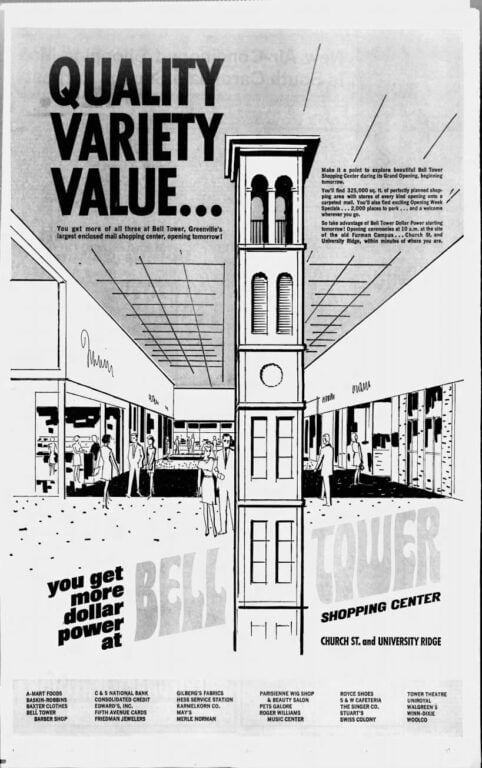
When Bell Tower Mall finally opened in 1970, a decade after all students had vacated, it hosted a WoolCo (Woolworth’s discount chain, comparable to a Walmart) and an Edwards store—a South Carolina Jewish-owned five and ten cent store chain. The Bell Tower had burnt down in a 1963 fire, given the general lack of maintenance at the old campus.
Residents speculate that a homeless man was staying in the Main Building and had lit a fire inside because it was an intensely cold winter night. The developers built a small 18-foot indoor replica instead of the proposed “tourist attraction” foretold by the Hammer Report. The mall would go out of business a little over a decade later and the County government would buy the space in 1984 for government offices to attempt to save the area next to Main Street from further decline.

___
This essay is a community submission in response to the Placing Furman project.
We have reserved space for your words on the Placing Furman site to feature short responses (up to 750 words). You may send them directly to [email protected] and/or you may contact us to explore themes or specific topics you would like to address.
In the spirit of thoughtful dialogue, we promise to review and reply to each submission you send us.
We reserve the right to publish the most productive and thoughtful essays. In cases where we are not sure we can publish your ideas, we may ask for revisions or clarification
We don’t seek to censor; we invite disagreement. But we are an educational institution, so we intend to publish pieces that are meant to provoke reflection, not anger.
Our goal is to foster a constructive conversation. Please, tell us, what does our project,
Placing Furman, mean to you?