
By Brandon Inabinet, Professor in Communication Studies
As Claire Whitlinger and Jillian Hall found in their piece on campus memorialization, voices were not unified on the original need for a move. A local real estate consultant offered a 1947 report on the potential of expansion: “A hasty study of your present campus plan seems to indicate the following new buildings as listed by you, could be located on this enlarged campus (after all temporary structures and negro houses were removed) without in any way crowding existing buildings.” Buying low-price African American housing parcels around the men’s campus would allow plenty of space for four hundred women to enroll on the combined campus, and a large auditorium and significant library; but future expansion would be more difficult, explained the agent. With–or despite–this information, Plyler did not act on purchasing land or rebuilding on the existing campus.
Such findings beg the question of who proceeded to purchase the new campus lands in 1949 and 1950, and to what purpose?
This was a burning question I had kept since researching for Seeking Abraham, the 2017-2018 report on Furman University’s antebellum history. Why would leaders try to leave the beautiful riverside campus in the heart of downtown, with a tree-covered campus with generous room for near-term building (including multi-floor construction like any other downtown university)?
Summer researcher Kathleen “Katy” Watkins (Communication Studies, ’26) found our answer.
John Plyler’s management of the campus not to build or expand was coupled with Alester Furman, Jr.’s excitement for move and expansion, as a real estate developer. As Chairman of the Board of Trustees for the University, Alester Furman, Jr, speculated about the necessity of a move to the SC Baptist Convention of 1949. At the spring meeting of the Trustees, John Plyler reflected this message of constraints on nearby housing for faculty and students, and the difficulty of merger of the men’s and women’s colleges at the present site. The introduction of the first parking permit sales to students bringing cars to campus rather than arriving by train coincided with these initial concerns—part of the answer to why Furman moved is traditional white flight that came alongside widespread automobile ownership and highway construction to create suburban America. Policies that incentivized growth outward for those with the means to do so.
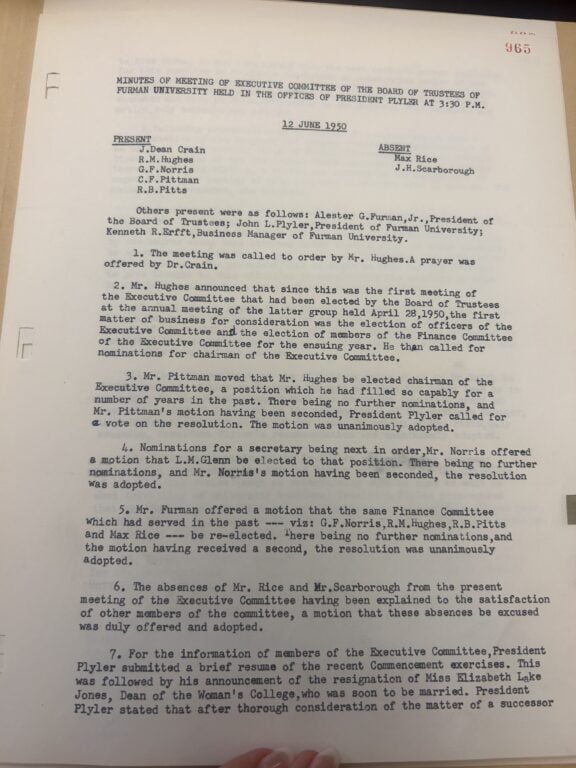
More specific to Furman, though, the same year as the land purchases by Alester Furman and the Furman Company, Plyler directed the executive committee of the Board of the Trustees to the question of “admission of negro students.” The question had been raised by several cases.
First in a series of high-profile cases in higher education (the Sweatt and McLaurin decisions), the Supreme Court had determined that prestige and reputation could create unequal circumstances in education.
Second, on May 16, 1950, plaintiffs filed Briggs v Elliot, the South Carolina case that would serve as the lethal blow to legal segregation (remembered as Brown v Board, four years later). Plyler explained to trustees that state universities would be legally compelled to take “Negro” students, but as a private religious institution, Furman would not be.
Therefore, trustees imagined the campus size necessary to take not only the post-war influx of white males and white women from the merged GWC, but now also white students of both genders fleeing desegregated public institutions. The decision to purchase rural land and build over the next decade looked better considering this imagined growth in white student population as a reaction to public desegregation and the potential need of a white Christian enclave fleeing “mixed” public educational facilities.
Throughout most of the 1950s, the leadership did not signal that the downtown campuses would close, and left open the idea that the old campuses would continue to function as part of a “greater Furman.” Thus, old buildings would need to be maintained, even while construction energy on the new campus would create some deferred maintenance downtown. The administration reiterated the need to keep up buildings on both campuses, men’s and women’s, in 1954, only a year before the first men would move into the new campus.
If the 1950 outlook on race and admissions had held, both downtown and new campus would have been necessary.

___
This essay is a community submission in response to the Placing Furman project.
We have reserved space for your words on the Placing Furman site to feature short responses (up to 750 words). You may send them directly to [email protected] and/or you may contact us to explore themes or specific topics you would like to address.
In the spirit of thoughtful dialogue, we promise to review and reply to each submission you send us.
We reserve the right to publish the most productive and thoughtful essays. In cases where we are not sure we can publish your ideas, we may ask for revisions or clarification
We don’t seek to censor; we invite disagreement. But we are an educational institution, so we intend to publish pieces that are meant to provoke reflection, not anger.
Our goal is to foster a constructive conversation. Please, tell us, what does our project,
Placing Furman, mean to you?